49 works in this view — arrow keys or swipe to move between them.
Dance in Art
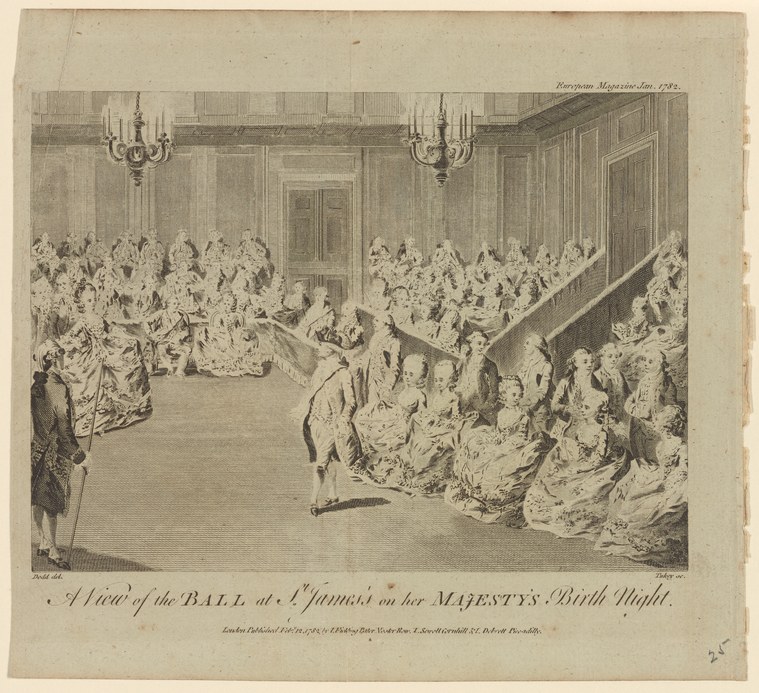
A view of the ball at St. James's on her Majesty's birth night
Unknown artist
- Collection:
- Prints depicting dance
- Source:
- New York Public Library
- Rights:
- Public domain — free to use, share and adapt.
- Recorded as:
- Public Domain
This is a rare period document of actual court ball practice rather than a dance manual or allegorical representation. It shows the physical reality of 18th-century ballroom culture—the crowding, the mixture of activity, the prominence of women's costume—and thus corrects many idealisations in dance historical accounts. The image is also a crucial record of a specific royal celebration, tying dance practice to documented historical events and patrons.
What you are looking at
A formal ballroom scene during a royal celebration, likely a masquerade or costume ball. The composition is crowded and energetic, with dozens of figures in elaborate dress filling a grand interior with panelled walls, tall candlelit wall sconces, and a coffered ceiling. The dancers wear full-skirted gowns with pattern and ornament typical of 18th-century court dress; the men wear formal coats and breeches. The space is densely packed with bodies in various states of movement and interaction—some couples appear to be dancing in the centre, while others cluster in conversation or transition around the margins. The architectural setting suggests St James's Palace or a similar royal venue. The overall impression is one of aristocratic leisure and display, with the formal ballroom functioning as theatre for social performance.
The dancing
Couples are distributed throughout the space in various formations. Some pairs stand in apparent conversational proximity; others appear to be engaged in forward motion that suggests dancing. The women's skirts are voluminous and occupy considerable space, creating visual rhythm across the composition. Most figures are upright with arms at various angles—some paired, some resting at sides. The footwork is not legible at this scale and medium, but the overall body carriage is formal and restrained, consistent with court etiquette. Weight appears to be held through the torso rather than expressed through the legs.
The dance depicted
This depicts a court ball of the mid-18th century, most likely a Quadrille, Cotillion, or general ballroom occasion rather than any single named dance. The title specifies it was held 'on her Majesty's birth night,' indicating a royal celebration. The formation—couples distributed across a large floor space, moving within formal spatial boundaries—is consistent with the structured country dances and cotillions that dominated European court ballrooms from the 1730s through the 1780s. The density and informality of the groupings, however, suggests this may document the social and flirtatious reality of ballroom attendance rather than a specific choreographic moment, capturing the space as a whole rather than focusing on technique.
How it was made
This is a printed engraving, executed in fine lines typical of 18th-century reproductive printmaking. The technique allows for broad distribution of the image and suggests this was a commercial publication—likely a news print or souvenir of the royal event. The engraver has used parallel hatching and cross-hatching to suggest volume, fabric drape, and spatial depth; the human figures are rendered in relatively fine detail despite the crowded composition. The medium's requirement for legibility at modest scale has caused the artist to simplify footwork and focus on silhouette and overall composition rather than anatomical precision.
About this work
This engraving documents a royal ball at St James's Palace, celebrating the monarch's birthday. It is a record of court dance as social ritual and public spectacle—a space where aristocratic bodies performed rank, taste, and allegiance through formal dress and movement. The image captures not a moment of technical virtuosity but the ballroom as institution: a feminised, hierarchical, architecturally framed space where dancing was inseparable from conversation, display, and the assertion of social position. For historians of dance, it offers evidence of how ballroom dancing functioned in elite circles—not as performed art but as embedded social practice, where the dance and the occasion were one.
How to look at it
Attend first to the architecture and the way bodies relate to the space—how the palace interior frames and contains the dancing bodies. Then look at the distribution: no single focus, no moment of climax, but rather a sustained condition of activity. Notice the proportion of women's dress to visible bodies; the skirts dominate the composition visually and physically. Finally, look at the mix of stances: some figures are clearly moving, others are static, and many are ambiguous—capturing the reality that a ball was never a moment of pure dancing but a mixture of movement, standing, conversation, and observation.
The artist
The artist is not recorded. The engraving was published by 'Bowles' (a London print house active in the 18th century), and bears the imprint of other London printmakers typical of the period. Such prints were commercial products—news and entertainment for literate buyers—rather than the work of individually celebrated artists.
The period
The mid-18th century saw the rise of the Cotillion and Quadrille as dominant court dances, displacing earlier Baroque forms. These were structured group dances that combined elements of choreography with improvisation and social interaction. Ballroom dancing was central to aristocratic social life and was ritualised through occasion—royal birthdays, court celebrations, and seasonal events. The ballroom itself became an icon of civilisation and taste in European culture. Simultaneously, printed images of court life and royal occasions proliferated as a form of news and entertainment for the propertied classes.
Where it lives
This engraving is held in the Prints collection at the New York Public Library. It is a commercial print from the 18th century, likely published within weeks or months of the event it documents, and would have been affordable to middle and upper-middle-class buyers.
Dance in this work
Questions about this work
Can you identify which of the King's or Queen's birthdays this depicts?
The catalogue record does not specify the year or the monarch, so it cannot be precisely dated. The style of dress and printmaking suggests the mid-18th century. The title 'her Majesty's birth night' could refer to any queen regnant or consort of that period. Further research in royal archives or print publications of specific dates may narrow this.
What dance was actually being danced?
The image does not show a single dance but rather the general activity of a ball. Couples may have been dancing Quadrilles, Cotillions, or various country dances in sequence throughout the evening. The engraver has chosen to depict the ballroom as a whole rather than focus on a specific choreography.
Why do the women's skirts dominate the image?
Court dress of the period featured extremely full skirts supported by panniers (side hoops). These were both expensive and fashionable and signalled rank and taste. The engraver emphasised them because they were visually distinctive and socially significant—a woman's skirt was as much a statement of status as her dancing ability.
Is this the same as a Romantic ballet scene?
No. This is a document of social dancing in a real ballroom, not a theatrical performance. There is no stage, no orchestra visible, no artificial lighting, and no framing that suggests performance for an audience. The ballroom was the venue; the dancing was the occasion, not the spectacle.
More dance artwork





