49 works in this view — arrow keys or swipe to move between them.
Dance in Art
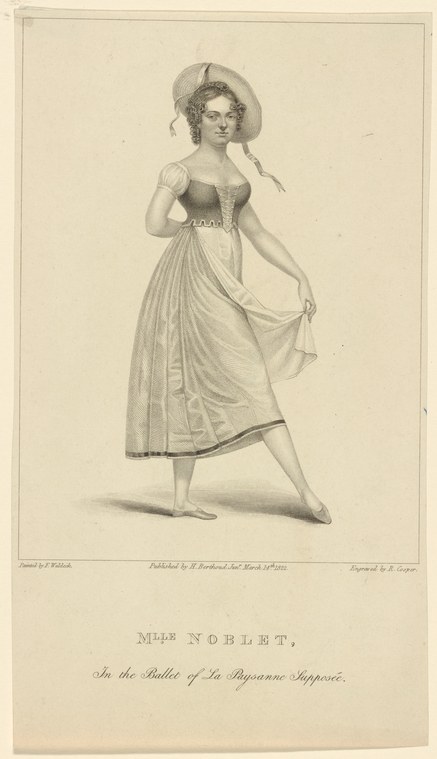
Mlle. Noblet, in the ballet of La paysanne supposée
Unknown artist
- Collection:
- Prints depicting dance
- Source:
- New York Public Library
- Rights:
- Public domain — free to use, share and adapt.
- Recorded as:
- Public Domain
Theatrical prints like this one are often the only visual record of early 19th-century ballet performers and the roles they created. They show us how Romantic ballet presented itself to its audience and reveal that dancers like Mlle. Noblet, now largely unknown, were professional attractions whose images were commodified and collected. The work also documents the era's fascination with peasant and rustic roles, a key thematic strand of Romantic ballet.
What you are looking at
A young woman stands in a three-quarter pose against a plain background, her body angled to the left while her gaze follows over her right shoulder. She wears the costume of early 19th-century Romantic ballet: a fitted dark bodice with short puffed sleeves, a pale skirt of considerable length falling to mid-calf, and a large bonnet or headdress tied beneath her chin. Her right arm is raised and bent, the left hangs at her side. Her weight appears settled on her left leg, the right leg extended slightly forward. The engraving renders her figure with fine line work, using hatching to suggest form and volume. The composition is frontal and portrait-like, isolating the dancer against white space, which was standard for theatrical prints of this period used to publicize performers and roles.
The dancing
A single standing figure, female, in a pose that is neither fully arrived nor in motion—a transitional moment between positions. The body carries the weight unevenly, suggesting a brief suspension between steps. The raised right arm is moderately lifted, bent at the elbow, while the left remains loose. The posture and arm carriage are consistent with the contained, upright frame of early Romantic ballet, where legs were expected to turn outward and the upper body to maintain formal alignment. There is no visible evidence of the extreme elevation or extended leg positions that would dominate later ballet technique.
The dance depicted
This is a theatrical portrait of a dancer in a principal role from *La paysanne supposée* (*The Supposed Peasant Girl*), a ballet produced in early 19th-century Europe. The costume—particularly the bonnet, the short puffed sleeves, and the long pale skirt—is consistent with the rustic or village maiden roles common to Romantic ballet, where shepherdesses and peasant girls appeared as protagonists or in divertissements. The print documents not the dance itself but the performer and her costume in the role, a standard function of theatre publicity. Nothing in the pose or costume indicates which specific step or phrase was intended; the figure is posed for recognition and for the sale of the print to theatre-goers and collectors.
How it was made
This is an engraving, likely a copper-plate engraving given the fine parallel line work (hatching) used to model the figure and the crisp black-and-white contrast. The verso carries printed text identifying the dancer, the role, and the publisher. Engravings were the primary medium for circulating images of theatre performers in the early 19th century; they were relatively economical to produce in quantity, affordable to audiences, and portable. The technique required skilled labour at the plate and allowed for wide distribution through booksellers and print sellers. This format places the work squarely within the commercial dance and theatre world, reaching literate audiences in major cities.
About this work
This is a theatrical portrait engraving of a dancer (Mlle. Noblet) in the title role of *La paysanne supposée*, a ballet now difficult to locate in performance history but documented here through costume and publicity materials. It is one of thousands of similar prints produced across Europe in the 1820s–1840s to publicize stage performers. The image preserves not a choreographic idea but a costume, a role, and the identity of a dancer whose name survives largely through such ephemera. It belongs in a dance archive because it is evidence of how dance careers were marketed and how Romantic ballet's aesthetics—the pale tutu, the upright posture, the rural or pastoral costuming—were sold to the public.
How to look at it
Look first at the costume: the short sleeves, long pale skirt, and bonnet are the period markers of a Romantic ballet heroine, and particularly of rustic roles. Then observe the pose itself—it is static and symmetrical, designed for recognition and for the viewer to take in the whole figure at once. The slight turn of the head and the modest raise of the arm are conventional gestures of the period, indicating grace and a certain dignified simplicity. Notice how the figure is isolated against empty space; this was standard for theatrical portraits and served a commercial purpose—the dancer and her role were the sole focus, with no distraction or narrative context.
The artist
The artist is unrecorded on this impression. The publication line (visible on the verso) credits a London or European publisher, and the print shows professional engraving technique. Such portraits were produced by workshops and anonymous artisans who specialized in theatrical publicity; the choreography of the pose and the costume accuracy were often checked against live performance or a dancer's own input, but the engraver's name rarely appeared or survived.
The period
This print dates to the 1820s–1830s, the early Romantic era in European ballet. The aesthetic of the Romantic tutu—shorter, pale, and gathered—was crystallizing in Paris and London. Ballets with rustic or folk themes were extremely popular, drawing on a Romantic interest in the peasant as a noble or virtuous figure. Theatre culture of this period generated enormous quantities of printed publicity: playbills, engravings, lithographs, and character studies sold at the theatre, in shops, and through subscription. Mlle. Noblet was a working professional dancer in this system; her survival in print indicates she was known enough to merit the cost of an engraving.
Where it lives
The print is held in the New York Public Library's collection of prints depicting dance. It is a published theatrical souvenir, one of countless similar prints produced in major European cities and sold to theatre audiences in the 1820s–1830s.
Dance in this work
Questions about this work
Who was Mlle. Noblet?
A professional ballet dancer active in the early 19th century, documented here in a leading role. Beyond this print and scattered playbills, little is known of her life and career. She represents the hundreds of working dancers who were celebrated in their own time through prints like this but whose names and achievements were not preserved in dance history.
What is 'La paysanne supposée'?
A now-obscure ballet, likely a French or Parisian work, whose plot—a girl falsely believed to be a peasant—was typical of early Romantic ballet. The title suggests a comedy of mistaken identity, popular in the era. Copies of the libretto (if one exists) and choreography are not easily located today.
Why are there so many engravings of ballet dancers from this era?
Theatre was a major form of entertainment and a highly commercialized industry in the 1820s–1830s. Dancers were celebrities, and their images sold well to middle-class collectors and enthusiasts. Engravings were inexpensive, portable, and collectible—a precursor to the modern photograph and the star system.
What does this print tell us about ballet technique at the time?
The upright posture, the turned-out legs, the contained arm position, and the overall formality suggest the technique was still transitional—not yet the extreme elongation and elevation of late 19th-century ballet. The pose is elegant but grounded, consistent with the early Romantic style.
More dance artwork





