49 works in this view — arrow keys or swipe to move between them.
Dance in Art · 2019
Dance cartoons
Unknown artist
- Medium:
- Source:
- New York Public Library
- Rights:
- Public domain — free to use, share and adapt.
- Recorded as:
- public_domain
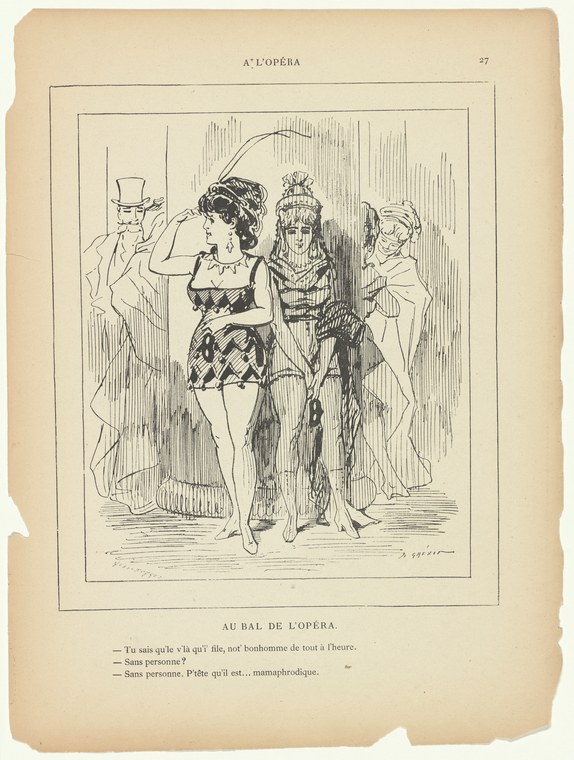
This work shows how dance historians can read satire as social document. The exaggerated poses and theatrical mixing tell us what seemed absurd or worthy of mockery about the opera ball to a contemporary observer—the artificiality, the costume changes, the social climbing, the confusion of real and performed identity. This is how non-dancers thought about the ball, and that perception shaped how the dance was understood and consumed.
What you are looking at
This is a satirical sketch of a ball at the opera, rendered in pen and ink with hatching for shadow and volume. Five figures occupy a shallow interior space marked by vertical striations suggesting a columned hall or backstage area. At center, a woman in an elaborate diamond-patterned skirt and low-cut bodice poses with one hand on her hip, her hair crowned with what appears to be an ornate headdress. To her left stands a dandy in top hat and formal dress, hand raised to his hat in exaggerated greeting. To her right, a second woman in draped classical costume with a Greco-Roman headdress—possibly costumed for a role—leans toward the central figure. On the far left, a rotund man in evening dress adjusts his hat. On the far right, a young man in formal attire gestures toward the group. The composition is crowded and awkward; the figures overlap and jostle rather than moving in concert. The line work is fluid and confident, with caricatural emphasis on facial features and poses. This is clearly theatrical satire about social performance and costume rather than depiction of actual dance movement.
The dancing
No dancers are in closed hold or any recognizable dance frame. The figures strike individual attitudes—the central woman postures with a jutting hip, the man on the left performs an exaggerated hat-tip, the classical figure leans in conspiratorially. There is no synchronized movement, no hold, no footwork visible. The bodies are arranged for visual comedy rather than kinetic cooperation. The woman's stance suggests vanity and display; the men's gestures suggest fawning attention or social awkwardness. This is pantomime and social satire, not ballroom technique.
The dance depicted
This is not a depiction of an actual dance but rather a satirical commentary on opera-ball theater and the social theater of courtship and costume. The image mocks the performative nature of the opera ball—the absurd costumes, the affected poses, the collision of real people (dandy, ingénue, attendants) and theatrical pretense (the woman in classical dress). While set at a ball, no dancing occurs. The work targets the pretension and artificiality of the setting rather than documenting a dance form.
How it was made
This is a pen-and-ink engraving or etching, likely from a satirical periodical or collection of dance and theater cartoons. The technique is linear and economical—the artist creates volume and shadow through hatching rather than tonal wash, which allows for crisp reproduction in print. The fluent line work suggests a practiced hand in commercial illustration. This medium implies wide circulation through periodicals or bound collections aimed at an educated urban readership familiar with opera, theater, and ballroom society.
About this work
This is a satirical engraving from a French series titled 'Au Bal de l'Opéra' (At the Opera Ball), mocking the social performance and theatrical costume at one of Paris's most famous public balls. The work belongs to a nineteenth-century tradition of dance and theater satire in which artists used exaggeration and visual wit to critique the manners and pretensions of urban leisure. Rather than documenting actual dance technique, it documents the social comedy of the ball itself—the collision between real bodies and theatrical fantasy, between courtship ritual and costume spectacle. The caption—'You say you saw my daughter, but not a soul at the hour?'—anchors the scene in a specific comedy of social anxiety and surveillance. The work is valuable not as evidence of how a particular dance was performed, but as evidence of how the opera ball was perceived and satirized by artists and audiences of the period.
How to look at it
Look first at what the bodies are not doing—they are not in hold, they are not moving in synchrony, they are not executing steps. Instead, attend to the attitudes and gestures: the exaggerated postures, the theatrical overlapping, the focus on faces and costume rather than on footwork or frame. The artist has frozen the moment not of a dance step but of social theater—the moment of display and flirtation. Note how the classical costume (the woman on the right) sits uneasily among the real evening dress, a visual joke about the collision of theatrical fantasy and actual social space.
The artist
The work is not attributed in the catalogue. The signature on the print is not legible in reproduction. The style is consistent with French mid-to-late nineteenth-century satirical illustration, likely from a periodical like *Charivari* or a collection of opera and theater sketches. The fluid draftsmanship and confident caricature suggest a trained illustrator working in the commercial press.
The period
The opera ball (Bal de l'Opéra) became a major public spectacle in Paris in the nineteenth century, particularly after the opening of the Palais Garnier in 1875. These masked balls combined elements of carnival, theater, and social display, attracting a mixed crowd—from legitimate society to demi-mondaines and adventurers. They were celebrated in literature and visual art as emblems of modernity, bohemia, and the collision of classes. Satirical artists seized on the opera ball as a subject for mocking the performativity of modern urban life and the instability of social identity under costume and mask. The ball was danced (quadrilles, waltzes, polkas), but the satire focuses on theater, display, and flirtation rather than on the mechanics of any particular dance form.
Where it lives
The work is held by the New York Public Library and comes from their collection of prints. It is identified as a print from a series or publication titled 'À l'Opéra' (At the Opera). The specific periodical, date, and publisher are not recorded in the catalogue provided.
Questions about this work
Is this showing an actual dance?
No. The figures are not in any recognizable dance hold or frame, and they are not moving in synchrony. This is a satirical sketch of the social theater and costume at an opera ball, not a documentation of a dance step or form. The artist is mocking the artificiality and social pretension of the event, not instructing in how the dances at the ball were performed.
What is the opera ball and why was it satirized?
The Bal de l'Opéra was a famous public masked ball held at the Paris Opera, particularly celebrated in the nineteenth century as a site of social mixing, costume play, and theatrical display. Satirists mocked it because it embodied modern anxieties about identity, class, and the performativity of urban social life. The collision of real people with theatrical costume and the instability of identity under the mask made it irresistible to satirical artists.
What does the caption say and why does it matter?
The French caption reads roughly: 'You say you saw my daughter, but not a soul at the hour? / Without anyone? / Without anyone. Perhaps it is… a mannequin.' This is a joke about surveillance, social anxiety, and the possibility that the woman in costume is not a real person—or at least, not identifiable as the same person. It reinforces the satire's theme of masked identity and the blurring of real and performed self.
More dance artwork