49 works in this view — arrow keys or swipe to move between them.
Dance in Art
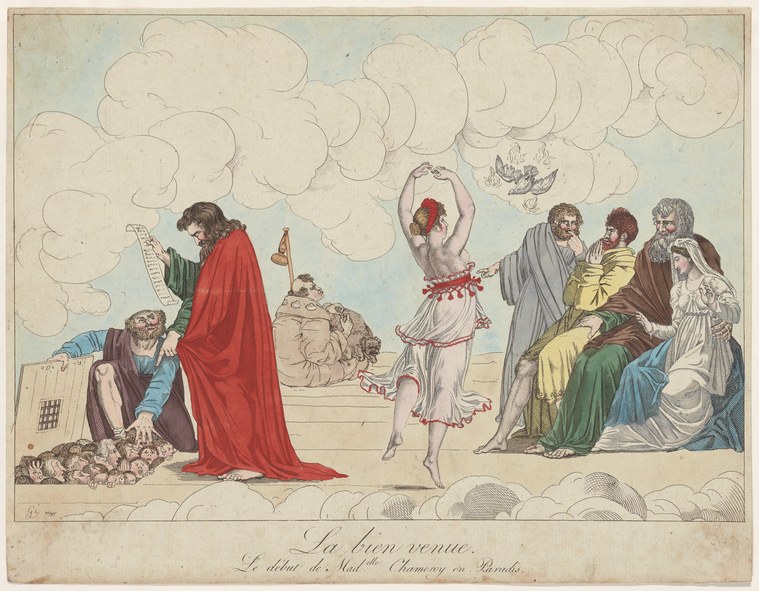
La bien venue; le début de Mad'elle Chameroy en Paradis
Unknown artist
- Collection:
- Prints depicting dance
- Source:
- New York Public Library
- Rights:
- Public domain — free to use, share and adapt.
- Recorded as:
- Public Domain
This print is a rare document of how Romantic ballet was understood and marketed to the public—not as entertainment alone, but as a species of transcendence. It shows the dancer's body at the moment it was being theorized as capable of defying gravity and mortality, a central preoccupation of 19th-century ballet aesthetics and a visual claim that may have influenced the development of pointe work and other techniques designed to suggest weightlessness.
What you are looking at
A heavenly reception scene unfolds across a cloud-filled sky. On the left, a figure in a red cloak stands before a seated elder surrounded by putti and treasure, gesturing toward the center. There, a young woman in diaphanous white drapery and red flowers performs an elevated leap or jump, her body arched and weightless mid-air, arms raised in an ecstatic pose. On the right, a group of onlookers in classical dress—some seated, some standing—watches the spectacle with rapt attention. The composition is divided into registers of clouds that float against a pale blue ground, creating the illusion of a supernatural space. The scene is inscribed as "La bien venue. Le début de Mad.elle Chameroy en Paradis" (The welcome. Mademoiselle Chameroy's debut in Paradise), identifying this as a theatrical or allegorical moment of ascension and triumph.
The dancing
The central dancer executes what appears to be a grand, sustained jump or leap with the body in a fully extended arch, the head thrown back and both arms raised in exultation. Her pose is weightless and balletic, suggesting trained technique rather than folk or social movement. The surrounding figures are static—witnesses rather than participants—arranged in classical contrapposto poses or seated in attitudes of contemplation. The dancer's isolation at the apex of the composition and the vertical lift of her body mark her as the sole performer and object of veneration.
The dance depicted
This image most likely depicts an early Romantic theatrical ballet or an allegorical ballet scene, possibly associated with the Paris Opéra of the 1840s–1850s. The identification of Mademoiselle Chameroy as the performer and the theme of her "debut in Paradise" suggests this is a commemorative or promotional print celebrating a specific dancer's triumph, perhaps after her first major role. The dancer's sustained elevation, arched back, and raised arms are consistent with the emerging technique of the Romantic period, in which the illusion of weightlessness and transcendence became central to the aesthetic. The heavenly setting transforms dance into an apotheosis—the dancer's body made divine through movement.
How it was made
This is a hand-colored etching or engraving, characteristic of early-to-mid 19th-century theatrical publicity. The technique allows for fine linear detail in the architecture of the cloud formations and the rendering of drapery folds, while the delicate hand coloring in red, blue, yellow, and green distinguishes the main figures. The print's small scale and the care taken with figure drawing suggest it was created for circulation among the literate public—likely as a souvenir or advertisement of a celebrated performance. This medium was the primary means of disseminating images of celebrated performers before photography.
About this work
This is a hand-colored print commemorating a dancer's theatrical debut, rendered as an allegorical ascension. The work sits at the intersection of dance history, theatrical publicity, and Romantic aesthetics—a moment when the dancer's body could be elevated to the status of the miraculous through the combination of technique, costume, and setting. The scene conflates theatrical achievement with spiritual transcendence, a characteristic conceit of Romantic ballet.
The image documents a specific historical moment in the development of professional ballet: the emergence of the celebrated ballerina as a public figure worthy of commemoration through such elaborate and fanciful prints. Mademoiselle Chameroy's leap into Paradise is not merely an acrobatic feat but a claim that the female dancer had achieved a new kind of social and artistic status.
How to look at it
Note the precise moment chosen: the dancer is captured not in contact with the ground but in the apex of her flight, the body suspended and weightless. The artist has rendered her in a pose that would be physically impossible to sustain—an artistic device that transforms motion into stasis and implies that her leap transcends ordinary dance. The static figures around her, their attention fixed upward, confirm that we are witnessing not a regular performance but a supernatural or allegorical event. The hand coloring and the delicate etched line work create an ethereal quality that supports the illusion of the dancer as spirit rather than body.
The period
This print dates to the Romantic era of ballet, likely the 1840s or 1850s, when the Paris Opéra was the center of European dance and Marie Taglioni, Carlotta Grisi, and other celebrated ballerinas had achieved celebrity status. The allegorical framework—a debut as a cosmic or spiritual event—reflects the Romantic period's investment in transcendence, the supernatural, and the female body as the primary vehicle for expressing the ineffable. Such prints were part of a larger commercial apparatus that made the ballerina a public personality and icon, distinct from earlier periods when dancers were less visible in civic life.
Where it lives
This print is held by the New York Public Library's collection of prints depicting dance. It is a theatrical publicity or souvenir print, likely created and distributed in Paris or another European cultural center in the mid-19th century.
Dance in this work
Questions about this work
Who was Mademoiselle Chameroy?
The catalogue record does not identify her further. She was evidently a dancer who performed at a major theatrical venue, celebrated enough to warrant a commemorative print. The print itself is the primary historical record of her debut and fame; she may not be documented elsewhere in surviving archives.
Why is the dancer shown in heaven or paradise?
This is an allegorical conceit typical of Romantic-era theatrical prints. The ascension transforms the dancer's technical achievement into a spiritual or cosmic event, suggesting that her artistry and beauty transcend the merely physical. Such imagery was used to elevate the dancer's status and to market her performance as a rare and extraordinary experience.
Is this a real dance or a fantasy?
The pose and the setting are both fantastic—no dancer could sustain that arch and leap in literal paradise. However, the print documents a real dancer and a real performance. What the print captures is not the literal event but the Romantic imagination's vision of what the dancer's art should aspire to be: weightless, transcendent, and divine.
What technique would this dancer have used?
Given the date and the dancer's prominence, she likely trained in the Romantic ballet technique then being codified at the Paris Opéra—emphasizing verticality, turnout, and the illusion of effortlessness. The elevated position and the arched back are consistent with the emerging aesthetic of pointe work, though the exact technique is not evident from the print alone.
More dance artwork





