49 works in this view — arrow keys or swipe to move between them.
Dance in Art
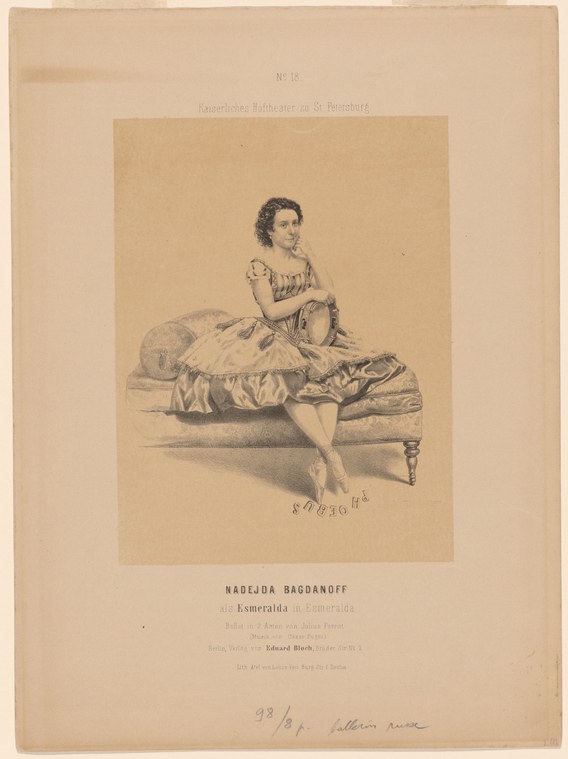
Nadejda Bagdanoff: als Esmeralda = in Esmeralda
Unknown artist
- Collection:
- Prints depicting dance
- Source:
- New York Public Library
- Rights:
- Public domain — free to use, share and adapt.
- Recorded as:
- Public Domain
The print documents the aesthetics and celebrity culture of Romantic ballet at its height, showing how the tulle skirt, the pale tones, and the downward-gazing introspection of the Romantic heroine were standardized and circulated as theatrical icons. For historians of dance, costume, and 19th-century visual culture, it reveals the relationship between stage performance, portraiture, and mass-market theatrical ephemera.
What you are looking at
A young woman in mid-19th-century theatrical dress sits on a cushioned bench or ottoman, posed in a moment of apparent repose or introspection. She wears a pale, voluminous skirt—characteristic of Romantic-era ballet costume—with puffed sleeves and what appears to be a fitted bodice. Her dark hair is styled close to her head in the fashion of the 1830s–1840s. The figure is rendered in fine stippled or dotted technique, creating soft modeling and shadow across the fabric. The composition is intimate and portrait-like, framing the dancer within a simple rectangular border. The background is plain and neutral, throwing all attention onto the figure and the exquisite rendering of the costume's texture and weight.
The dancing
The dancer's posture is contemplative rather than active: she sits with her legs extended, one foot visible beneath the skirt, her torso slightly turned, one arm resting loosely. Her gaze is downward and away. This is not a depiction of active dancing movement, but of stillness and an emotional or narrative moment—a costume study or a scene from a ballet's dramatic action rather than an action shot. The frame emphasizes the silhouette of the costume as much as the body within it.
The dance depicted
The title identifies the subject as Nadejda Bagdanoff in the role of Esmeralda—the heroine of the ballet *La Esmeralda* (choreography by Jules Perrot, 1844), which itself was derived from Victor Hugo's *Notre-Dame de Paris*. This role became a cornerstone of the Romantic ballet repertory and was danced by many prominent ballerinas of the mid-19th century. The costume—the pale tulle skirt and bodice—is consistent with the aesthetic conventions of Romantic-era ballet, and the figure appears to be captured in a dramatically charged but non-dancing moment from the narrative, perhaps a moment of vulnerability or pathos that was central to the emotional arc of the role.
How it was made
This is a fine engraving or steel engraving, identifiable by the precise linear hatching, dotted modeling, and the controlled tonal gradations characteristic of this medium. The print is hand-colored or tinted with a subtle wash, most visible in the pale yellow-brown of the costume and background. The technique allowed for wide circulation as a theatrical souvenir—these prints were mass-produced and sold to audiences as keepsakes of celebrated performances and performers. The inscription at the bottom indicates this was a published print, likely from a theatrical print series.
About this work
This is a mid-19th-century engraved portrait of a celebrated stage dancer in costume, documenting both the performer Nadejda Bagdanoff and the visual convention of Romantic ballet spectacle. The work sits at the intersection of theatrical portraiture, costume documentation, and popular entertainment—part of a flourishing genre of dancer prints that allowed audiences to take home images of stars and roles. It preserves the silhouette and aesthetic ideology of the Romantic ballet, in which the ethereal, veiled, and emotionally fragile heroine was the dominant female type. The image is valuable not as a record of choreography or movement, but as evidence of how the Romantic ballet was packaged, marketed, and consumed as visual spectacle.
How to look at it
Notice the extreme attention to the texture and fall of the skirt—the way it pools and wraps around the figure, suggesting weight and dimensionality despite being rendered in line. The artist has chosen a moment of stillness and inward emotion rather than active dancing, which was typical for portraits of celebrated roles; the drama lies in the costume and the suggested narrative, not the body's action. The engraving technique, with its fine hatching and tonal control, was ideal for rendering fabric and conveying the luxury and craftsmanship of theatrical costume to an audience that would never see the stage itself.
The artist
The artist is not recorded in the catalogue. The engraving style and the subject matter suggest a professional theatrical print publisher, likely French or active in Paris, where *La Esmeralda* premiered and where such prints were produced for widespread circulation. The inscription at the base indicates a publisher credit, though the text is not fully legible in reproduction.
The period
This print dates to the heyday of Romantic ballet (roughly 1830–1860), when ballerinas like Marie Taglioni, Fanny Essler, and others became international celebrities and their images saturated popular culture. The ballet *La Esmeralda*, first performed at the Paris Opéra in 1844, was a major vehicle for dramatic and emotional performance within the ballet tradition. In this same period, theatrical printing and portraiture were flourishing industries; colored engravings of celebrated performers were among the most sought-after popular prints, functioning much as photograph postcards would later. The image documents the peak of the tulle skirt as the defining costume element of Romantic ballet and the femininity it embodied.
Where it lives
This print is housed in the New York Public Library's collection of prints depicting dance (catalog number 18). It is part of a substantial holdings of 19th-century theatrical prints, most of which document ballet and theatrical spectacle of the Romantic era. Such prints were commercial products, sold to theatre-goers and collectors as souvenirs and collectibles.
Dance in this work
Questions about this work
Who was Nadejda Bagdanoff?
Bagdanoff was a professional ballerina active in the mid-19th century, known enough to have theatrical prints published in her likeness. While detailed biographical records are limited, she performed in the major European repertory of the period, including the popular *La Esmeralda*. She exemplifies the professional female dancer of the Romantic era—celebrated on stage and marketed through portraiture and print.
What is Esmeralda and why is this role important?
*La Esmeralda* (1844) was choreographed by Jules Perrot to a libretto based on Victor Hugo's novel *Notre-Dame de Paris*. The title role—a young Romani woman—was central to the Romantic ballet tradition and offered ballerinas a chance to portray emotion, drama, and pathos rather than pure technical display. It remained a staple of the ballet repertory well into the 20th century.
Why is she sitting rather than dancing?
This print documents the costume and the role, not a specific movement or step. Artists depicting Romantic ballet often chose moments of stillness, vulnerability, or narrative significance rather than technical virtuosity. The seated pose emphasizes the costume itself as a spectacle and suggests the emotional or dramatic context of the role.
More dance artwork





