49 works in this view — arrow keys or swipe to move between them.
Dance in Art
Theatrical portraits
Unknown artist
- Collection:
- Prints depicting dance
- Source:
- New York Public Library
- Rights:
- Public domain — free to use, share and adapt.
- Recorded as:
- Public Domain
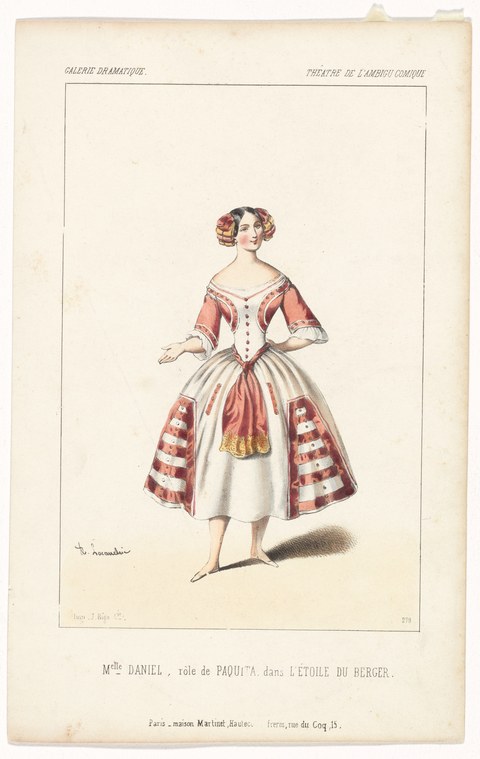
Costume portraits like this one are primary visual evidence of how dancers dressed and how they were understood to move and present themselves. For historians of Romantic ballet and theatre, such prints are among the only surviving records of how specific roles were realized in performance—the cut of the skirt, the placement of trim, the styling of hair, all elements of how a character was visually constructed on stage.
What you are looking at
A woman in mid-nineteenth-century theatrical dress stands in three-quarter view against a plain background, her pose suggesting a moment of performance or presentation. She wears a coral-pink silk bodice with white trim and long sleeves, paired with a full skirt of cream silk gathered at the waist. The skirt's lower half is striking: deep coral-pink panels alternate with cream, creating bold horizontal stripes that extend to the hem. A gold ribbon or trim runs along the skirt's inner hem. Her hair is styled in the period fashion, gathered at the back with coral-pink ribbons woven through. Her left arm gestures outward in an open, presenting position; her right hand rests near her waist. She stands in an easy contrapposto, her weight on one leg, creating a graceful diagonal line through her body. The plain background and the formal staging suggest this is a theatrical portrait—a record of a performer's costume and bearing rather than a narrative scene.
The dancing
The single figure demonstrates an open, composed posture typical of nineteenth-century stage presentation. Her arms are held at mid-height, neither rigidly extended nor resting at her sides, creating a balanced frame. Her weight appears settled on one leg, allowing the other to extend slightly forward, a stance that suggests both ease and readiness. The gesture conveys confidence and theatrical presence rather than active dance movement—this is how a performer would stand to be observed and admired by an audience.
The dance depicted
The image does not depict active dance movement. Instead, it records a costume and a performer's stage presence in what appears to be a theatrical or operatic role from the mid-nineteenth century. The inscription identifies the figure as Mlle. Daniel in the role of Paquita from *L'Étoile du Berger* (The Shepherd's Star). Paquita is a character from ballet, suggesting this may document a performer from the Romantic ballet era, though the image itself shows the dancer in presentation rather than in the midst of choreography.
How it was made
This is a hand-colored engraving or lithograph, evidently from a theatrical portrait series. The delicate line work and the precise registry of color suggest either aquatint engraving with hand coloring or color lithography. The inscription is printed. Such portraits were common in the nineteenth century, distributed as prints to fans and archives, making them instruments of star-making and role documentation. The technique allowed for wide circulation of images of celebrated performers and their most famous costumes.
About this work
This is a theatrical costume portrait of Mlle. Daniel as Paquita, likely from the mid-nineteenth century. The work documents both a celebrated performer and a specific theatrical role—part of the archive of Romantic-era dance and opera through which singers and dancers secured their fame and legacy. The image belongs in a gallery of dance art because it records the visual culture of performance, the costumes and presence through which dancers embodied character and commanded attention on stage.
How to look at it
Attend to the cut and construction of the costume: the way the skirt's stripes create vertical emphasis while the gathered waist emphasizes the dancer's silhouette. Notice how the pose is neither frozen mid-movement nor in a static, rigid stance—instead, it conveys an ideal of composed grace, a body ready to move. The pale silks and coral highlights reflect light, suggesting how the costume would catch stage lighting. This is not a moment from choreography but a formal presentation, the kind of image a celebrated dancer would give to admirers.
The artist
The signature on the print reads 'C. Naudet' (or similar). The print was published by Martinet Éditeur (Paris) in the style typical of mid-nineteenth-century French theatrical portraiture. Without additional documentation, attribution remains uncertain, but the work belongs to a well-established commercial practice of publishing hand-colored costume portraits to advertise performers and roles to the theatre-going public.
The period
This portrait dates to the era of Romantic ballet in the mid-nineteenth century, when full skirts, pale silks, and ethereal costuming became the visual language of the stage. The Romantic period prized lightness, grace, and an impression of effortlessness—qualities the portrait conveys through the loose sleeves, the flowing skirt, and the dancer's easy posture. At the same time, such prints were commercial products, sold to audiences as mementos and souvenirs, making them part of a culture in which dance and theatrical performance had become spectacles for a growing urban public.
Where it lives
This print is held in the New York Public Library's collection of prints depicting dance. It is part of a broader archive of hand-colored theatrical and operatic costume portraits from the nineteenth century, evidence of how the theatre industry documented and marketed its stars.
Dance in this work
Questions about this work
Who was Mlle. Daniel?
Without access to detailed theatrical records, little can be said with certainty. She was celebrated enough to be the subject of a published costume portrait, suggesting she was a notable performer of the mid-nineteenth century. The title *L'Étoile du Berger* suggests she performed in opera or ballet-pantomime, roles that blended dance with dramatic narrative.
What does the skirt tell us about how dance was performed?
The full, gathered skirt—gathered at the waist and allowed to fall in soft folds—was fundamental to Romantic ballet aesthetics. It allowed a performer to move with an impression of weightlessness and fluidity while also requiring specific movement qualities: lifts and ports de bras that could extend through the extended fabric, and a torso that carried itself with particular composure.
Why was this image made?
Theatrical costume portraits were commercial products sold to theatre-goers and collectors. They served as souvenirs, publicity, and a form of art appreciation in an era before photography became standard. They also functioned as a kind of visual repertory, documenting how famous roles were realized by celebrated performers.
More dance artwork





