49 works in this view — arrow keys or swipe to move between them.
Dance in Art
Theatrical portraits
Unknown artist
- Collection:
- Prints depicting dance
- Source:
- New York Public Library
- Rights:
- Public domain — free to use, share and adapt.
- Recorded as:
- Public Domain
Theatrical portrait prints like this one are among the few visual records we have of how Romantic-era dancers actually moved and dressed. They show the precise silhouette of the tutu, the carriage of the body, and the styling choices for specific roles—information that can otherwise only be inferred from choreographic texts, paintings of named stars, or later photographic evidence. For historians of Romantic ballet technique and costume, such prints are primary evidence.
What you are looking at
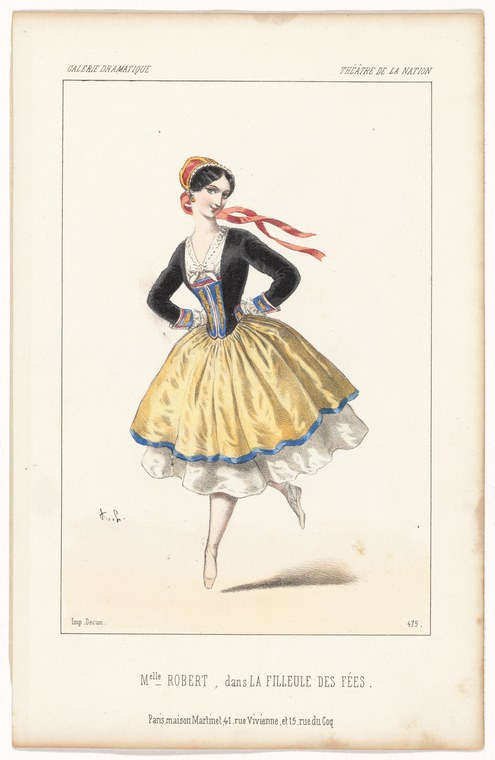
A young woman in theatrical dress stands in a posed, dynamic position against a plain background. She wears a black velvet bolero jacket with long sleeves over a corset-style bodice with blue ribbon detail, paired with a full skirt in pale golden yellow silk with a blue hem stripe and white underskirt that swings out from her legs. A red ribbon trails from her hair, which is styled up and back in the fashion of the 1830s–1840s. Her weight is shifted to one leg in a balletic stance; her body is animated and her gaze directed away. The figure is drawn with delicate hand-coloring over what appears to be a lithographic base, capturing the soft modeling of fabrics and the subtle play of light across the skirt. The composition is a three-quarter-length portrait, positioned frontally but with the body subtly twisted to suggest movement or a moment of dramatic pause.
The dancing
The dancer stands on a single supporting leg in a turned-out position suggesting classical training, with the free leg bent and partially obscured by the full skirt. Her upper body twists slightly, and her arms are held in a position consistent with Romantic-era ballet vocabulary—one arm extended or held at shoulder height in a soft frame. The posture and weight distribution suggest the lifted, ethereal carriage of early-19th-century theatrical dance. There is only one figure, isolated against the plain ground in the manner of a theatrical portrait print.
The dance depicted
This is a portrait of a theatrical dancer, most likely a ballet dancer of the Romantic period (1830s–1850s), identified in the inscription as Mlle. Robert in *La Fileuse des Fées* (The Spinner of Fairies). The costume—the full romantic tutu, the fitted jacket, the elevated carriage—and the balletic stance all confirm classical ballet training and technique. The golden skirt with blue trim and the dramatic red hair ribbon suggest a specific theatrical role, likely a supporting or character part rather than a sylph or prima ballerina, given the earthy color palette and practical styling. The pose captures the dancer between movements, in a moment of dramatic readiness.
How it was made
This is a hand-colored lithograph, a technique that allowed rapid production and wide circulation of theatrical portraits in the 1830s–1840s. The image shows the characteristic light key stone of lithography beneath applied watercolor or gouache in flesh tones, fabrics, and ribbon detail. The fine lines of the face and the delicate articulation of the legs suggest a skilled artist working from a live model or detailed study. Lithographic theatrical portraits were the primary means by which dancers' images reached audiences and were collected by patrons, making them central to 19th-century dance celebrity culture.
About this work
This is a hand-colored lithographic portrait of Mlle. Robert performing in a Romantic-era ballet, identified as *La Fileuse des Fées*. The work belongs to the tradition of theatrical portraiture that documented the dancers and performances of the 1830s–1840s, when ballet was one of the dominant forms of theatrical entertainment in Europe. The image is a valuable record of how a professional dancer of the period presented herself—the precise costume, the trained body, the carefully composed pose that conveyed both discipline and theatrical presence. Such prints circulated widely among theatergoers and collectors, functioning as both souvenirs and documentation of ephemeral performance.
How to look at it
Note the precise, trained posture and the turned-out stance—this is not an actress or a pantomime performer, but a ballet-trained dancer. Observe the silhouette of the skirt: the full, layered volume suggests the tulle construction and the silhouette favored in Romantic ballet, very different from earlier or later periods. Look at the moment the artist chose: the dancer is poised and composed, not mid-leap or mid-turn, but held in a position of readiness that conveys both the technical discipline of ballet and the theatrical presence expected of a performer of the era. The simplicity of the background and the formality of the pose are conventions of theatrical portraiture, designed to showcase the costume and the body without distraction.
The artist
The lithograph is inscribed with the printer's name (Imp. Becquet) and an address, but no artist's name appears on the print itself. It is part of a commercial series of theatrical portraits, likely published in Paris. The print was issued by the Maison Mathieu et Cie., rue Vivienne, Paris, suggesting a professional theatrical publishing house producing standardized portraits of performers. Without further documentation, the original artist—whether a theater artist, a commercial lithographer, or a traveling portraitist—cannot be identified.
The period
This print dates to the height of the Romantic ballet era in France, when dancers like Marie Taglioni, Fanny Elssler, and Carlotta Grisi commanded public fascination. Theatrical lithographs became the primary medium for circulating images of dancers to a wide audience; photography was not yet in common theatrical use. The inscription *La Fileuse des Fées* suggests a fairy-tale or fantastical narrative ballet, consistent with the themes that dominated European ballet in the 1830s–1840s. Such prints were sold at the theater box office, in print shops, and by subscription, making dancers' likenesses available to fans and collectors at an affordable price.
Where it lives
This hand-colored lithograph is held in the New York Public Library's Prints collection in the section depicting dance. It is one of a large number of Romantic-era French theatrical portraits in that collection, many of them issued by Parisian theatrical publishers and printers. Such prints were commercial objects, produced in editions and distributed through theatrical and retail channels.
Dance in this work
Questions about this work
Who was Mlle. Robert?
We do not know from this print alone. She was a professional dancer performing in Paris in the 1830s–1840s, and she danced in at least one piece titled *La Fileuse des Fées* (The Spinner of Fairies). Theatrical portraits of this era rarely record a performer's full name, biographical details, or career trajectory. Research in Parisian theater records, playbills, and dance historians' archives might identify her further.
What is *La Fileuse des Fées*?
The title translates as *The Spinner of the Fairies* or *The Fairy Spinner*. It appears to have been a ballet or theatrical work performed in Paris in the Romantic era. The golden costume and fairy-tale subject suggest a minor or character role in a fantastical narrative ballet, consistent with the themes popular in European ballet of the 1830s–1840s. No known detailed record of the work survives.
How can you tell this is Romantic-era ballet?
The full, layered tulle skirt, the soft slipper-like footwear, the fitted bodice, and the turned-out, lifted carriage of the body are all hallmarks of Romantic ballet technique and costume. The painting style, the hand-coloring technique, and the format of the theatrical portrait print are all consistent with 1830s–1840s French theatrical publishing. The inscription and printer's mark provide further confirmation of date and place.
Why are theatrical portraits important to dance history?
They are among the only visual documents of how dancers actually dressed, carried their bodies, and presented themselves on stage before photography became standard. They show us the silhouettes, materials, and styling of costumes; they preserve the names and roles of performers who might otherwise be forgotten; and they reveal how dancers were marketed to the public as celebrities and spectacles. For a period like the Romantic era, when ephemeral performance was the main art form, these prints are invaluable historical evidence.
More dance artwork





