49 works in this view — arrow keys or swipe to move between them.
Dance in Art
Theatrical portraits
Unknown artist
- Collection:
- Prints depicting dance
- Source:
- New York Public Library
- Rights:
- Public domain — free to use, share and adapt.
- Recorded as:
- Public Domain
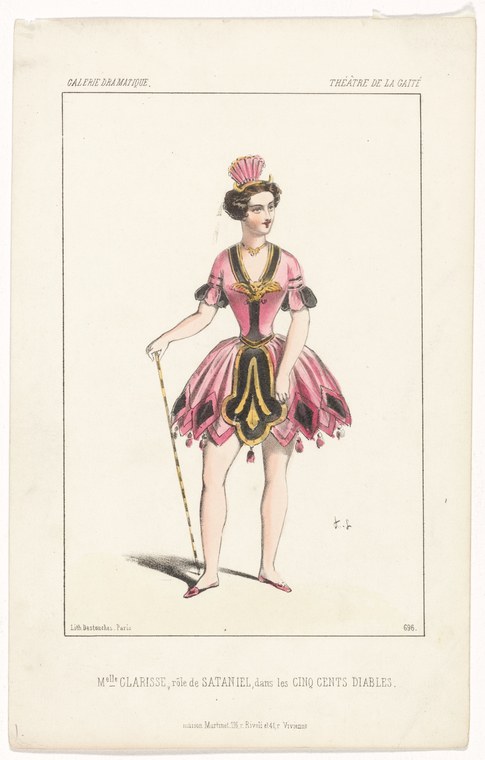
This image preserves the exact appearance of a Romantic ballet costume—fabric, fit, ornament, and silhouette—in a moment when such dances existed only in live performance. For dancers and choreographers studying the visual language of 19th-century ballet, it is a primary source of how bodies were dressed, framed, and presented to audiences.
What you are looking at
A single female dancer stands in a three-quarter pose against a plain background, wearing a pink tulle skirt with a distinctive scalloped hem in darker pink or red silk, and a coordinating pink bodice with short puffed sleeves. A decorative gold ornamental belt or sash cinches her waist. She wears a tall pink headdress or crown and holds a thin cane or stick in one hand. Her pose is upright and composed, with weight balanced on both legs; she gazes outward in profile. The figure is rendered in a hand-colored engraving or lithograph, with careful attention to the shading of the fabrics and the delicate rendering of her facial features. The pale background and restrained composition emphasize the elegance of the costume and the formality of the theatrical presentation.
The dancing
A single dancer, presumably female, stands at ease with weight distributed evenly and arms held gracefully. One arm extends naturally, holding a cane or wand; the other hangs at her side. Her stance is upright and dignified—balletic in its posture—with no suggestion of dramatic action or sharp movement. The body alignment suggests training in courtly or theatrical dance of the 19th century, though the gesture is restrained rather than dynamic.
The dance depicted
The costume and presentation identify this as a theatrical dance character, likely from a Romantic-era ballet or theatrical piece. The pink tulle skirt, gold ornamental belt, and headdress suggest a fairy or ethereal character typical of mid-19th century ballet. The cane or wand may indicate a supernatural or magical role. Without a title beyond 'Theatrical portraits,' the specific ballet is not identified here, though the style and costume are consistent with works from the 1840s–1860s era of Romantic ballet.
How it was made
This is a hand-colored engraving or lithograph, identifiable by the fine linear hatching visible in shadow areas and the characteristic precision of printmaking. The handcoloring—applied to the pink fabrics, gold details, and flesh tones—is even and deliberate, suggesting a professional hand. As a theatrical portrait, this work would have been produced for circulation among theatergoers, collectors of dance imagery, and opera-going audiences; it belongs to a widespread 19th-century practice of selling character portraits and costume studies to document celebrated performances and dancers.
About this work
This is a theatrical costume portrait in the tradition of 19th-century dance documentation, depicting a single dancer in character dress posed formally for the print market. The work captures the materials and silhouette of Romantic-era ballet fashion—the signature tulle skirts, bodice construction, and ornamental details that defined a pivotal moment in the history of ballet theater. Such prints served both as souvenirs of celebrated performances and as primary documents of how dancers appeared in roles that have since vanished from the stage, preserved now only in images like this one.
The image belongs to a vast archive of European theatrical portraiture that circulated widely in the 19th century, printed in Paris, London, and Berlin for theaters and the broader public. These prints are invaluable to dance historians as a visual record of costume, posture, and the aestheticization of the dancer's body during an era when photography was still in its infancy and live performance was ephemeral.
How to look at it
Notice the precision of the costume rendering: the weight and translucence of the tulle, the articulation of the puffed sleeve, the fine detailing of the ornamental belt. The cane or wand is a stage prop, likely indicating a magical or supernatural role. Observe the dancer's posture—trained, elongated, and formally composed—which suggests the balletic training essential to Romantic dance. The stillness of the pose is itself telling: unlike action images, this portrait captures the dancer as a static image for consumption, a moment of repose that emphasizes the costume and the body's alignment rather than movement.
The artist
The artist is not recorded. The print bears a publisher mark suggesting it was produced in Paris, likely by a commercial printmaking firm specializing in theatrical portraiture. Such prints were often unsigned or credited only to the publisher, making individual artists difficult to trace. The hand-coloring suggests production by a workshop with multiple colorists working from a common design.
The period
This print dates to the golden age of Romantic ballet in Europe (roughly 1830s–1860s), when dancers like Marie Taglioni, Fanny Elssler, and Carlotta Grisi revolutionized the art form by emphasizing ethereal, weightless movement and supernatural subjects. The tulle skirt, ankle-length and in pastel hues, became the uniform of the Romantic ballerina and represented a radical departure from the heavier silks and lower hemlines of earlier theatrical dance. Theatrical portraiture flourished in this period, fueled by the celebrity of individual dancers and the growth of a middle-class audience for opera and ballet. These prints were cheap, portable, and collectible—analogous to modern entertainment photography—and they played a crucial role in cementing the visual identity of Romantic ballet in the public imagination.
Where it lives
This work is held in the New York Public Library's collection of prints depicting dance. It is part of a much larger archive of 19th-century theatrical portraiture acquired from commercial print publishers and theatrical archives.
Dance in this work
Questions about this work
What character is this dancer portraying?
The catalogue record does not identify the specific role. The costume—pink tulle skirt, headdress, and ornamental wand—suggests a fairy or supernatural character typical of Romantic-era ballets such as La Sylphide or Giselle, but the print's generic title 'Theatrical portraits' offers no confirmation of which ballet or role this is.
Who was the dancer?
The print is not inscribed with the dancer's name in the provided image. The text at the bottom may contain identifying information, but it is not legible enough in this reproduction to read with certainty.
What is the cane or stick the dancer is holding?
In Romantic-era ballet, wands or canes were common stage properties for supernatural or magical roles, often held by fairy characters or enchantresses. It may be a magic wand, a dramatic prop, or a symbol of the character's otherworldly status.
Why was this image printed and sold?
Theatrical portraits were commercial products sold in the lobbies of theaters and through print shops, marketed to fans of dance and opera. They functioned as souvenirs of celebrated performances and dancers, similar to modern theatrical photography or playbills, and they were affordable enough for a wide middle-class audience.
More dance artwork





