49 works in this view — arrow keys or swipe to move between them.
Dance in Art
Theatrical portraits
Unknown artist
- Collection:
- Prints depicting dance
- Source:
- New York Public Library
- Rights:
- Public domain — free to use, share and adapt.
- Recorded as:
- Public Domain
This image preserves a specific role and costume from a lost or poorly documented piece of nineteenth-century theatrical dance, showing how character dancers were costumed and how they held their bodies on stage. For historians of dance and theater, such prints are primary sources for understanding the technical and sartorial requirements of secondary roles, the mixing of ballet technique with comic character work, and the visual conventions of popular dance theater before photography became the dominant recording medium.
What you are looking at
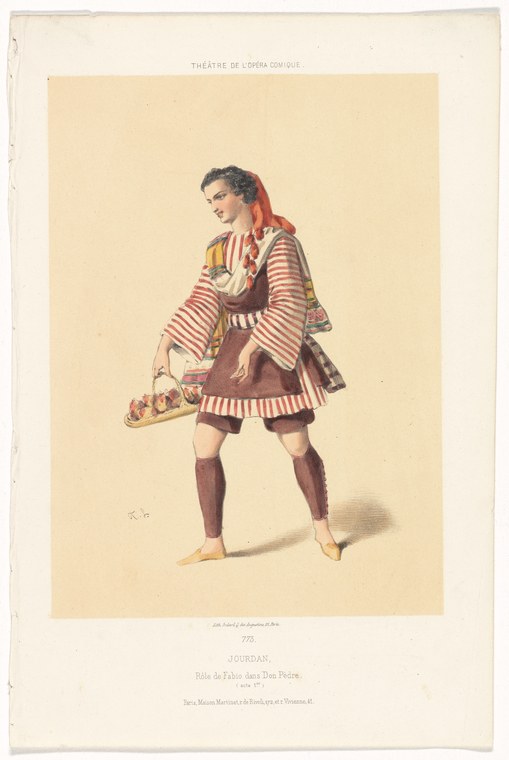
A single male dancer in theatrical costume stands against a plain pale background, posed in profile with his weight on his left leg and his right leg extended in a balletic attitude derrière. He wears a striped tunic in red and cream with short sleeves, a deep burgundy skirt or culotte, and burgundy stockings that reach mid-thigh, paired with soft flat shoes in pale leather or canvas. Around his neck and shoulders hangs a striped cape or shawl in the same red-and-cream pattern. His dark hair is pulled back, and his posture is upright and dignified. In his left hand he holds a small wicker basket filled with vegetables or produce. The figure's stance and costume suggest a character role from nineteenth-century theatrical dance—possibly a peasant, shepherd, or stock character from a narrative ballet or comic theatrical piece.
The dancing
The dancer is positioned in a single-figure portrait pose, neither engaged with other dancers nor demonstrating a partnered hold. The extended right leg, turned outward, shows balletic training and positioning; the frame is open, the torso upright, the arms held naturally rather than in a formal ballet port de bras. The weight distribution and the slight forward inclination of the head suggest a walking or traveling step momentarily held for effect, or a pose struck for portraiture rather than a step in mid-performance. The basket in the hand is integral to the characterization and suggests this is a named role rather than a generic corps figure.
The dance depicted
This appears to be a character dance or demi-caractère role from nineteenth-century ballet or theatrical dance—likely French, given the title and the publication context. The costume and pose suggest a peasant or comic character type common in Romantic and later nineteenth-century ballets, where such roles combined basic ballet technique with naturalistic, character-specific movement and costume. The absence of pointe shoes and the relatively relaxed arm position indicate this is not a principal classical role but a secondary character part. Without the title or inscription fully legible, the specific ballet cannot be identified, but the visual evidence points to professional theatrical dance of the mid-to-late 1800s.
How it was made
This is a hand-colored engraving or lithograph, typical of the mass-produced theatrical portrait prints that circulated in France during the nineteenth century. The technique allowed for fine detail in the costume and figure while maintaining the pale, uniform background that focuses attention on the dancer and dress. The color is applied by hand over the printed image, visible in the slight irregularities of the striping and the subtle modeling of the fabrics. Such prints were produced for sale to audiences and theater patrons, making them both artistic records and commercial products—far cheaper and more widely distributed than paintings, and more accessible to dancers and the public than photographs until the 1880s.
About this work
This is a theatrical portrait print of a named character dancer in mid-nineteenth-century European ballet or dance theater, likely French. The figure wears a costume that identifies him as a peasant or comic character—a secondary role requiring both balletic training and character specificity. As one of a series of such prints (the image bears the stamp 'THÉÂTRE DE L'OPÉRA COMIQUE'), it belongs to the rich tradition of ephemeral theatrical prints that documented performance, circulated images of popular dancers and roles, and served as souvenirs of the theater. The work sits at the intersection of dance history, theatrical documentation, and commercial visual culture.
How to look at it
Note the turn-out and extension of the right leg, which signals trained ballet technique even in a comic or character role. Observe the contrast between the dignity of the classical ballet pose and the mundane realism of the vegetable basket and peasant costume—this tension is the whole point of the character role. The frontal presentation of the figure, the clear visibility of the costume, and the neutral background all point to this as a portrait meant to be read and kept rather than a scene meant to convey narrative action. The print's purpose is to preserve the image of a specific performer in a specific role, not to tell a story.
The artist
The artist is not recorded. The print bears a publisher's mark ('THÉÂTRE DE L'OPÉRA COMIQUE') and appears to be part of a series of theatrical portraits. Such prints were typically produced by commercial engraving and publishing houses in Paris and other European theater centers, often working from theater sketches or from observation during performances. The hand-coloring may have been done in the publisher's workshop or by individual colorists; the quality and consistency suggest professional production.
The period
This print dates to an era when the Opéra Comique in Paris was a major venue for ballet and dance-theater, and when such prints were a standard and affordable way for audiences to own images of performers and roles. The costume style and the figure's balletic training point to the mid-to-late nineteenth century, when character dance was an established part of ballet companies—a distinct repertory from classical ballet, employing national and folk dance vocabularies alongside trained technique. This was the era of Romantic ballet and its aftermath, when such secondary roles remained commercially viable and culturally significant.
Where it lives
The print is part of the New York Public Library's collection of prints depicting dance ('Prints depicting dance'). It bears the imprint of the Théâtre de l'Opéra Comique, a major Parisian theater. Such prints were typically sold at the theater or through Paris publishers and circulated throughout Europe; they are now scattered across public collections in Paris, London, and North America.
Dance in this work
Questions about this work
What is a character dance role?
Character dance (demi-caractère in French ballet) is a theatrical role that combines balletic training with narrative and comic specificity. Unlike a corps dancer or a classical principal, a character dancer embodies a named or typed character—a peasant, a servant, a national type—and moves in ways that blend ballet technique with more naturalistic, characterful gesture. Such roles were central to nineteenth-century ballet narratives and remained popular in comic and narrative ballets throughout the era.
Why is there no name or date on this print?
This is typical of nineteenth-century theatrical prints. Many were published by theatrical printers and publishers whose names appear on the work (here, the Opéra Comique's mark), but the dancer's name, the ballet's title, and the date may have been printed on a caption strip that has since been lost or removed. Some were sold as loose prints without a title page or binding. The inscription 'THÉÂTRE DE L'OPÉRA COMIQUE' is all that survives to place the work in its context.
Is this a real dancer or a costume study?
Most likely both. The print depicts an actual performer in an actual role, captured either from a theater sketch or drawn from observation. Such prints were made to sell to theater-goers and to circulate images of popular performers. Whether the pose is exactly as performed or slightly idealized and clarified for the print is impossible to say, but the figure is not a generic costume study—it is a theatrical portrait of a named role.
More dance artwork





