49 works in this view — arrow keys or swipe to move between them.
Dance in Art
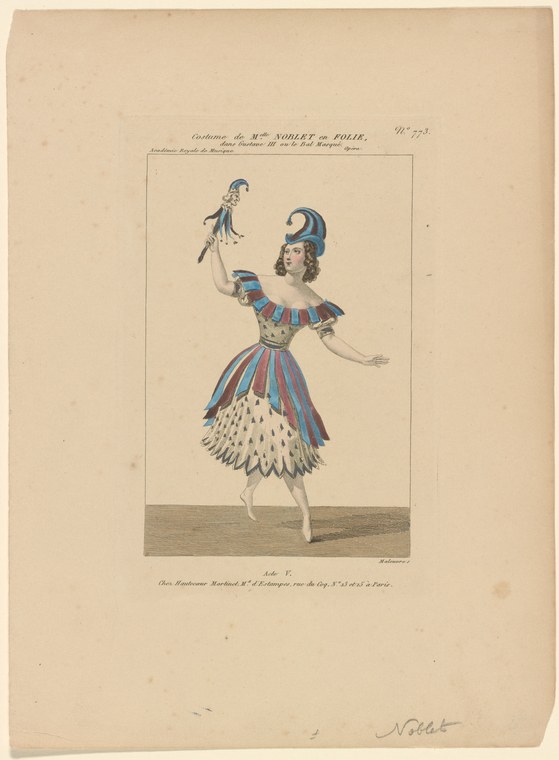
Costume de Melle. Noblet en Folie, dans Gustave III; ou Le bal masqué, opéra, acte V, Académie royale de musique
Unknown artist
- Collection:
- Prints depicting dance
- Source:
- New York Public Library
- Rights:
- Public domain — free to use, share and adapt.
- Recorded as:
- Public Domain
Costume plates of this kind are among our primary sources for understanding how early-19th-century dancers actually moved and what roles they played. The image records not only the sewn and constructed costume but the dancer's spatial relationship to it—how Noblet inhabited and displayed this role—and thus gives insight into the embodied practice of Romantic dance that survives in no other medium. The role of Folie itself, and the comic or grotesque register it occupied, represents a strand of theatrical dance that romantic ballet later sidelined in favor of the ethereal and tragic, making this a rare document of a lost aesthetic.
What you are looking at
A young female dancer stands alone on a shallow stage, balanced on one leg en pointe in a pose of delighted abandon. She holds aloft a small figure—a marionette or doll dressed in blue—in her raised right arm, while her left arm extends gracefully to the side. Her costume is theatrical and fanciful: a white feathered or scalloped skirt of short length, worn beneath a blue and red striped bodice with a blue cap or headdress. The upper garment has a marked Egyptian or orientalist character, with striped panels and what appear to be tassels or fringe. The dancer's expression is one of playful joy as she presents the puppet to the viewer. The background is minimal and neutral, focusing all attention on the solitary figure and the vivid colors of her dress.
The dancing
The dancer is shown in a single-leg vertical extension, rising onto pointe on her left foot with the right leg bent or extended behind her. Her torso is upright and engaged, her shoulders square but animated. The right arm lifts the puppet high with a gesture of presentation or delight, while the left arm balances the frame with an open, welcoming curve. The pose conveys effortless grace and confident control—she is not straining but displaying herself and her prop with the ease expected of a trained theatrical dancer. The gesture is one of performance toward the viewer, not of narrative interaction with another dancer.
The dance depicted
This is a costume study for a theatrical ballet or opéra dansé, specifically for *Gustave III; ou Le bal masqué* (Act V). The work depicts Mademoiselle Noblet in the role of Folie (Madness or Folly), one of the allegorical or comic characters typical of Romantic-era opera-ballet. The costume and pose convey lightness, wit, and theatricality rather than the weightless storytelling of a Romantic narrative ballet. The presence of the puppet suggests either a comedic skit within the larger work or a danced scene featuring comic or grotesque elements. The technical execution shown—secure balance, pointed foot work, and controlled extension—indicates this was a role for a trained dancer of standing, not a walk-on or chorus part.
How it was made
This is a hand-colored engraving or etching, likely from the early 19th century, executed in the tradition of costume plates and theatrical documentation. The fine lines defining the figure and the precision of the engraved base are visible; the color has been applied by hand in watercolor or gouache, creating the jewel-like tones of the costume. This medium was standard for recording and distributing images of famous dancers and roles in the period before photography. The print was likely issued as a collectible item for theatre-goers and dance enthusiasts, similar to portrait engravings of celebrated singers. The inscription at top and bottom would have carried the dancer's name, the work's title, and the printmaker's attribution.
About this work
This is a costume plate documenting Mademoiselle Noblet's performance as Folie in *Gustave III; ou Le bal masqué*, one of the major opéra-ballets of the Romantic period in Paris. The print records not just the dress but the dancer's bearing and the character's theatrical mood—a combination of technical refinement and playful abandon that was central to the peripatetic style of early-nineteenth-century dance theatre. Noblet was a celebrated ballerina of the 1820s-30s, and this image preserves both her likeness and her performance in a key role of her career. The work belongs to the genre of theatrical ballet because it depicts a scene from a work for the stage; it sits at the borderline between ballet proper and opéra dansé (sung opera with danced scenes), a form now largely forgotten but once central to Parisian theatrical culture.
How to look at it
Look first at the precision of the dancer's balance: the pointed foot, the upright torso, the controlled placement all mark this as a moment of technical accomplishment, not a casual gesture. Notice how the costume itself is part of the performance—the striped bodice with its suggestion of Egyptianizing or exotic dress, the feathered skirt that would move dramatically with the dancer's motion. The marionette held aloft is key: it shifts the mood from classical grace to theatrical wit, suggesting that Folie (Madness) is a character part requiring both technical skill and comic timing. The hand-coloring of the print gives the costume vivid presence that a simple engraving would lack; observe how the blue, red, and white are applied to guide the eye and make the figure legible from a distance—as it would need to be from the audience in the opera house.
The period
This work dates to the 1820s or early 1830s, a period of extraordinary vitality in Parisian dance and a moment when the opéra-ballet—a mixed form combining sung recitative and danced interludes—was the reigning theatrical form. *Gustave III; ou Le bal masqué*, by Auber and others, was first performed at the Académie Royale de Musique (the Paris Opéra) and was a major success. The same decade saw the rise of the ballerina as a public celebrity; prints of famous dancers in famous roles were collected eagerly and functioned as a form of theatrical publicity and souvenir. Mademoiselle Noblet was part of the generation immediately before the triumph of Romantic ballet proper (which emerged around 1832 with works like *La Sylphide*). Her roles blended the technical vocabulary of classical ballet—evident here in the pointe work—with the theatrical and often comic character roles that had defined pre-Romantic dance.
Where it lives
This print is housed in the Prints collection at the New York Public Library, part of a larger archival collection of dance imagery spanning centuries. Costume plates of this type were produced in runs for public sale and distribution; they were often issued shortly after a work's premiere or during its run of performances, making them roughly contemporary with the choreography they document.
Dance in this work
Questions about this work
Who was Mademoiselle Noblet?
Marie-Madeleine Noblet (c. 1801–1852) was a French ballerina and celebrated dancer of the Paris Opéra during the 1820s and 1830s. She danced principal roles in opéra-ballets and was known for both her technical skill and her comic gifts. She was the sister of the dancer Lise Noblet. By the time Romantic ballet emerged in the early 1830s, she had largely retired from the stage.
What is an opéra-ballet?
An opéra-ballet (or ballet-héroïque) was a theatrical form combining sung recitative, instrumental music, and extended choreographed dance sequences. Popular in 18th- and early-19th-century France, it often featured allegorical characters and spectacular staging. Unlike later Romantic ballet, the opéra-ballet was not narrative-driven; instead, it offered a series of episodes, divertissements, and character turns. By the 1840s, the form declined as ballet became the primary vehicle for story-telling on the dance stage.
What does 'en pointe' mean, and did dancers in 1830 really dance on pointe?
En pointe (on the tips of the toes, supported by reinforced shoes) is a hallmark of later 19th-century ballet. In the 1820s–30s, it was used only occasionally, for effect or to achieve height in specific poses—as we see here. Full reliance on pointe work became standard only from the 1840s onward. Noblet's confident balance on pointe in this pose suggests either that she was a very accomplished technician or that the pose was held briefly for maximum visual impact, much as a portrait freezes a moment.
Why would a dancer hold a marionette or doll?
The puppet is a prop that defines the character of Folie (Madness or Folly). In 19th-century theatrical tradition, Folly was often depicted as playful, anarchic, and surrounded by inanimate objects or animals. The dancer's delighted pose suggests she is performing a comic or grotesque scene, possibly part of a divertissement within the larger opera. The puppet allowed the dancer to extend her characterization beyond pure dance movement into mime and theatrical storytelling.
More dance artwork





