49 works in this view — arrow keys or swipe to move between them.
Dance in Art
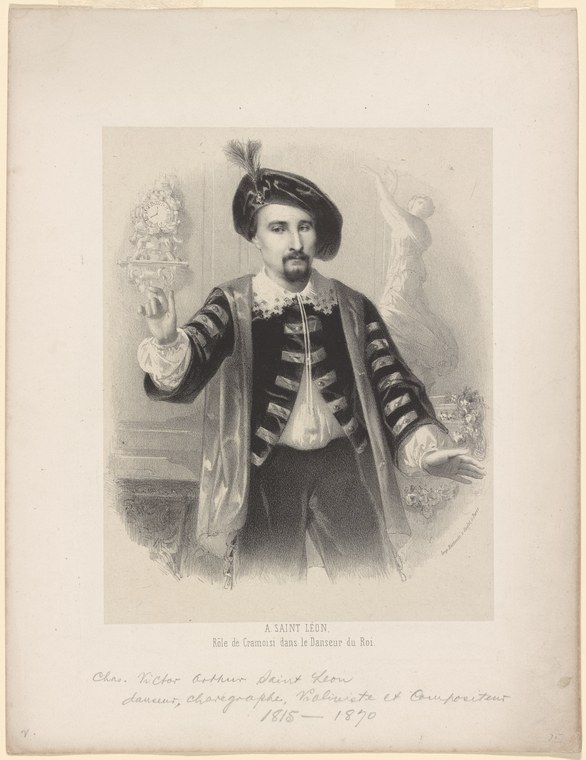
A. Saint Léon, rôle de Cramoisi dans Le danseur du roi
Unknown artist
- Collection:
- Prints depicting dance
- Source:
- New York Public Library
- Rights:
- Public domain — free to use, share and adapt.
- Recorded as:
- Public Domain
This print preserves evidence of how a significant Romantic-era male dancer dressed and presented himself on stage, and it documents a specific theatrical work and role that is now largely lost to us. Saint Léon's contributions to dance—both as a performer of remarkable technique and as a choreographer of ballets still performed today—make contemporary images of his work valuable historical records. The engraving also shows how theatrical dance was promoted and circulated as celebrity imagery in the 19th century, a parallel to modern playbills and promotional photography.
What you are looking at
A male dancer stands in a three-quarter pose against a neutral background, dressed in elaborate mid-19th-century theatrical costume. He wears a dark velvet jacket with horizontal striping or banding across the sleeves, richly decorated with what appears to be gold embroidery or trim. Beneath this sits a white shirt with an ornate lace jabot at the throat. His lower body is clad in fitted dark breeches. A long, flowing cape or coat with fur trim drapes from his shoulders, suggesting aristocratic or courtly dress. On his head sits a dark beret or cap adorned with a feather plume. His right arm is raised with palm outward in a gesture of presentation or salutation; his left hand rests near his torso. The background includes architectural elements—a relief or sculptural detail at upper left and a draped fabric or curtain suggestion at right—placing him in an interior courtly setting. The engraving technique renders the figure with fine cross-hatching and careful attention to the fall and texture of fabric. A handwritten inscription at the bottom of the page, partially legible, appears to identify the performer and role.
The dancing
A single male figure stands with weight balanced evenly, neither in motion nor in a static rest position. His right arm extends upward with the palm facing outward in a gesture of acknowledgment or address—a formal presentation pose common to theatrical performance of the period. His shoulders are held back, his torso erect. The stance and arm position suggest a moment of formal introduction or dramatic address rather than active choreography. The costume and bearing indicate a trained performer comfortable in aristocratic movement vocabulary.
The dance depicted
This appears to document a specific theatrical dancer—A. Saint Léon—in a named role, 'Cramoisi' in the work 'Le danseur du roi' (The King's Dancer). The image does not show active dance movement but rather a posed portrait of the dancer in character costume. Saint Léon was a celebrated 19th-century dancer and choreographer, and the style of dress and artistic convention suggest this is likely from the 1840s-1850s. The work itself seems to have been a theatrical piece, possibly a ballet or pantomime-ballet, concerned with court life and courtly dance, though the engraving captures a moment of formal presentation rather than choreographed steps.
How it was made
This is an engraving, a print medium that would have allowed wide circulation of the image among theatregoers and the literate public. The artist has employed fine cross-hatching and careful linear work to render both the texture of the costume fabrics—distinguishing the pile of velvet, the delicacy of lace, the weight of the cape—and the volume of the body beneath. The technique is well-suited to capturing detail and flattery, suggesting this was a commercial portrait circulating as a theatrical print, a common form of celebrity promotion in the 19th century. The handwritten inscription at the base indicates this print was owned, annotated, and valued as a document of a specific historical performance.
About this work
This engraving documents a celebrated moment in 19th-century theatrical dance: the appearance of the virtuoso dancer A. Saint Léon in a specific named role within a theatrical work exploring courtly life and dance. Saint Léon was one of the leading male dancers of the Romantic era, known equally for his performing and choreographic achievements. The image is not a record of choreography but of costume, persona, and theatrical presence—of what a principal male dancer wore and how he presented himself to an audience of the mid-1800s. It belongs in a gallery of dance imagery because it documents both the star system of theatrical dance and the integration of dance into narrative theatrical works of the period. The engraving is a product of the 19th-century theatre culture in which dance occupied a major, celebrated place alongside drama and music.
How to look at it
Look at the costume first—the engraver has lavished attention on the texture and ornamentation, and these details tell us what a principal male dancer of the 1840s-50s wore on stage. Note the raised arm and open palm: this is the moment of formal presentation, the dancer acknowledging the audience or addressing another character. This pose, held and composed, is not a step or an active movement, but a theatrical gesture—the dancer's moment of stillness and dignity within the narrative. The background details place him in an interior setting of wealth and power, consistent with the role of 'Cramoisi' in a work about court and kingship. Read the handwritten inscription at the bottom: it personalizes the print, tying it to a specific performance and a specific dancer whose work mattered enough to annotate and preserve.
The artist
The engraver is not recorded in the catalogue. The work is a theatrical print, a commercial product, and the engraver's name may have been omitted or is now lost. Such prints were typically produced by publishing houses specializing in theatrical imagery, often in collaboration with theatres themselves. The quality of the work and the care taken with detail suggest a skilled practitioner of the engraving craft, competent in rendering both the dignity of a principal performer and the ornamental complexity of theatrical costume.
The period
This print dates to the height of the Romantic ballet era, a period (roughly 1830–1860) when ballet occupied a central place in European theatrical culture and male dancers were celebrated virtuosos. Saint Léon was active during this period and was known for his technical gifts, his dramatic presence, and his work as a choreographer—he created ballets for major European theatres and collaborated with the leading dancers of his time. The style of costume visible in the engraving—the emphasis on rich fabric, historical or exotic dress, and courtly elegance—reflects the Romantic period's fascination with narrative, character, and the visual splendor of theatrical spectacle. The work 'Le danseur du roi' places dance within a framework of court life and courtly intrigue, typical of mid-19th-century theatrical interests.
Where it lives
This engraving is held in the New York Public Library's Prints collection, specifically within the section devoted to prints depicting dance. It is a theatrical print, a form of commercial promotion and artistic documentation combined, and its presence in a research library reflects its value both as a historical record and as a work of printmaking craft.
Dance in this work
Questions about this work
Who was Saint Léon?
Arthur Saint-Léon (1815–1870) was a French dancer, choreographer, and violinist who became one of the most celebrated male dancers of the Romantic era. He danced at major European theatres, created numerous ballets, and was known for both his virtuosic technique and his dramatic presence. He also composed music and was a skilled violinist, an unusual accomplishment among dancers of the time.
What was 'Le danseur du roi'?
This appears to have been a theatrical work, likely a ballet or pantomime-ballet, involving a narrative about court life or court dance. The character 'Cramoisi' suggests either a comic role or a courtier of some significance. The work is not widely documented in modern dance histories, and this print may be one of the few surviving records of its appearance on stage.
Why would a theatre print have a handwritten inscription?
Theatrical prints of this era were often sold to theatregoers and collectors, and owners would annotate them with information—the date, the theatre, the performer's name, or personal notes. This inscription documents the specific performance or the owner's interest in preserving a record of seeing a celebrated dancer in a particular role.
What does the costume tell us about dance in this period?
The richness and historical detail of the costume reflects the Romantic era's investment in spectacle and narrative. Male dancers wore elaborate costumes suited to their roles—aristocrats, peasants, courtiers, soldiers—and the quality of the engraving shows how important these visual elements were to the theatrical experience. Dance was not an abstract art form but a narrative spectacle in which costume, setting, and character were essential.
More dance artwork





