49 works in this view — arrow keys or swipe to move between them.
Dance in Art
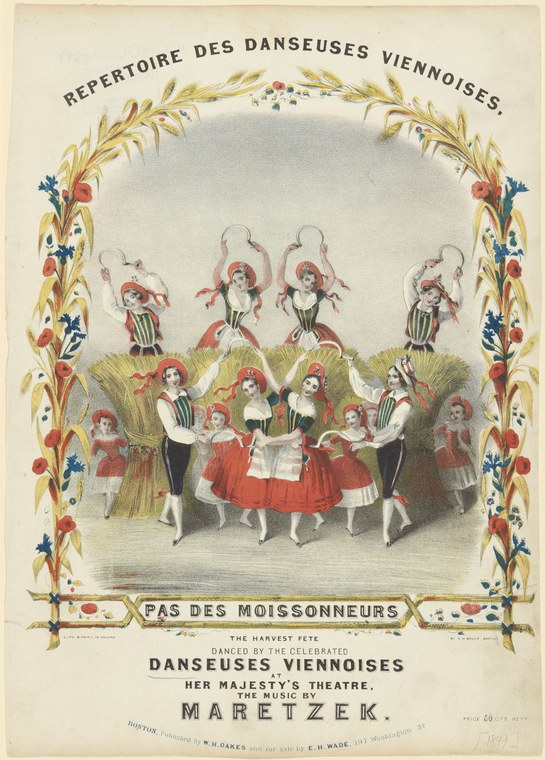
Pas des moissonneurs: the harvest fete danced by the celebrated Danseuses viennoises at Her Majesty's Theatre, the music by Maretzek
Unknown artist
- Collection:
- Prints depicting dance
- Source:
- New York Public Library
- Rights:
- Public domain — free to use, share and adapt.
- Recorded as:
- Public Domain
The Danseuses Viennoises and their repertoire of waltzes and character dances represent a strand of nineteenth-century dance practice that falls between classical ballet and social dance—a popular, commercially successful form that has been largely overshadowed in dance history by the Romantic ballet and the Russian Imperial tradition. This print is evidence of what audiences actually watched and paid for in London theatres of the era. The decorative treatment of the subject—the ornamental border, the emphasis on collective joy rather than individual virtuosity—reveals how dance was marketed and imagined in popular visual culture.
What you are looking at
This is a chromolithograph cover for a theatrical dance number, framed by an ornate border of golden wheat stalks and polychrome wildflowers. Within the decorative frame, a group of approximately twelve young women in peasant costume—red skirts, white blouses, and red caps—dance together in a pastoral harvest celebration. They are arranged in a loose semicircle or gathered group, some with arms raised or linked, caught in animated movement. The setting is minimal: a simple grassy ground and pale sky occupy the background. The composition emphasizes the collective joy and informality of a folk celebration rather than the structured precision of classical ballet, though the dancers' youth, training, and theatrical costuming—all matching, all carefully posed—make clear this is a professional stage performance of a folk theme, not an actual peasant festival. The decorative border, with its wheat and flowers, anchors the "harvest" subject explicitly.
The dancing
The dancers are disposed in an informal, celebratory cluster rather than a strict geometric formation. Several dancers have arms raised or extended; others hold hands or link arms across the group. The poses suggest active turning, jumping, or swaying rather than static tableau work. All wear identical or near-identical costumes—a theatrical convention that emphasizes the corps de ballet or ensemble nature of the piece. The dancers' bodies are young and slender, their limbs relatively extended, and their overall frame upright and energetic rather than grounded or heavily weighted. No individual dancer dominates; the visual focus is collective.
The dance depicted
The title identifies this as a 'pas des moissonneurs' (harvest dance), a late-nineteenth-century theatrical number set to music by Maretzek, performed by the celebrated Danseuses Viennoises (Vienna Dancers) at Her Majesty's Theatre in London. This is a character dance or demi-caractère piece—a theatrical genre that draws on folk or national themes while maintaining the technique and aesthetic of ballet. The Danseuses Viennoises were a professional company known for performing waltzes and folk-themed numbers; they were not a classical ballet company but rather popular entertainers who blended ballroom, folk, and light theatrical movement. The informal, celebratory grouping and peasant dress confirm the character-dance tradition, while the coordinated ensemble and theatrical setting distinguish it sharply from actual folk practice.
How it was made
This is a chromolithograph (color lithograph), a print technique that allows multiple colors to be printed in sequence, with separate stones or plates for each hue. The bright, flat color fields—the red skirts, white blouses, golden wheat, blue flowers—and the decorative precision of the border are characteristic of mid-to-late-nineteenth-century chromolithographic design. The technique was ideal for theatrical and commercial publicity, allowing for vivid color and ornamental detail at relatively modest cost. The print is a cover for a published dance score or theatrical program, circulated as an advertisement and souvenir; it reached a broad urban audience rather than collectors or galleries.
About this work
This chromolithographed cover depicts a character-dance number, 'Pas des Moissonneurs,' performed by the Danseuses Viennoises at a London theatre in the nineteenth century. The work is neither classical ballet nor folk dance, but a theatrical hybrid: professional dancers in matching peasant costumes, arranged informally to suggest collective harvest-time celebration, bound within a decorative border that emphasizes the rural and seasonal subject. The print format and theatrical context place it squarely within nineteenth-century popular entertainment, a world in which ballet companies performed light, genre-based pieces alongside waltzes and national dances. It is an artifact of a now-vanished performance tradition and a record of how professional dancers of the period engaged with folk material.
How to look at it
Observe the informality of the grouping and the emphasis on collective movement rather than the symmetry or hierarchy of classical ballet. Notice how the decorative border—with its wheat and flowers—frames and aestheticizes the peasant theme, turning a harvest into a theatrical fantasy. The bright, flat color and the precision of the printing are themselves part of the period's visual language: this is how a Victorian audience encountered dance through popular media. The absence of any single focal figure or virtuosic pose signals the genre: this is entertainment dance, built for ensemble effect and visual pleasure rather than technical display.
The period
The Danseuses Viennoises were active in the mid-nineteenth century, when Vienna-derived waltzes and character dances were wildly popular across Europe and America. The 1870s–1890s saw a proliferation of theatrical companies built around national or regional dance styles: Spanish, Hungarian, Russian, and Viennese dancers all toured extensively. This was the era of Offenbach and comic opera, when light, entertaining dance in a folk idiom competed successfully with the increasingly refined and difficult Classical and Romantic ballet traditions. The character dance—a ballet technique applied to folk material—emerged as a major theatrical genre during this period. The print's chromolithographic style is typical of mid-to-late-nineteenth-century theatrical publicity, when vivid color and ornamental design were used to attract middle-class audiences to music halls and theatres.
Where it lives
This chromolithograph is held by the New York Public Library in its collection of prints depicting dance. It is a theatrical cover or program advertisement, not a fine-art print; it was produced and distributed as commercial ephemera accompanying performances or published scores.
Dance in this work
Questions about this work
Who were the Danseuses Viennoises?
A professional dance company based in Vienna that toured across Europe and America in the mid-to-late nineteenth century, performing waltzes, character dances, and light theatrical pieces. They were popular entertainers rather than a classical ballet company, and they specialized in dances based on Viennese, Hungarian, and other Central European folk idioms. The group was famous enough to command bookings at major theatres and to be featured on printed programs and covers.
What is a 'pas des moissonneurs'?
A character-dance number set to music, typically choreographed as a theatrical celebration of a harvest festival. The 'pas' (dance for a group) is part of the ballet vocabulary but performed here in a folk idiom. Maretzek, the composer, was a nineteenth-century conductor and composer who wrote many light theatrical scores. This particular piece became established enough to be republished and performed multiple times.
What is a character dance?
A theatrical dance form that uses ballet technique but draws movement, costume, and music from folk or national traditions. Unlike Classical or Romantic ballet, which aimed for ethereal or tragic effect, character dance is earthy, narrative, and often comic or festive. By the nineteenth century, character dance had become a staple of professional ballet companies, appearing in interludes or as standalone pieces.
Why does this print have such an ornate border?
The decorative frame of wheat and wildflowers serves multiple purposes: it anchors the harvest theme, it gives the print visual richness and appeal (important for commercial publicity), and it frames the dancers as a scene to be admired rather than showing them on a stage. This type of ornamental framing was standard in nineteenth-century theatrical chromolithography.
More dance artwork





