49 works in this view — arrow keys or swipe to move between them.
Dance in Art
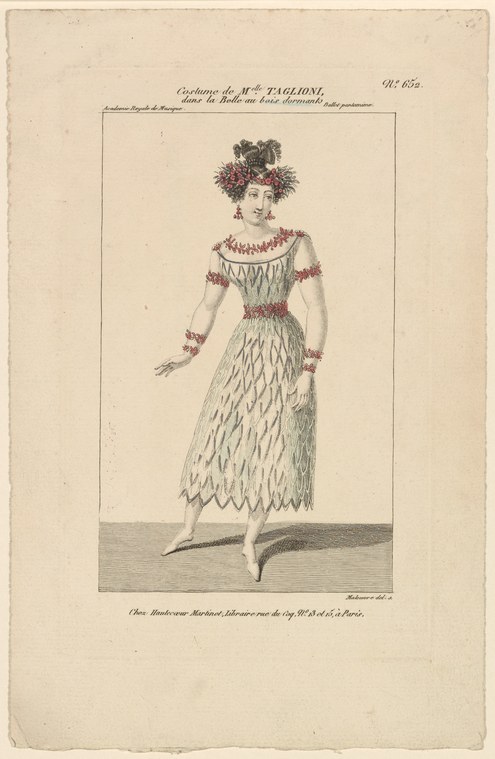
Costume de Melle. Taglioni, dans La belle au bois dormant, ballet pantomime, Académie royale de musique
Unknown artist
- Collection:
- Prints depicting dance
- Source:
- New York Public Library
- Rights:
- Public domain — free to use, share and adapt.
- Recorded as:
- Public Domain
Costume plates like this are primary evidence for understanding Romantic ballet as a visual and material practice, not merely as a technique preserved in choreographic notation. Taglioni's roles defined the era; her costumes — the off-shoulder cut, the tulle, the floral crown — became the visual shorthand for Romantic femininity in dance and in broader culture. For historians and dancers, such prints are documents of what the stage actually looked like and how roles were presented to audiences.
What you are looking at
A single female figure stands in a three-quarter frontal pose against a plain ground, her body weight settled on one leg in a classical ballet stance. She wears a Romantic-era tulle skirt with a distinctive scalloped or feathered hemline that falls to mid-calf, paired with a fitted bodice cut off-shoulder and adorned with red rosettes and garland trim at the neckline and sleeves. Her hair is dressed high and crowned with flowers and foliage. The figure's pose is stationary and formal rather than dynamic — a presentation of costume and bearing rather than a captured moment of movement. The engraving is hand-coloured, with soft greens and pinks applied to the tulle and red details picked out precisely. The technique and style of the print, along with the inscription at the top crediting Mlle. Taglioni and citing *La belle au bois dormant* (Sleeping Beauty), identifies this as a costume plate documenting stage dress.
The dancing
The dancer stands in a neutral, supported position with one leg bearing weight and the other lightly placed, a standard display posture for costume documentation rather than an active dance position. Her arms hang naturally, one slightly forward. The uprightness of her carriage and the formal frontality of her stance suggest classical training, but the image records costume and type rather than movement vocabulary. There is no indication of pointe work, turnout, or the specific physical demands of the role.
The dance depicted
This is a costume plate for a production of *La belle au bois dormant* (The Sleeping Beauty) at the Paris Opéra, documenting the stage dress of the role performed by the legendary dancer Marie Taglioni. The work does not depict dance in action but rather serves as a record of how Romantic ballet was costumed in the 1830s–1840s. Taglioni was the defining figure of Romantic ballet and the most celebrated dancer of her era; her roles — particularly in *La Sylphide* — established the visual and physical language of the Romantic style. This plate captures the off-shoulder neckline, fitted corseting, and layered tulle skirt characteristic of the period.
How it was made
This is a hand-coloured engraving or aquatint, a reproductive print technique that allowed wide circulation of costume documentation and performance imagery in the early 19th century. The base image is line-engraved or etched, then selectively coloured by hand using watercolour or gouache — a labour-intensive process that made such prints affordable only to a cultivated audience. The technique's precision made it ideal for recording fine detail of dress and trim, and the circulation of such prints shaped public understanding of contemporary performance and fashion across Europe.
About this work
This is a costume documentation plate for a Romantic-era ballet production, engraved and hand-coloured in the mid-19th century. It records the stage dress of Marie Taglioni, the supreme dancer of the Romantic period, in a role from the Paris Opéra repertory. Although it does not depict dance in motion, it is essential evidence of how Romantic ballet looked, how it was costumed, and how performance imagery circulated among educated audiences. Such prints shaped the visual identity of the Romantic movement and remain invaluable documents of performance practice.
How to look at it
Attend to the costume's silhouette: the off-shoulder neckline and narrow bodice create an elongated line broken only by the corseting at the waist, while the scalloped tulle skirt both frames the legs and permits movement. The high hair arrangement with flowers reads as fanciful and otherworldly — appropriate for Sleeping Beauty — while remaining within the bounds of Romantic femininity. The pose itself is not a dance step but a display stance; viewers of this print would have recognized it as the formal presentation mode of mid-19th-century theatrical costume documentation. The hand-colouring — subtle greens and pinks — is restrained and precise, emphasizing the delicacy of the tulle rather than overwhelming the form.
The period
This plate dates to the era of Romantic ballet (c. 1830–1850), when ballet shifted from the abstract courtliness of neoclassical forms toward narratives of haunting, otherworldly femininity. Marie Taglioni dominated this period; her 1832 debut in *La Sylphide* established her as the supreme technician and artist of the age. *La belle au bois dormant* (Sleeping Beauty) exists in multiple versions from this period — most famously the Petipa/Tchaikovsky version of 1890, but earlier versions existed in the Paris Opéra repertory. The costume documented here — the Romantic tutu in its developed form, with layered tulle and a hem that freed the lower leg and ankle — became the canonical silhouette of classical ballet and remains so today. Engraved costume plates were a major industry in Paris during this period, satisfying demand from dancers, choreographers, connoisseurs, and fashionable audiences who followed stage dress closely.
Where it lives
This print is held by the New York Public Library in a collection of dance-related prints and ephemera. It is a costume plate, a form of theatrical documentation and publicity that circulated widely among the dance world and fashionable society in the 19th century.
Dance in this work
Questions about this work
Was this the Tchaikovsky Sleeping Beauty?
No. Tchaikovsky's *Sleeping Beauty* premiered in 1890 St. Petersburg under Petipa's choreography and is the version best known today. This plate documents an earlier French version danced at the Paris Opéra, likely in the 1830s–1840s. Multiple versions of *La belle au bois dormant* existed across Europe during the Romantic era.
Who was Marie Taglioni?
Taglioni (1804–1884) was a Swedish-Italian dancer who became the supreme ballerina of the Romantic era. Her debut in *La Sylphide* (1832) revolutionized ballet by establishing the ethereal, otherworldly femininity and technical brilliance that defined the period. She was the most celebrated dancer of her age and remained a cultural icon throughout her life.
Why is the skirt shaped that way?
The layered tulle skirt with a scalloped or feathered hemline is the canonical Romantic tutu. It was invented to show off the dancer's footwork and the newly developed pointe technique while maintaining an ethereal, floating quality. The hemline just below the knee became the standard for classical ballet and remains so today.
Is this a photograph?
No. This is a hand-coloured engraving or aquatint, a reproductive print technique that required skilled engravers and hand-colourists. Photography existed by mid-century but was not used for fashion or costume documentation in this way. Engraved prints were the standard medium for circulating images of stage dress and celebrity dancers.
More dance artwork





