49 works in this view — arrow keys or swipe to move between them.
Dance in Art
The fairy grotto
Unknown artist
- Collection:
- Prints depicting dance
- Source:
- New York Public Library
- Rights:
- Public domain — free to use, share and adapt.
- Recorded as:
- Public Domain
For dance historians, this print is crucial evidence of how Romantic ballet was marketed and understood by its public. It shows that the genre's power lay not in depicting visible technique but in creating atmosphere and narrative suspension—the viewer's belief that weightless, magical movement was occurring, even when the figure is too distant to see footwork or line. The theatrical conventions it records—the grotto as threshold, the distant ethereal figure, the pale-dressed mortal witness—became the template for fairy scenes across the century.
What you are looking at
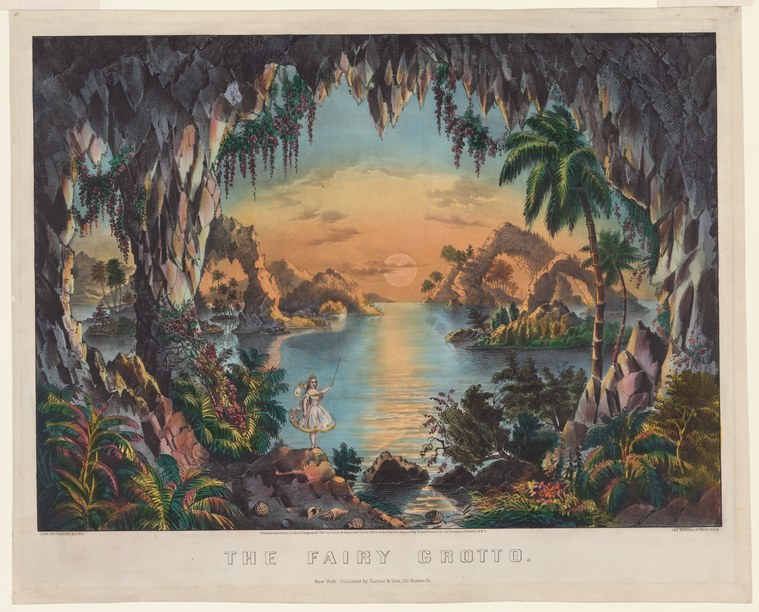
A figure in a pale dress stands on a rocky shore within a vast limestone cavern, gazing out toward a luminous seascape. The cave mouth frames a dreamlike tropical landscape: calm water reflects golden sunset light, distant rocky islands rise from the sea, and palm fronds arch from the right margin. Hanging vines and stalactites drape from the cavern ceiling in soft grays and ochres. The lighting is theatrical—warm gold suffuses the seascape while cooler blues shadow the cave interior, creating a sense of passage from darkness into an idealized, almost supernatural natural world. A small figure in the middle distance appears to be dancing or moving on the water itself, suggesting either illusion or the supernatural agency of fairies.
The dancing
The foreground figure wears a pale, high-waisted Empire-line dress typical of early 19th-century romantic fashion. Her posture is upright and contemplative rather than actively dancing; her body faces the view, her gaze directed outward toward the seascape. The distant figure on the water is too small to read in anatomical detail, but appears to be in a lifted or elevated pose—possibly en pointe or airborne—suggesting otherworldly movement. The scale relationship between the two suggests narrative rather than social dance: the foreground figure is observer or participant in an enchantment, not partner to the distant figure.
The dance depicted
This is a theatrical romantic ballet scene, most likely from the 1840s Romantic era when ballets about fairy encounters and supernatural beings became the dominant form. The title identifies this as 'The Fairy Grotto,' a subject that aligns with works such as *La Sylphide* (1832) or the grotto scenes in *Giselle* (1841). The distant figure's pose suggests the ethereal, gravity-defying movement that defined the Romantic ballerina—the illusion of weightlessness and otherworldly presence that made the supernatural believable on stage. The work depicts not the dance itself but the narrative moment of encounter, the mortal protagonist entering the magical realm where fairies dance.
How it was made
This is a hand-colored lithograph, recognizable by the characteristic soft tonal gradations and the style of color application typical of mid-19th-century commercial theatrical prints. Lithography allowed rapid, affordable reproduction in color, making such images accessible to theater audiences and ballet enthusiasts as souvenirs and promotional material. The technique's ability to render atmospheric effects—the glow of the sunset, the mist in the cavern—suited Romantic subject matter perfectly. The soft palette and diffused light effects are the lithographer's signature strengths, creating the dreamlike mood essential to the fairy subject.
About this work
This lithograph documents the visual language of Romantic ballet in its height. It captures not a moment of actual dance technique but the Romantic ballet's central fantasy: the irruption of the supernatural into the mortal world, rendered as a landscape of enchantment. The theatrical grotto setting, the luminous seascape, and the distant aerial figure together constitute a visual grammar that audiences of the 1840s would have recognized immediately—the grammar of fairy ballet, where dance and landscape merge into a single dream. The work is a record of how Romantic ballet imagined and staged the impossible.
How to look at it
Look first at the composition's division into three planes: the dark, enclosing cavern; the middle distance where the distant figure moves; and the luminous seascape beyond. This staging creates a narrative of discovery and enchantment—the viewer enters the grotto with the foreground figure and witnesses the supernatural ballet occurring in the magical realm beyond. Notice how the artist has made the distant figure almost illegible as technique; what matters is the pose's suggestion of weightlessness and the setting's assertion that she is not bound by ordinary gravity. This is how Romantic ballet worked in practice: the distance and the light did as much work as the dancer's body.
The artist
The artist is unrecorded in the catalogue. The print was published by Currier & Ives, the dominant American lithographic firm of the mid-19th century, known for theatrical and romantic subjects. Currier & Ives employed dozens of artists and colorists; the hand-colored lithograph would have been executed by a workshop team rather than a single named artist. This anonymity is typical of commercial theatrical prints of the period, where the image served the theater and the public more than it served artistic reputation.
The period
This print dates to the height of Romantic ballet in the 1840s, when fairy, sylph, and spirit ballets dominated European and American stages. Works like *La Sylphide* (Paris, 1832; London, 1832) and *Giselle* (1841) had established the supernatural female dancer as the period's defining theatrical image. Gas lighting, which allowed unprecedented control of atmospheric effect on stage, made such scenes technically feasible. In visual culture, lithographic prints like this one were the primary way ballet imagery reached the broad public—they functioned as theatrical publicity, souvenirs, and artistic records all at once.
Where it lives
Held by the New York Public Library in its collection of theatrical prints and dance imagery. Such prints were produced in large editions and circulated widely as popular theater memorabilia in the 19th century; multiple copies likely survive in public collections.
Dance in this work
Questions about this work
Is this depicting an actual ballet, and if so, which one?
The title and imagery suggest a scene from a Romantic-era fairy ballet, most likely *La Sylphide*, *Giselle*, or a now-lost contemporary work in that tradition. The grotto setting and the distant ethereal dancer are signature elements of such ballets. Without a dated title page or other documentation, the specific work cannot be confirmed, but the visual language is unmistakably that of 1840s Romantic ballet.
Why is the distant figure so small and unclear?
This is not a limitation but a choice. Distance and obscurity were essential to Romantic ballet aesthetics. The supernatural could not be shown too clearly or made too legible as human technique—it had to remain partially mysterious, suggesting powers beyond ordinary physicality. The lithograph reproduces stage practice: dancers performing fairy roles often danced at a distance or through gauze to enhance the illusion of otherworldliness.
What is the pale dress the foreground figure is wearing?
An early 19th-century high-waisted Empire-line gown, typical of Romantic-era theater costume. This is a mortal character's dress, distinguished from the ethereal fairy by its solidity and weight. The contrast between the earthbound figure in the foreground and the weightless figure in the distance is central to the Romantic ballet narrative.
Who made this print?
The artist is unknown. It was published by Currier & Ives, a New York lithographic firm that produced thousands of theatrical and popular prints. Such commercial prints were typically created by workshop teams; the image would have been designed by one artist, drawn on the stone by another, and colored by hand by a third. Attribution to a single named artist is usually impossible.
More dance artwork





