49 works in this view — arrow keys or swipe to move between them.
Dance in Art
Marietta Bonfanti [on the verso: Madame Ristori]
Unknown artist
- Collection:
- Prints depicting dance
- Source:
- New York Public Library
- Rights:
- Public domain — free to use, share and adapt.
- Recorded as:
- Public Domain
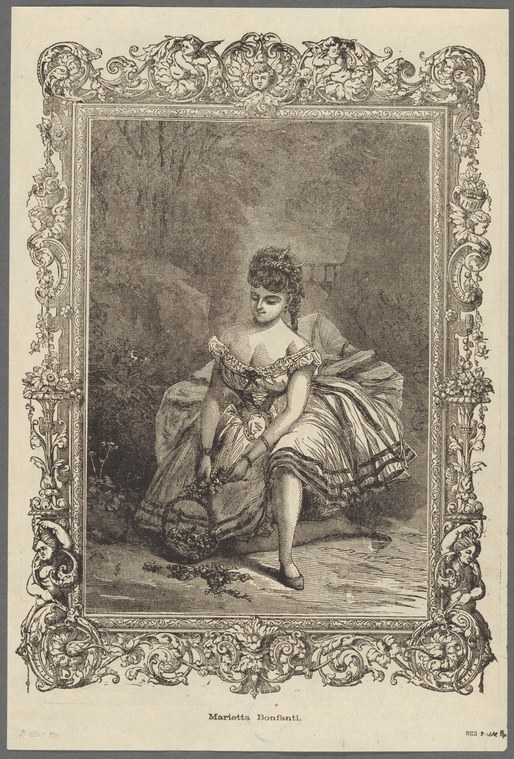
Marietta Bonfanti was a major international ballerina whose career bridged Europe and America, and prints like this were the primary means by which audiences who could not attend the theater encountered and remembered her. The image is evidence of how Romantic ballet dancers were packaged as objects of beauty and aspiration, and of the central role of reproductive prints in sustaining the fame of performers before mass media.
What you are looking at
A young woman in mid-nineteenth-century theatrical dress stands in a shallow interior space defined by a dark backdrop. She wears a white or pale silk dress with off-shoulder sleeves, nipped waist, and a full skirt gathered at the hem with dark trim or banding—the silhouette of the 1840s–50s Romantic era. Her hair is pinned high and ornamented. She is caught in a moment of theatrical poise: her weight appears to be on her right leg, her left leg slightly extended or poised, her torso upright and her gaze directed downward in a demure or contemplative expression. One arm hangs at her side; the other is raised or gesturing. The composition is a portrait in performance rather than narrative action. The ornate, deeply carved frame of scrollwork, foliate detail, and grotesque masks indicates this is a formal reproductive print, made for circulation among admirers of the performer.
The dancing
A single female figure, likely a ballerina, stands in a three-quarter view with weight slightly shifted. Her posture is upright and elongated, consistent with ballet carriage. The raised arm position and the angle of the torso suggest a moment of formal presentation or a posed attitude rather than active movement; the gesture is controlled and statuesque rather than dynamic. Her left leg appears to be pointed or extended, a defining feature of ballet technique of the period. The overall frame is one of poised elegance typical of Romantic ballet portraiture.
The dance depicted
This is almost certainly a portrait of the ballerina Marietta Bonfanti, a celebrated performer of the mid-nineteenth century, shown in costume and posed as she would have appeared in a theatrical role. The dress, posture, and pointe work indicate Romantic ballet, the dominant form of European theatrical dance of the 1840s–60s. Bonfanti was known for roles in full-length ballets and was active in both Europe and America. The image captures not movement in progress but the formal presentation of a dancer in character—a convention of theater portraiture that emphasizes beauty, elegance, and star power rather than the specifics of choreography.
How it was made
This is an engraving or steel engraving, a reproductive print technique that allowed fine detail and wide distribution. The tonal modeling, the crisp line work, the ornate border, and the pale paper stock are consistent with mid-nineteenth-century engraving practice. The elaborate frame is a hallmark of gallery-quality reproductive prints made to be collected, framed, and displayed in homes or theatrical institutions. The technique allowed the image to be copied and circulated in large numbers, making it an essential tool for the promotion of stage stars and a key format for dance imagery in the period before photography became dominant.
About this work
This is a portrait engraving of Marietta Bonfanti, a major ballerina of the mid-nineteenth century, posed in full Romantic ballet costume. The image is both a document of dance fashion and a promotional print celebrating a celebrated performer. It belongs in a gallery of dance in art as evidence of how the Romantic ballet era was visualized, celebrated, and circulated to the public—and as a record of a specific dancer's celebrity and the conventions of how female ballet dancers were presented to admirers. The work shows the intersection of theater, dance, printmaking, and star culture in the Victorian era.
How to look at it
Observe the precision of the engraver's line work: the modeling of the face and hands, the texture of the silk, the definition of the body beneath the dress. Notice the moment chosen: not a leap or dramatic action, but a poised, stationary attitude—the dancer as object of contemplation rather than kinetic force. This reflects both the aesthetic values of Romantic ballet and the technical limitations of printmaking: the artist captures not the flash of movement but the formal beauty of the dancer at rest. The ornate frame elevates the image to the status of fine art.
The artist
The artist is not recorded on the object or in the catalogue. The engraving is a work of theatrical portraiture in the tradition of celebrity prints, a major commercial and artistic practice in the nineteenth century. Hundreds of engravers worked in this genre, often in commercial studios or publishing houses, and most remain unattributed. The ornate border suggests the work was produced by a publisher of some standing.
The period
The Romantic era (c. 1830–1870) was the golden age of ballet as a theatrical art form, dominated by the image of the ethereal, otherworldly female dancer in a tutu, pointe shoes, and pale colors. Marietta Bonfanti danced during this period and was celebrated for her technique, grace, and dramatic presence. At the same time, reproductive prints—engravings, lithographs, and later photographs—became the primary means by which dance was made visible to the public beyond the theater. Stars like Bonfanti were promoted and celebrated through such portraits, which functioned like modern celebrity photography.
Where it lives
The object comes from the New York Public Library's collection of prints depicting dance. It is one of hundreds of similar promotional and celebratory prints produced in the mid-to-late nineteenth century. The verso inscription 'Madame Ristori' suggests the print may have been bound or collected together with other theatrical portraits.
Dance in this work
Questions about this work
Who was Marietta Bonfanti?
A celebrated ballerina of the mid-nineteenth century, known for roles in Romantic ballets and for her virtuosity and beauty. She danced in major European theaters and also toured America, where she was a major star. She was one of the most famous dancers of her era.
What is Romantic ballet?
The dominant form of theatrical dance in Europe and America from roughly 1830 to 1870. It was characterized by ethereal, otherworldly female characters, pointe work, pale costumes, and an emphasis on grace and beauty. Famous works include Giselle and La Sylphide. Male dancers were secondary to female stars.
Why was this print made?
To celebrate and promote Marietta Bonfanti to a wide public. Such prints were sold, collected, and displayed in homes and theaters. They functioned as souvenirs, promotional material, and fine art, and were a major form of dance imagery in the nineteenth century before photography.
What does the verso inscription mean?
The inscription 'Madame Ristori' on the back may indicate that this print was bound or stored with other theatrical portraits, or that it was once part of a collection. Adelaide Ristori was a celebrated Italian actress of the same period, suggesting the prints may have been collected together.
More dance artwork





