49 works in this view — arrow keys or swipe to move between them.
Dance in Art
La leçon de danse
Unknown artist
- Collection:
- Prints depicting dance
- Source:
- New York Public Library
- Rights:
- Public domain — free to use, share and adapt.
- Recorded as:
- Public Domain
This print documents the private transmission of academic ballet technique in the Regency period, showing how formal training was embedded in upper-class domestic life. For historians of dance pedagogy and social history, it is primary evidence of how and where ballet vocabulary was taught before the consolidation of professional academies. The clarity of the dancer's line and the instructor's corrective gesture preserve a moment of technical instruction that would otherwise be lost to history.
What you are looking at
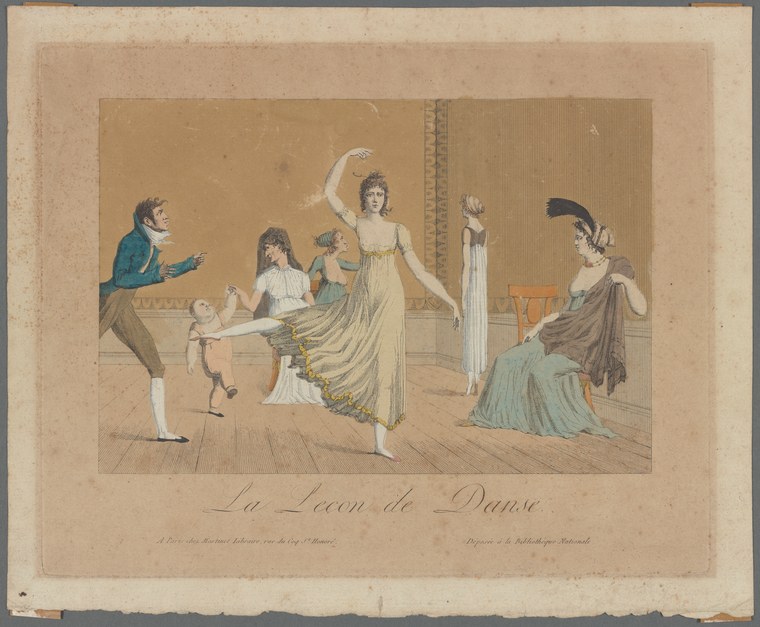
A dance lesson in progress in an interior space defined by neoclassical columns and wainscoting. A young male dancer in blue coat and white breeches executes a high lift of the leg, watched attentively by a female instructor in a high-waisted white gown who gestures upward with one arm in correction or encouragement. To her right, two young female students in white muslin dresses observe; one stands at ease, the other sits. A young child in light drapery watches from the center foreground. At the right margin, a female figure in a blue-green dress and feathered bonnet sits, possibly a parent or chaperone, and turns toward the scene. The wooden floor and spare furnishings emphasize the purpose-built teaching space. Warm daylight falls across the figures.
The dancing
The central male dancer rises on one leg in a controlled extension, thigh lifted high and turned out, demonstrating classical line. His upper body is upright, arms positioned in a restrained frame typical of academic dance training. The female instructor stands in a teaching posture—weight grounded, one arm raised pedagogically—and her elevated arm and forward lean suggest she is correcting or praising the extension. The observing students stand in contrapposto, their posture formal and composed. The seated figures maintain the decorum of witness.
The dance depicted
This depicts a private lesson in neoclassical or early Romantic ballet technique, likely from the early 19th century. The male dancer's lifted leg, turned-out hip position, upright carriage, and the instructor's authoritative pedagogical gesture all conform to the formal ballet vocabulary of this period. The private domestic setting—a music room rather than a theater or academy—and the presence of young female pupils alongside a teaching master suggests this was a common form of elite dance instruction among wealthy families. The title *La leçon de danse* (The Dance Lesson) is explicit.
How it was made
This is a hand-colored engraving or aquatint, characteristic of early 19th-century French print distribution. The refined stippling in the background, the careful parallel hatching in the drapery, and the selective hand-coloring of the figures against a neutral ground are typical of the medium. Such prints circulated widely among the educated middle and upper classes as both art objects and instructional documents. The technique allowed for rapid reproduction and dissemination—the fact that it survives in multiple copies in collections suggests it was commercially published.
About this work
This is a French instructional and aesthetic print documenting the teaching of ballet to young aristocratic or bourgeois students in a private domestic setting of the Regency or early Romantic era. The print serves a dual purpose: to celebrate dance as a refined accomplishment and to document the pedagogical methods by which it was transmitted. The scene is intimate and orderly, emphasizing discipline, observation, and the transmission of technique from master to pupil. Such prints were part of a broader visual culture around dance instruction and social accomplishment in early 19th-century Europe.
The work belongs here because it is explicit evidence of how ballet was taught, where it was taught, and who taught and learned it. The print preserves a specific pedagogical relationship—the correcting master and the observing pupils—that defines dance instruction to this day.
How to look at it
Attend first to the male dancer's lifted leg and the angle of his torso—the artist has chosen a moment of controlled extension that displays the discipline of academic training. Notice the instructor's raised arm: it is not merely decorative but pedagogically active, correcting or affirming the student's position. The composition frames the lesson as a solemn, orderly affair, not a social dance. The presence of the seated observer at right reminds us that even private lessons were semi-public, conducted before family members and social peers. The print values clarity and legibility: every figure's posture and role in the scene is unambiguous.
The artist
The artist is not recorded. The style, subject, and execution place this work within the tradition of French dance prints of the early 19th century, a period when publishing houses in Paris produced illustrated works on manners, accomplishments, and domestic life for a wide educated audience. The engraving's clarity and the sophistication of its composition suggest a commercial artist of competence working within an established genre.
The period
In the early 19th century, private dance lessons were a standard accomplishment for young people of means across Europe. Professional ballet was flourishing in the theater—the Romantic era had begun with works like *La Sylphide* (1832)—but most training remained private, conducted by itinerant or resident masters in homes, salons, and small academies. The neoclassical interior and the formal dress suggest this print dates to approximately 1810–1830, a moment when ballet technique was becoming codified and when dance instruction was increasingly documented in print. The print participates in a larger visual conversation about refinement, discipline, and the proper education of young women.
Where it lives
Held by the New York Public Library as part of its collection of prints depicting dance. Such prints were commercial products, widely distributed among middle and upper-class households and preserved in personal collections before entering institutional holdings.
Dance in this work
Questions about this work
Was this a real moment or an idealized scene?
Almost certainly idealized. The composition is too orderly, the light too perfect, the postures too composed. But the scene is rooted in actual practice: private lessons in domestic spaces were real, and the pedagogical relationship shown—instructor correcting a pupil before observing peers—reflects how dance was actually taught. The print documents a real social fact through an aestheticized image.
Who danced like this?
Wealthy young people, primarily women, though this print shows a male dancer. Dance instruction was part of upper-class socialization across Europe. Young women learned dance for social accomplishment and deportment; young men of status learned it for grace and social fluency. Professional dancers learned at academies, but this scene depicts a private household.
How do you know this is ballet and not another dance form?
The turned-out hip position, the lifted extension, the upright carriage, the interior setting, and the formal pedagogical relationship all point to academic ballet technique. The French title reinforces this: *danse* in this context refers to the classical ballet vocabulary that was becoming standardized across Europe in this period.
More dance artwork





