49 works in this view — arrow keys or swipe to move between them.
Dance in Art
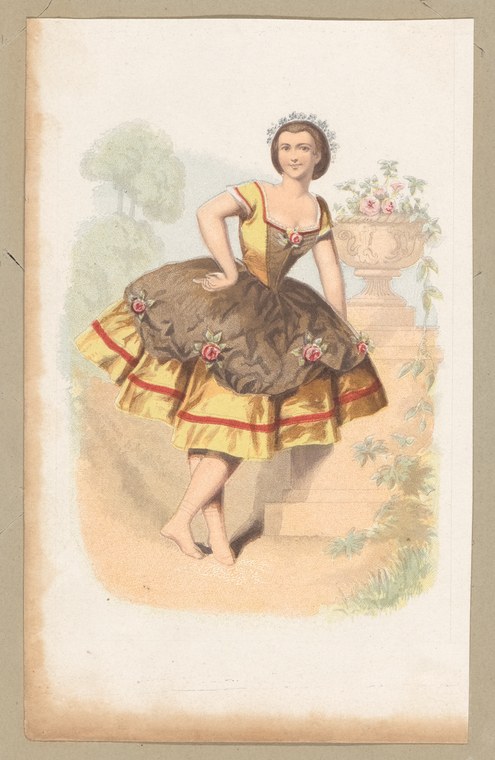
A ballerina in a folk costume
Unknown artist
- Collection:
- Prints depicting dance
- Source:
- New York Public Library
- Rights:
- Public domain — free to use, share and adapt.
- Recorded as:
- Public Domain
This image captures a crucial moment in ballet history when classical technique was being hybridized with folk, nationalist, and exotic themes—a transformation that shaped the Romantic repertoire and later modern ballet's appropriation of vernacular forms. The barefoot dancing is particularly significant: it predates by decades the modern dance movement's conscious rejection of the pointe shoe, suggesting alternative or non-academic dance practices circulated and were documented even within the classical theatrical world.
What you are looking at
A young woman in theatrical costume stands alone against a pale, atmospheric background, posed in a moment of dance or performance. She wears a yellow sleeveless bodice trimmed in brown, with a striking skirt of chocolate-brown fabric decorated with applied yellow ribbons arranged in horizontal bands. The skirt is voluminous and captured mid-movement, suggesting a spinning or lifting action. Her dark hair is styled close to her head with a small tiara or decorative circlet. She stands barefoot on one leg, the other lifted, in a pose of lift and extension. To the right of the figure, a classical stone urn overflowing with pink and red flowers anchors the domestic or garden setting. Pale trees suggested in the background complete a romantic, stage-like composition. The hand-coloured print, rendered in soft pastels, uses subtle gradations to create depth and a theatrical spotlight effect around the solitary figure.
The dancing
The dancer stands on a single supporting leg with the other leg raised, creating an arabesque or attitude line. Her upper body is slightly inclined, with one arm extended at the hip and the other positioned to support the pose. Her posture shows engagement and control, with the lifted leg and torso suggesting classical balletic training, though the position is not strictly formal. The body appears light and momentary, caught at the apex of a turn or lifting step.
The dance depicted
This appears to be a Romantic-era balletic image, likely from the mid-19th century, depicting a dancer in a folk-inspired theatrical costume rather than the classical pointe work associated with academic ballet proper. The fusion of ballet technique—the lifted leg, the arabesque-like line, the balletic carriage—with folk costume elements (the tiered skirt with applied ribbon decoration, the simple bodice) suggests this may document a character role or nationalist ballet from the period when European Romantic ballet was incorporating folk and exotic themes. The barefoot execution is notable and unusual for classical ballet of this era, suggesting either a deliberate artistic choice or documentation of non-classical dancing.
How it was made
This is a hand-coloured lithographic print, identifiable by the soft granulated texture, the translucent wash of pastel tones, and the pale, almost luminous quality of the paper. The artist has employed lithography's capacity for subtle tone modulation to create atmospheric depth and to emphasize the figure's theatrical presence against a hazy background. The hand-colouring—applied after the stone or plate—allows for the precise detail of the costume's yellow ribbons and the pink flowers while maintaining the soft, diffuse quality of the setting. This technique was standard for theatrical portraiture and dance documentation during the 19th century, indicating this was created for circulation among dance enthusiasts, theatre audiences, or collectors of theatrical memorabilia.
About this work
This hand-coloured lithographic print documents a mid-19th-century theatrical dancer in a Romantic-era folk-inspired costume, posed in a moment of balletic elevation. The work exemplifies the period's fascination with nationalist and folk-derived themes in ballet, translating traditional costume into a classical balletic frame. The barefoot execution and hybrid costume suggest either a character role within a larger ballet narrative or an experimental fusion of folk and theatrical dance forms. The print belongs within the history of theatrical dance documentation and the Romantic era's visual celebration of the dancer as romantic subject.
How to look at it
Notice the moment the artist has chosen: the dancer is suspended in a lifted position, one leg extended, caught between steps rather than in a stable pose. This captures the ephemeral, transcendent quality Romantic ballet prized. Observe how the costume—the tiered skirt with its bright yellow ribbons—dominates the composition, making the folk and theatrical identity of the figure unmistakable. The barefoot stance is the work's most provocative detail: attend to how it grounds the figure even as the pose emphasizes lift and ethereality. The classical urn and flowers anchor the dancer in a pastoral or domestic realm that contrasts with the theatricality of her posture and the precision of her line.
The period
The mid-to-late 19th century saw European Romantic ballet at its height, with choreographers like Marius Petipa and Jean Coralli incorporating nationalist, folk, and Orientalist themes into classical ballet narrative. This was also a period of intense theatrical documentation through lithographic prints, which were cheap, reproducible, and widely collected. The print medium allowed theatrical images to circulate far beyond theatre audiences, creating a mass visual culture of dance. The folk costume depicted here reflects the Romantic era's broader cultural investment in the 'authentic' or 'natural' as a counterpoint to industrial modernity—a paradox captured in the image's marriage of classical balletic technique with peasant dress.
Where it lives
The work is held in the New York Public Library's collection of theatrical and dance-related prints. It represents the kind of mass-produced, hand-coloured lithographic portrait that documented and promoted theatrical performers to mid-19th-century audiences, functioning as a form of theatrical publicity, fan memorabilia, and visual archive.
Dance in this work
Questions about this work
Why is the dancer barefoot?
Barefoot dancing in this period could indicate several practices: non-classical or folk-derived dance, an experimental artistic choice, or documentation of dancers working outside the strict academic ballet tradition. It predates by decades the modern dance movement's deliberate rejection of the pointe shoe, suggesting alternative dance forms circulated and were valued even during the height of classical ballet.
What does the folk costume tell us?
The hybrid costume—balletic carriage combined with tiered folk skirt and simple bodice—reflects the Romantic era's fascination with nationalist and peasant themes as subjects for theatrical ballet. European choreographers of the period frequently created 'character' roles using folk costume while requiring classical balletic technique, making this image a visual record of that aesthetic.
How was this image made and circulated?
This is a hand-coloured lithographic print, a standard method for theatrical portraiture in the 19th century. Lithography allowed cheap, reproducible images that circulated as fan memorabilia, theatrical publicity, and collected prints. This process was crucial in creating a mass visual culture of dance separate from the theatre itself.
More dance artwork





