49 works in this view — arrow keys or swipe to move between them.
Dance in Art
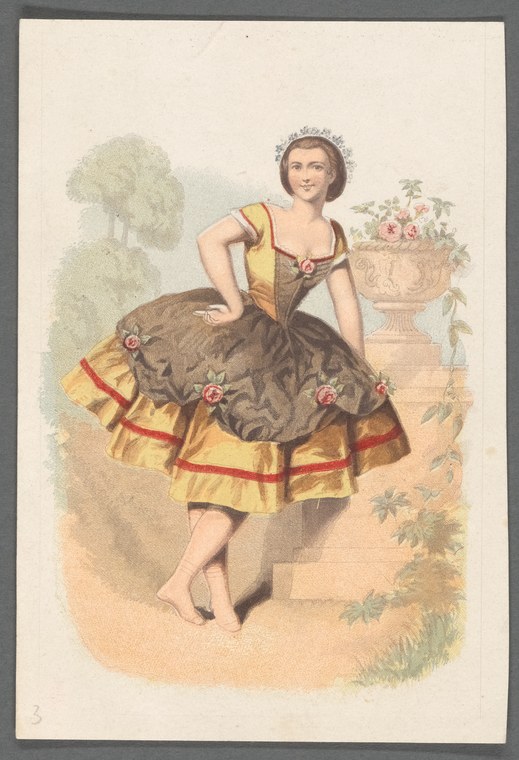
A ballerina in a folk costume
Unknown artist
- Collection:
- Prints depicting dance
- Source:
- New York Public Library
- Rights:
- Public domain — free to use, share and adapt.
- Recorded as:
- Public Domain
This image preserves the look of a dance form—character ballet and national dances—that dominated European stages but survives today only in written description and rare visual records. It shows that 19th-century dancers were not the ethereal, pointe-dancing classical ballerinas of later stereotype; they were also performers of comedic, folk-derived, sensual, and spectacular pieces. The print format tells us that dance was a visual commodity, marketed and reproduced in the way pop culture is today.
What you are looking at
A young woman in a yellow silk corset and elaborate skirt stands barefoot in a garden setting, her pose frozen mid-twirl. The skirt is striking: a dark damask or brocaded fabric with applied rosettes, bordered with bold horizontal stripes of yellow and red that fan out as the fabric lifts. She wears a tiara or coronet and gazes upward with a slight smile. Behind her, a classical stone urn overflows with pink roses; to the left, a pale green tree suggests a formal garden. The background is soft and atmospheric, rendered in muted tones. The composition is a three-quarter view against a shallow, undefined space, typical of theatrical costume plates of the 19th century.
The dancing
The dancer is alone, standing in a classical contrapposto with one leg engaged and the other bearing weight, the pose suggesting the moment just before or after a pirouette. Her arms are positioned expressively—one hand at her hip, the other extended or raised—in a pose of theatrical presentation rather than technical ballet position. The body is upright and elongated, with no visible strain; her face is composed and directed toward the viewer or upward. Her bare feet are small and pointed but do not suggest the fully articulated ankle and arch demanded by pointe work.
The dance depicted
This is almost certainly a romantic-era theatrical dance costume plate or promotional image, likely European and most probably from the mid-19th century. The style—a solo female dancer in an ornate folk or fantasy costume, depicted in a garden or pastoral setting—is consistent with the 'character' or 'national' dance craze that swept ballet stages from the 1830s onward. Dancers like Fanny Elssler made the cachucha (Spanish dance) famous; other performers built careers on Hungarian, Polish, and Alpine folk-inspired pieces. The dress here—the damask with applied ornaments and striped hem—suggests a stylized Central European or possibly Germanic folk costume rather than authentic peasant wear. The image documents both the performance and the fantasy aesthetic: the dancer is presented as an idealized, decorative figure rather than an athlete, and the garden setting emphasizes romance over technique.
How it was made
This is a hand-colored lithograph or engraving, characteristic of theatrical costume documentation from the 1840s–1870s. The soft tonal modeling, delicate shading, and subtle color gradations in the background suggest lithography, which allowed for broader dissemination than oil painting and was the standard medium for dance and theater promotion of the era. The hand coloring (visible in the variations and slight irregularities in the yellow and red tones of the skirt, the subtle gradations in skin tone, and the pink of the roses) indicates production as a commercial print for theater-goers, collectors of dance images, or dance masters seeking costume references. This was ephemera—beautiful but intended for circulation, not archive.
About this work
This is a costume plate documenting a solo theatrical dance in the romantic style, likely a character piece drawn from European folk tradition. The work captures the visual economy of 19th-century theater marketing: the dancer is presented as an ornamental figure, her beauty and costume equally important to any suggestion of virtuosity. The garden setting and theatrical pose place this firmly in the romantic-era dance world, when ballet had turned away from pure classicism toward narrative, exotic, and national subjects. As a printed object, it is evidence of how dance was consumed, remembered, and sold to a broad public in the pre-photographic era.
How to look at it
Notice the moment: the skirt is lifted, the legs are in motion or poised to move, but the dancer's gaze is calm and upward, as if she has paused for the viewer or the artist. This is not a snapshot but a rhetorical moment—the kind of pose a dancer would hold for a painter or that a theater director would approve as 'picturesque.' Observe how the costume dominates the composition: the skirt, with its striking color and pattern, occupies nearly half the frame. The artist is showing you both the dancer and the dress as equally important spectacle. The contrast between the soft, ethereal background and the precise, vivid costume reflects a key principle of romantic-era design: the dancer should stand out, legible and beautiful, against an atmospheric world.
The period
This print dates from the height of Romantic ballet, a period beginning around 1830 when the classical ballet of the court and early 19th century gave way to narrative, exotic, and folk-inspired works. Marie Taglioni, Fanny Elssler, Carlotta Grisi, and others became international stars, and their images were mass-produced and collected. The 1830s–1860s saw an explosion of dance prints: lithographs and hand-colored engravings sold in theaters, distributed to wealthy patrons, and gathered into albums. The damask and rose ornaments in this image reflect the period's taste for Oriental, Polish, and Iberian exoticism—a moment when European culture was consuming 'national' and 'peasant' aesthetics as stage material. The garden setting echoes the pastoral fantasies of Romantic literature and visual art; the bare feet suggest both classical allusion and a kind of artful informality that contrasted with the rigid formality of earlier court dance.
Where it lives
This print is held in the New York Public Library's collection of dance-related prints and engravings. Such collections were assembled in the late 19th and early 20th centuries as cultural institutions recognized the historical and artistic value of ephemeral dance documentation. The print's original circulation was likely as a theater souvenir or a trade card—affordable, reproducible, and distributed to a wide audience.
Dance in this work
Questions about this work
Who was the dancer in this picture?
The catalogue record does not identify the performer or the specific dance. The costume and style suggest a professional European ballerina of the mid-19th century performing a character piece—a folk-inspired or exotic dance—but without a signature, inscription, or caption, we cannot name her. Many such prints were produced without clear attribution.
What is she dancing?
The costume—stylized Central European or Alpine folk dress—suggests a character dance of the romantic era, possibly a Hungarian, Polish, or German-inspired piece. These dances were popular on European stages from the 1830s onward but are now rarely performed in their original form. The image shows the costume and aesthetic ideal rather than the actual steps or structure of the dance.
Why is she barefoot?
Bare feet served multiple purposes in romantic-era dance: they evoked classical antiquity (suggesting that the dance had artistic legitimacy), they allowed the dancer to move freely and expressively in the softer 'character' idiom that was distinct from classical ballet, and they were a marker of exoticism or 'naturalness' in a costumed fantasy. Pointe shoes had not yet become standard even for classical ballet roles in the 1830s–1840s.
Is this a real folk costume?
No. While it borrows elements from Central European dress—the embroidered damask, the cut, the colors—it is a theatrical fantasy. The applied rosettes, the shocking red and yellow striped hem, and the overall silhouette are designed to be beautiful, legible, and striking from a distance on stage. Theater costumes were always stylized, not documentary.
More dance artwork





