49 works in this view — arrow keys or swipe to move between them.
Dance in Art
Dancers on music covers
Unknown artist
- Collection:
- Prints depicting dance
- Source:
- New York Public Library
- Rights:
- Public domain — free to use, share and adapt.
- Recorded as:
- Public Domain
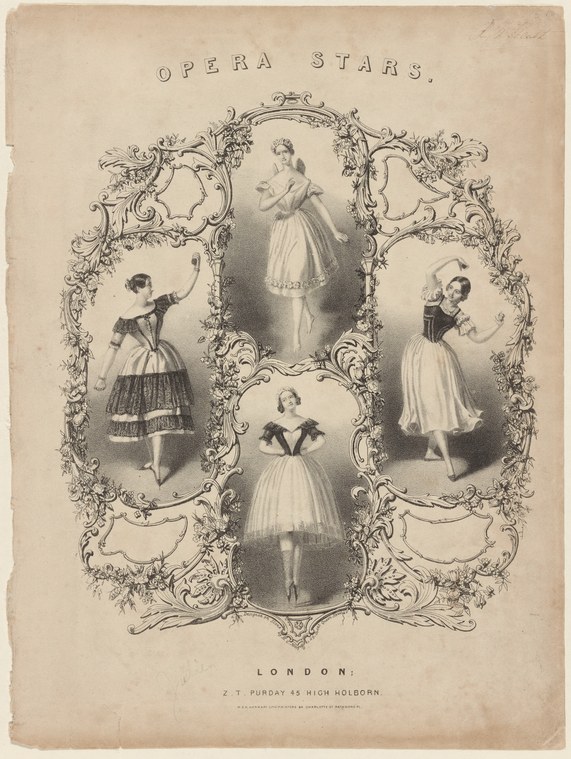
This image captures the visual language that made ballet a dominant form in nineteenth-century European entertainment, and shows how that language was commodified and circulated through popular prints. For dance historians, it documents the aesthetic standards and body ideals of romantic ballet as they reached beyond the theater into homes and music halls. For artists and engravers, it exemplifies the technical virtuosity expected of commercial theatrical illustration.
What you are looking at
This is a decorative engraving, likely a music cover or theatrical advertisement, titled "Opera Stars" and published in London by J. Purday. Five female dancers are arranged within an elaborate rococo frame of intertwining vines, flowers, and scrollwork. The central figure stands alone at the top in a pose of classical grace, wearing a pale tutu and pointe shoes, with one arm raised. Four additional dancers occupy the corners and sides of the composition: two on the left and right in three-quarter poses wearing darker bodices with pale skirts, and one at the bottom center in a similar costume. All five figures are rendered in fine detail against a plain background, their poses suggesting the refined, ethereal quality of mid-nineteenth-century ballet. The ornamental border itself is as prominent as the figures, with its classical scrolls, flowers, and ribbon-like forms characteristic of the period's decorative vocabulary.
The dancing
All five dancers are depicted in turned-out positions with extended limbs and elongated silhouettes. The central figure displays the classical upright carriage and raised arm position of romantic-era ballet. The four surrounding figures adopt varied poses—some standing in near-profile with arms aloft, others in quarter-turns—but all maintain the characteristic lifted, weightless bearing of the period. The dancers' bodies show the straight line from neck to supporting foot that defines pointe work. Their costuming is consistent: fitted bodices (some dark, some light) paired with bell-shaped tutus falling to mid-calf, with pale stockings and heeled pointe shoes. The poses suggest a vocabulary of classical positions rather than a narrative moment.
The dance depicted
This engraving depicts romantic-era ballet as it would have been known to London theatregoers in the mid-nineteenth century, likely celebrating celebrated opera and ballet stars of the day. The tulle skirts, pointe shoes, and ethereal poses are unmistakable markers of theatrical ballet of the 1840s–1860s, the heyday of romantic ballet in European theaters. The composition presents ideal types rather than a staged scene—a celebration of the ballerina as the central figure of operatic entertainment. The image captures the period's elevation of the ballerina to near-supernatural status, emphasizing verticality, refinement, and otherworldly grace.
How it was made
This is a wood or steel engraving, hand-colored or printed in monochrome tones, rendered in the high-detail style that characterized mid-nineteenth-century commercial music covers and theater ephemera. The fine cross-hatching visible in the background and the precise linear rendering of anatomical detail are typical of engraving rather than lithography. The decorative border is executed with the same precision, suggesting a professional commercial engraver working for a London publisher. This technique allowed for mass production and wide circulation to theaters, opera houses, and middle-class homes.
About this work
This work is a commercial engraving celebrating the operatic ballet stars of mid-nineteenth-century London. It functions as both a music cover (given the title and publisher) and a cultural document of ballet's emergence as a major draw in Victorian entertainment. The image distills the aesthetic principles of romantic ballet into five idealized figures: the ethereal, elongated silhouette; the emphasis on verticality and weightlessness; the refined costuming; the classical poses. It belongs in the gallery as evidence of how ballet was understood and marketed to the Victorian public—as an art form of spectacular physical refinement and aspiration.
How to look at it
Attend to the five poses individually and notice how each dancer occupies a different moment in the classical vocabulary—not a single frozen moment of choreography, but a catalog of achievable ideals. The central figure is the primary focus; note how the border curves around her, framing her as the apex. The ornamental border is not merely decorative: it elevates these dancers to the status of fine art, borrowing the aesthetic vocabulary of rococo design to lend them classical pedigree. The consistency of costume across all five figures reinforces a period aesthetic rather than individual characterization.
The period
This work dates to the mid-nineteenth century, when ballet had become the reigning spectacle of European opera houses, particularly in London and Paris. The romantic ballet movement (c. 1830–1870) established conventions of costume, movement vocabulary, and narrative that endured for over a century: the ethereal ballerina on pointe, the white tutu, the narrative of loss and longing. This engraving was produced during the height of that movement, when individual ballerinas—notably Marie Taglioni, Fanny Elsslér, and Carlotta Grisi—had become celebrities whose images were mass-produced and collected. The Victorian music cover industry created a vast circulation of such images, making ballet visual culture accessible far beyond theater-goers.
Where it lives
This engraving is held in the New York Public Library's Prints collection, classified under "Prints depicting dance." It functions as commercial ephemera—a music cover or theatrical advertisement—that crossed the boundary between disposable popular culture and preserved historical record.
Dance in this work
Questions about this work
Who are these dancers?
The engraving does not identify individual dancers by name, though the title "Opera Stars" suggests they represent celebrated performers of the mid-nineteenth-century London and continental ballet scene. The image is a generic celebration of the ballerina type rather than a portrait of specific individuals.
Is this a scene from a ballet?
No. The five poses represent idealized classical positions rather than a choreographed moment. This is an advertisement or celebration of ballet as a form, not a representation of any specific ballet's narrative or steps.
Why are all the dancers on pointe?
Pointe work was the defining visual marker of romantic-era ballet by the 1840s–1850s. It signaled technical mastery, refinement, and the dancer's transformation into an otherworldly being—a key aesthetic of the period.
What is the rococo border doing there?
The ornamental frame borrows the visual language of eighteenth-century high art and decoration, elevating the ballerinas to the status of classical subjects. This framing strategy was common in mid-nineteenth-century theater ephemera, claiming legitimacy and cultural prestige for commercial entertainment.
More dance artwork





