49 works in this view — arrow keys or swipe to move between them.
Dance in Art
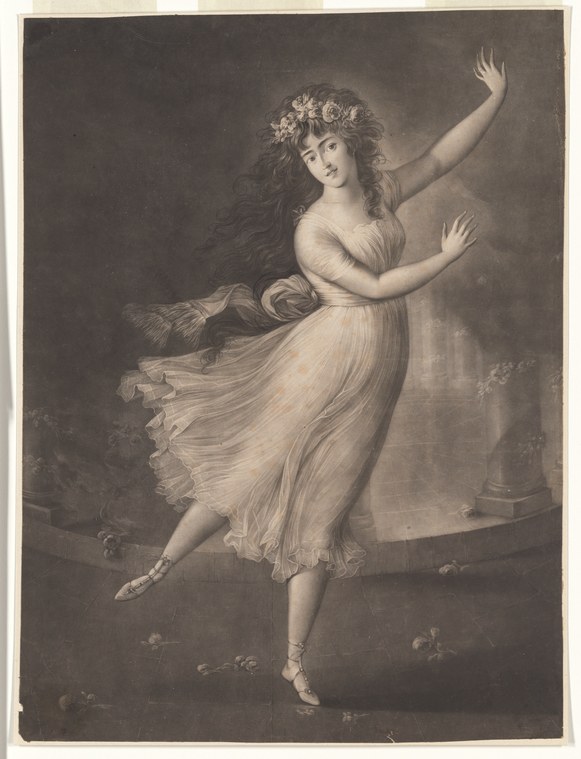
Madme Viganò
Unknown artist
- Collection:
- Prints depicting dance
- Source:
- New York Public Library
- Rights:
- Public domain — free to use, share and adapt.
- Recorded as:
- Public Domain
This is visual evidence of how Romantic ballet was performed and understood at its moment of emergence—the specific costume, the exact pose, the lighting design all convey an artistic vision. For historians of theater and dance, the image is also a record of a named performer whose work might otherwise be lost to time; the title suggests she was famous enough to be published, making this a primary source on the dancers who shaped the early history of European ballet.
What you are looking at
A solo female dancer in a flowing, diaphanous white or cream-colored gown dominates this neoclassical engraving. She is captured mid-movement, one arm raised high and curved gracefully while the other extends outward, her body angled in a dynamic contrapposto pose. Her long, loosely curled hair is crowned with flowers, and delicate ballet pointe shoes are visible at her feet. The skirt, rendered with fine parallel lines that suggest the transparency and movement of silk or muslin, billows around her legs as if caught in the moment of a turn or leap. The background is austere and darkened, with only the suggestion of classical architectural elements—a portion of what appears to be a column or pilaster—to establish a theatrical or temple-like setting. The lighting is soft and directed, emphasizing the pale figure against the shadow, a technique typical of late 18th-century printmaking.
The dancing
The dancer's body weight appears poised on or just leaving the supporting leg, with the working leg extended or lifted to create an elongated line. Her arms are raised to approximately shoulder height and above, creating an open, expansive frame characteristic of classical ballet port de bras. The upper body is lifted and turned slightly, suggesting a moment of elevation or sustained balance. Her posture demonstrates the lifted, weightless quality that neoclassical ballet aesthetics prized—the torso elongated, the carriage aristocratic, and the overall impression one of effortless grace rather than visible effort.
The dance depicted
This appears to be a portrait of a professional dancer, most likely a ballerina of the Romantic era or late 18th-century neoclassical period, captured in a characteristic pose of that tradition. The title 'Madme Viganò' suggests this may document a specific celebrated performer, likely a member of the renowned Viganò family of dancers and choreographers. The style of the dress, the pointe work, and the ethereal, uplifted aesthetic all point to Romantic ballet as it was emerging in the late 1700s and early 1800s. The pose itself—arms raised, body extended, elevated on the points of the feet—was a signature moment in the ballet vocabulary of this period, one that emphasized the illusion of weightlessness and otherworldly grace that became the hallmark of Romantic ballerinas.
How it was made
This is an engraving, executed in fine lines with careful attention to tonal gradation. The technique allowed for wide distribution of the image; multiple impressions could be pulled from the plate, making it an affordable way for theaters, dance enthusiasts, and collectors to own portraits of celebrated performers. The use of parallel lines (hatching and cross-hatching) to render tone, particularly visible in the rendering of the skirt and the background shadow, is characteristic of 18th-century engraving practice. The quality of the line work and the sophistication of the composition suggest this was a professional print, likely issued by or for a major theater or print publisher.
About this work
This engraving documents a moment in the history of professional dance: a named female performer, almost certainly a star of the Italian or European stage, preserved in a pose that became iconic of Romantic ballet aesthetics. The image celebrates both the technical achievement of the dancer—her apparent weightlessness, the precision of her pointe work, the control of her frame—and the theatrical fantasy she embodied. It belongs in the archive of dance imagery because it captures not just a figure but an entire aesthetic philosophy: the late 18th-century conviction that ballet could transcend the body and approach the sublime. The print format itself testifies to the celebrity of the performer and the commercial appetite for images of famous dancers.
How to look at it
Attend to the moment the artist chose to freeze: not a static pose, but the instant of maximum extension, where the dancer appears to hover between moments. Note the contrast between the soft, naturalistic rendering of the face and the more abstract, linear treatment of the skirt—a choice that emphasizes the dancer's humanity while allowing her drapery to suggest movement and ethereal quality. The placement of the figure off-center and the use of deep shadow to frame her create an intimate, almost devotional quality. The carefully rendered pointe shoes, visible at the base of the composition, are a technical detail that grounds the fantasy in actual bodily skill.
The artist
The artist is unrecorded in the catalogue. However, the print's quality and execution suggest a professional engraver working for a major theater, publisher, or print house in the late 18th or early 19th century. The style is consistent with neoclassical theatrical portraiture of the period, a genre in which engravers recorded performances and celebrated dancers for the entertainment and edification of the public.
The period
This engraving dates to a transformative moment in European dance and visual culture. The late 1700s saw the rise of Romantic ballet, a movement that privileged ethereal grace, narrative fantasy, and the illusion of weightlessness over the formal courtly elegance of baroque and rococo styles. At the same time, the democratization of print culture meant that images of theatrical celebrities could circulate widely, creating a new kind of public fandom. The Italian Viganò family were among the most celebrated dancers and choreographers of this era; any member of that family would have been a subject worthy of professional engraving and distribution. The image itself reflects the neoclassical aesthetic that dominated visual arts in this period, even as Romanticism was reshaping ballet and theater.
Where it lives
This print is held in the New York Public Library's collection of prints depicting dance. It is part of a broader documentary archive of theatrical imagery from the 18th and 19th centuries, a period when printmaking was the primary medium for circulating images of performers and creating a visual record of theatrical and balletic achievement.
Dance in this work
Questions about this work
Who was Madame Viganò?
The catalogue record does not identify which member of the Viganò family this engraving portrays. The Viganòs were an influential Italian family of dancers, choreographers, and theater directors active from the late 1700s onward. Any of them would have been celebrated enough to merit a professional engraved portrait. Without additional documentation, we cannot determine which Viganò this is, but the style and technique suggest she was a significant dancer of the late 18th or early 19th century.
Is this a portrait of a real performance or an idealized image?
Likely both. Theatrical engravings of this period often depicted named performers in characteristic or famous poses—ones the dancer was known for executing in actual performances—but the image was usually stylized and idealized. The neoclassical engraver would have heightened the grace and ethereality, softened the face, and rendered the fabric in ways that enhanced the fantasy. This image documents the theatrical tradition and the dancer's celebrity as much as any specific moment.
What are the pointe shoes visible in this image?
Pointe work—dancing on the tips of the toes—was emerging as a technique during this period, though it would not become the standard in ballet until later in the 19th century. The fact that the artist depicted the dancer on pointe suggests this was a notable technical achievement of the Romantic era, and that Madame Viganò was skilled in this demanding technique.
More dance artwork





