49 works in this view — arrow keys or swipe to move between them.
Dance in Art
Rôle de Jenny dans le ballet de Jenny
Unknown artist
- Collection:
- Prints depicting dance
- Source:
- New York Public Library
- Rights:
- Public domain — free to use, share and adapt.
- Recorded as:
- Public Domain
Prints like this were the social media of 19th-century dance: they circulated widely, shaped public understanding of ballet, and documented specific performers and roles that might otherwise be lost to history. The image provides material evidence of Romantic ballet costuming, the dancer's stance and use of turned-out positions, and the kinds of narrative roles—particularly relationships between adult and child characters—that were central to the ballet of this period.
What you are looking at
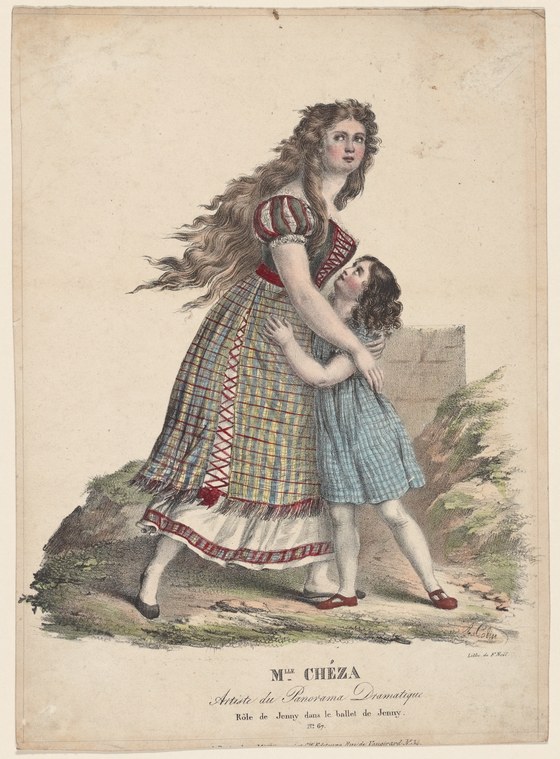
A young woman with long, flowing dark hair stands in three-quarter profile facing left, her body angled dynamically as if caught mid-movement. She wears a striking costume: a burgundy and white striped short-sleeved bodice with puffed sleeves, and a full skirt of plaid fabric in grey-green and burgundy with a deep burgundy border trim. The skirt is lifted or swirling, revealing white stockings and red heeled shoes. A younger child, dressed in a pale blue dress, stands beside and slightly behind her, clutching at the woman's skirt or waist in a pose suggesting playful interaction or a moment of theatrical narrative. The figures are set on rocky, sparse ground with minimal landscape detail—just a few scattered stones and hints of vegetation. The background is plain and neutral, emphasizing the figures. The hand-colored print technique is evident in the delicate watercolor washes defining form and fabric pattern.
The dancing
The principal figure's pose is one of arrested motion: weight shifted, torso rotated, the body's line suggesting a pivot or turn. Her left arm extends naturally, the right is less visible but appears to support the lifted skirt. The child below reaches upward in a gesture that reads as both affectionate and dependent, establishing a clear hierarchical and emotional relationship between the two. The woman's gaze is directed away from the child, upward and to the side, creating a sense of theatrical focus—she is not acknowledging the child's gesture directly, which heightens the narrative quality of the moment. Neither figure is in a closed ballroom hold or symmetrical partner frame; this is a theatrical rather than social dance encounter.
The dance depicted
This is a theatrical dance scene from Romantic-era ballet, likely from the 1830s–1840s based on the costume, print style, and the inscription identifying the work as a role performed by a dancer named Jenny. The costume—short ballet skirt, puffed sleeves, heeled shoes—and the fluid, turned-out stance all point to classical ballet of the Romantic period. The relationship between the adult dancer and the child figure suggests a narrative ballet, possibly a scene involving a fairy, spirit, or mother figure with a mortal child, though the specific ballet cannot be determined from the image alone. The dynamic pose captures a moment of theatrical storytelling rather than technique display.
How it was made
This is a hand-colored engraving or lithograph from the 19th century—the fine linear work in the drapery, the hair, and the ground are consistent with engraving, while the soft coloring in blues, greens, burgundies, and flesh tones is characteristic of hand-applied watercolor wash typical of prints intended for the popular market. The technique allowed for mass production of theatrical images for sale to ballet enthusiasts and the general public. The inscription at the base includes the title and performer's name, identifying this as a souvenir print of a specific performed role—a common format for distributing dance imagery before photography became dominant.
About this work
This is a hand-colored theatrical print documenting a Romantic-era ballet role danced by an artist named Jenny, rendered in the engraving or lithographic technique standard for 19th-century dance promotion. The image captures not a technique or ballroom convention, but a narrative moment: a woman in classical ballet dress in dynamic, turned-out stance interacting with a child figure, frozen at the instant of theatrical storytelling. The work belongs in a dance gallery as a primary document of how Romantic ballet was performed, promoted, and consumed—a record not of technique in isolation but of costume, character, narrative, and the relationship between dancers that defined the theatrical dance of its era.
How to look at it
Notice the woman's upward gaze and the turn of her head away from the child—the artist has chosen to emphasize her role as a character, not merely as a technical performer. The costume details—the puffed sleeves, the plaid pattern, the precise border trim—are rendered with clarity, suggesting that the visual distinctiveness of the costume was essential to the role's identity. The child's upward reach and the way the woman's skirt responds to or frames this interaction suggest a staged narrative moment, not a demonstration of steps or technique. This is a record of theatrical character and story, captured for an audience who knew the ballet and wanted to remember it.
The artist
The artist is not recorded in the catalogue. The signature or initials visible on the print (if any) have not been transcribed in the available data. The work is consistent with the output of commercial print workshops that specialized in theatrical imagery during the 1830s–1840s, when such prints were a profitable and popular business in European cities.
The period
The Romantic ballet era (roughly 1830–1850) transformed theatrical dance in Europe: it emphasized ethereal, otherworldly themes, supernatural characters, and pointe work; it celebrated the female dancer as the primary focus; and it created a hungry market for promotional and souvenir imagery. Prints were distributed in theater lobbies, sold by street vendors, and collected by devoted ballet-goers. This print sits within that commercial and aesthetic context, capturing the moment when ballet was not primarily an aristocratic court practice but a public theatrical form with a devoted audience.
Where it lives
This work is held in the New York Public Library's collection of prints depicting dance. It belongs within the category of 19th-century theatrical promotional and souvenir prints, a common genre that was produced and distributed in large quantities during the height of Romantic ballet.
Dance in this work
Questions about this work
Was this print made during the performance or after?
The image shows all the hallmarks of a souvenir print made to commemorate and sell the performance—the theatrical pose, the named performer in the inscription, the commercial printing technique. It was likely engraved or lithographed shortly after the role's premiere or during its run, to capitalize on public interest while the role was still topical.
What does the child represent in this scene?
Without identifying the specific ballet, we cannot say with certainty. In Romantic-era ballet, children often represented mortal or innocent figures in contrast to supernatural adult characters, or they were used in narrative scenes to heighten emotional content. The child's dependent gesture and the woman's displaced gaze suggest a theatrical relationship—affection, protection, or enchantment—rather than a casual interaction.
Why is the dancer's posture so turned-out and vertical?
This stance reflects the classical ballet training and aesthetic of the Romantic period, where turned-out legs, an upright spine, and an ethereal carriage were central to the technique and the visual ideal. The artist has frozen the dancer in a pose that demonstrates both her technical training and her role's character.
Who was Jenny?
The catalogue record does not identify which Jenny performed this role, and without additional research, we cannot establish her identity from the print alone. Several notable dancers named Jenny performed in European ballet during the 1830s–1840s; the inscription should guide research but is not enough to confirm identity.
More dance artwork





