49 works in this view — arrow keys or swipe to move between them.
Dance in Art
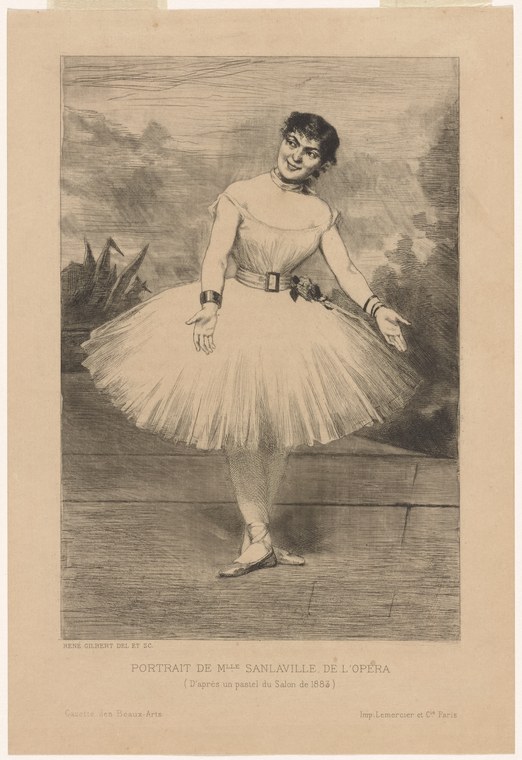
Portrait de Mlle. Sanlaville, de l'opéra (d'après un pastel du salon de 1883)
Unknown artist
- Collection:
- Prints depicting dance
- Source:
- New York Public Library
- Rights:
- Public domain — free to use, share and adapt.
- Recorded as:
- Public Domain
This is a documented portrait of a named performer from the Paris Opéra during the height of the Romantic ballet tradition in Europe, making it a primary visual record of professional ballet identity and costume at a specific historical moment. For dancers and teachers, it provides precise visual evidence of how late 19th-century classical ballet dancers presented themselves professionally and how their bodies and costumes were aestheticized in fine art.
What you are looking at
A young woman in a classical ballet costume stands in a three-quarter pose against a loosely sketched interior setting. She wears a short tulle skirt (tutu) in the Romantic style, a fitted bodice with short sleeves, and pointe shoes; her dark hair is pulled back in the fashion of the 1880s. She holds her arms in a relaxed, natural position—her right arm extended downward and slightly forward, her left arm at her side—and gazes toward the viewer with a composed, professional expression. The setting is minimal: behind her, a few architectural lines suggest a stage interior or rehearsal space, with some foliage or set dressing sketched at the upper left. The entire composition is rendered in fine linear etching or engraving, with careful tonal modeling to define the folds of the tutu and the contours of her body.
The dancing
A single ballet dancer is shown in a standing pose, not in mid-movement but in a relaxed professional stance—weight distributed evenly, torso upright, legs extended in a neutral frame. Her arms are softly positioned rather than held in a formal ballet port de bras, suggesting a moment between phrases or a studied portrait attitude. The artist demonstrates clear understanding of the ballet body: the posture is elongated, the proportions accurate, and the pointe shoes are rendered with specificity. Her gaze is direct and her expression serious, in keeping with the professional portrait convention of the period.
The dance depicted
This is a portrait of a professional ballet dancer—Mlle. Sanlaville of the Opéra (the Paris Opéra)—rendered as a theatrical portrait rather than as action. The tutu, pointe shoes, and bodice identify her unmistakably as a classical ballet dancer of the Romantic or late Classical tradition. The image does not show her dancing but rather presents her as a professional performer at rest, a convention common in theatrical portraiture of the era. The notation that this is drawn 'after a pastel from the 1883 Salon' indicates the work reproduces an earlier, celebrated portrait study; it is documentation of a known dancer's professional image rather than a narrative scene.
How it was made
This is a line engraving or fine etching, as indicated by the delicate parallel hatching and the clear linear definition of form throughout. The technique allows for fine gradation of tone and precise rendering of textile surface—the tutu's gossamer quality is conveyed through careful stippling and parallel lines rather than solid areas of tone. The print medium suggests this was a reproducible image, likely published as a print for theatrical circulation or the art market; the inscription at the base confirms it reproduced an earlier artwork shown at the 1883 Salon, placing it in the tradition of reproductive prints that documented notable salon paintings for wider audiences.
About this work
This is a theatrical portrait print of Mlle. Sanlaville, a professional ballet dancer at the Paris Opéra, reproduced in fine engraving from a pastel portrait exhibited at the 1883 Salon. It belongs to a rich tradition of theatrical portraiture—images of named performers in their professional dress, intended both as documentation of celebrated artists and as commodities for the art-consuming public. The work captures the professional self-presentation of a late 19th-century ballet dancer: the precision of her costume, her composed bearing, and her direct engagement with the viewer establish her as a celebrated performer worthy of fine art reproduction.
The image is valuable to dance historians as visual evidence of professional ballet costume and presentation in the 1880s, and as a named record of a performer in the Paris Opéra hierarchy. It also exemplifies how the reproductive print tradition made theatrical personalities visible across a wide social range, transforming individual dancers into recognizable professional types.
How to look at it
Attend to the precision of the costume details—the cut of the tutu, the precise rendering of the pointe shoe, the fit of the bodice—as evidence that the artist and the Salon audience understood the technical requirements of the art form. Notice how the dancer's pose is neither active nor theatrical but rather a composed professional stance; this reflects a portrait convention in which the performer is presented as a refined individual, not merely as a body in motion. The steady gaze and composed expression signal her status as a named professional artist rather than as an anonymous dancer, making this fundamentally a portrait of a person who dances rather than a genre scene of dancing.
The period
This portrait was created in the early 1880s or shortly after, a period when the Paris Opéra ballet tradition was undergoing transformation. The 1870s and 1880s saw a gradual shift from the pure Romantic aesthetic toward more dramatic, often exotic narratives; classical technique remained paramount, but the ethereal, otherworldly quality of mid-century Romanticism was increasingly hybridized with orientalist and naturalistic themes. The Salon exhibition of 1883 in which the original pastel appeared was a major venue for theatrical portraiture; such works circulated as both art objects and professional commodities, allowing ballet dancers and other performers to establish visual presence beyond their nightly performances.
Where it lives
This work is held in the New York Public Library's collection of prints depicting dance. The inscription indicates it is a reproductive print made after a pastel portrait of the same subject shown in the 1883 Salon, placing it within the tradition of salon-based reproductive printmaking that circulated images of celebrated performers.
Dance in this work
Questions about this work
Who was Mlle. Sanlaville?
The print identifies her as a dancer of the Paris Opéra, but little is now widely known of her individual career. She was prominent enough in the 1880s to have her portrait painted in pastel and exhibited at the official Salon, a mark of professional distinction. This reproductive print is one of the primary surviving visual records of her professional image.
Why is she not actually dancing?
This is a professional portrait, not a narrative scene. The convention of theatrical portraiture in the 19th century was to present the performer in costume but in a composed, neutral stance, emphasizing their identity and professional status rather than their performance. It is a portrait of a dancer, not a depiction of the act of dancing.
What does her costume tell us?
The short tutu, fitted bodice, short sleeves, and pointe shoes identify her as a classical ballet dancer working in the late Romantic or early modern classical tradition. The style and cut suggest the 1880s aesthetic—the tutu is shorter and fuller than mid-century Romantic tutus, and the overall silhouette is more austere, reflecting evolving taste in the period.
More dance artwork





