49 works in this view — arrow keys or swipe to move between them.
Dance in Art
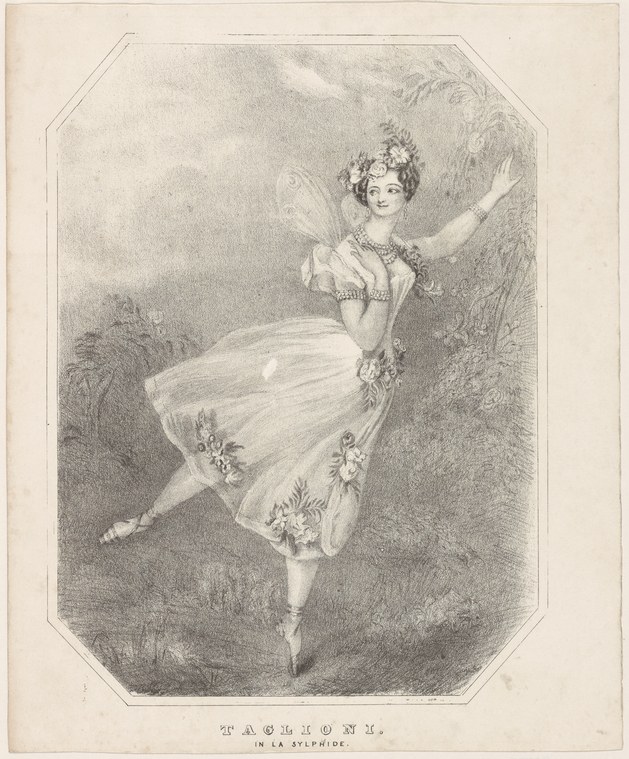
Taglioni in La sylphide
Unknown artist
- Collection:
- Prints depicting dance
- Source:
- New York Public Library
- Rights:
- Public domain — free to use, share and adapt.
- Recorded as:
- Public Domain
Marie Taglioni's interpretation of the Sylphide role revolutionized ballet by making weightlessness and ethereal quality central to the art form itself, and this engraving is a direct record of that visual transformation. For dancers and historians, it is evidence of how Romantic ballet actually looked in motion—not an abstraction, but a frozen moment of a specific choreography performed by the dancer most responsible for defining the style.
What you are looking at
A young woman in a romantic-era ballet costume stands center stage, caught in a moment of ethereal suspension. She wears a fitted bodice with off-shoulder sleeves and a gauzy skirt decorated with clusters of flowers at the hem, a signature silhouette of 1830s Romantic ballet. Her posture is buoyant—left leg extended behind her in an elegant line, right arm raised with graceful extension, gaze upward—creating an impression of weightless flight. The setting is indistinct but atmospheric, rendered in soft pencil tones that fade into shadow around the figure, giving the composition an ethereal, dreamlike quality. The engraver has used fine parallel hatching to model form and suggest the translucent quality of the tulle skirt. The image is framed within a beveled rectangular border, a standard format for theatrical prints of the period.
The dancing
A single female dancer is depicted in an attitude of aspiration and weightlessness. Her supporting leg is extended straight behind her in a line that emphasizes height and verticality; her torso is upright but tilted slightly forward as if caught mid-leap; her upper arm and hand reach upward in a gesture suggesting escape or transcendence. The bare neck and off-shoulder costume amplify the focus on the line of the extended limbs. The pose reads as a frozen moment of elevation—not a standing pose, but a point in the trajectory of flight.
The dance depicted
This is almost certainly Marie Taglioni performing the title role of *La Sylphide*, the canonical Romantic ballet that premiered in Paris in 1832 and became the vehicle for Taglioni's international fame. The sylph character is a weightless spirit being, and the ballet's aesthetic—pointe work, effortless elevation, ethereal costuming—became synonymous with Romantic ballet itself. The pose depicted here is consistent with the vocabulary of the period: an attitude or arabesque performed at height, designed to convey supernatural grace rather than earthly physicality. Taglioni was famously the first to use pointe shoes extensively as a narrative tool rather than a technical novelty, and this image captures the visual ideal that justified that innovation.
How it was made
This is a steel or copper engraving, executed with fine parallel hatching to create tonal gradation. The medium allowed for precise reproduction and wide distribution to print collectors and opera enthusiasts; the beveled border frame indicates it was issued as a finished print for sale, likely priced for a middle-class audience interested in theatrical portraiture. The soft handling of the background—nebulous shadow suggesting stage lighting—and the crisp delineation of the figure itself are characteristic of mid-19th-century theatrical engraving. The technique could capture the delicate articulation of the costume and the linear elegance of the extended pose.
About this work
This is a theatrical portrait engraving of a Romantic-era ballerina in the iconic role that defined an era. It records a specific moment of choreography—a leap or elevation—and a specific star performer at the height of her fame. The work is a primary document of how the ballet world understood and celebrated Romantic ballet aesthetics: weightlessness, verticality, spiritual transcendence achieved through the female body. As a mass-produced engraving, it also shows how theatrical celebrity functioned in the 19th century, with prints distributed to fans across Europe and beyond, making Taglioni's image as famous as her performances. The image sits at the intersection of dance history, art history, and the history of print culture.
How to look at it
Notice the upward tilt of the face and the extension of the arm toward an unseen height—the artist has frozen a moment of aspiration and lift, not a static pose. The lightness of the surrounding shadow and the ethereal rendering of the tulle emphasize the immateriality of the figure; she does not seem to rest on the stage floor. Pay attention to the line created by the extended leg and the curve of the back: Romantic ballet prized the continuous, arching line of the female body in elevation, and this engraver has captured that ideal precisely. The off-shoulder bodice and flower-trimmed hem are not decorative: they are the visual language through which Romantic ballet signified femininity and the supernatural.
The artist
The engraver is not recorded in the catalogue, but the work's high finish and distribution suggest it was produced by a professional shop in Paris or London working from a life study, photograph, or earlier sketch. Theatrical engraving was a major commercial enterprise in the 1830s–1850s, and prints of famous dancers were marketed as souvenirs and collector's items. The unsigned status is typical for reproductive prints of this period, where the engraver's labor was collaborative and anonymous.
The period
This print dates to the height of the Romantic ballet movement (c. 1830–1850), when ballet became dominated by supernatural and exotic female characters—sylphs, ondines, gypsy maidens—and when the female dancer became the unquestioned center of the theatrical spectacle. Marie Taglioni's debut in *La Sylphide* in 1832 coincided with the artistic and social ascendancy of Romanticism itself, with its emphasis on the otherworldly, the passionate, and the irrational. The promotion of ballet through theatrical prints and the cultivation of the male gaze as the defining mode of ballet spectatorship both intensified during this period. The engraving format was the dominant technology for theatrical reproduction before photography became economically viable for illustration.
Where it lives
The print is held in the New York Public Library's collection of theatrical and dance prints. It exists as a finished, independently distributed engraving—a commodity object intended for public sale to opera enthusiasts and theater-goers, not a unique work of art or a private commission.
Dance in this work
Questions about this work
Is this definitely Marie Taglioni?
The title cartouche identifies the subject as Taglioni in *La Sylphide*, and the costume and pose are consistent with her signature role. However, 19th-century theatrical prints often conflated the performer and the character, and without a documented provenance or artist attribution, it is technically possible that this depicts another dancer in the same role. The print should be read as a record of how the role was visualized and performed, whether by Taglioni herself or a direct imitator.
Was *La Sylphide* a real ballet with a real choreography?
Yes. *La Sylphide* premiered at the Opéra in Paris on March 12, 1832, with choreography by Filippo Taglioni (Marie's father) and a score by Jean-Madeleine Schneitzhoeffer. It remained in active repertory throughout the 19th century and still exists in two competing reconstructions (the Bournonville version from Denmark, and the Sergeyev version from Russia). This print is evidence of how the original choreography looked to its contemporary audience.
What are the flowers on the skirt?
They are ornamental trim characteristic of Romantic-era ballet costuming—a visual signal of youth, nature, and ethereal femininity. The flowers may have been intended to evoke a woodland setting or the Sylphide's affinity with natural spirits. In the actual ballet, the Sylphide wears a white tulle skirt trimmed with flowers, which this engraving records faithfully.
Is she on pointe shoes?
The engraving does not show her feet clearly enough to determine this with certainty. However, the pose—a high extension with a lifted torso—is consistent with pointe work, and Taglioni was famous for her use of pointe shoes. The extended leg line and the sense of elevation suggest she is supported on the ball of her supporting foot rather than the full foot, which would be consistent with pointe technique.
More dance artwork





