49 works in this view — arrow keys or swipe to move between them.
Dance in Art
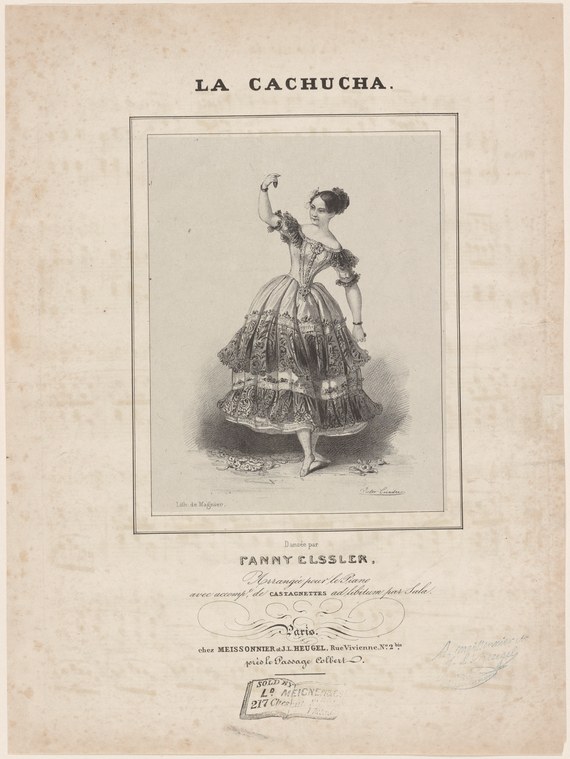
La cachucha. Dansée par Fanny Elssler, arrangée pour le piano avec accompt de castagnettes ad libitum par sala
Unknown artist
- Collection:
- Prints depicting dance
- Source:
- New York Public Library
- Rights:
- Public domain — free to use, share and adapt.
- Recorded as:
- Public Domain
Fanny Elssler was one of the two greatest ballet dancers of her era, and La Cachucha was central to her fame and artistic identity. This print is material evidence of how successful 19th-century stage dances were repurposed as domestic music and dance, reaching audiences far beyond those who could attend the theater. The work also documents the appetite in the 1830s-1840s for dance that blended classical ballet with national and character elements—a fascination that shaped the development of theatrical dance for the rest of the century.
What you are looking at
A woman in Romantic-era theatrical dress stands in a three-quarter pose, raising her right arm in a graceful arc. She wears an elaborately layered skirt of white gauze or silk with dark patterning or embroidery, gathered at the waist and extending to the ankles—characteristic of the 1830s stage. The skirt appears to be mid-twirl or mid-step, with the fabric caught in motion showing the layers and volume. She wears a fitted bodice with short, off-shoulder sleeves and her dark hair is styled in the fashion of the period. The figure is depicted against a plain background within a rectangular frame, rendered as an engraving or lithograph. The image is a printed sheet music cover or theatrical announcement, with text identifying the dance and performer below the figure. A small signature or mark appears in the lower left of the composition.
The dancing
The dancer is captured in a single, iconic pose rather than mid-step—standing nearly upright with weight distributed evenly, right arm raised to shoulder height with fingers delicately extended, left arm held at her side. The posture emphasizes verticality and grace rather than dynamic movement. The raised arm and lifted gaze suggest an aspirational, ethereal quality typical of Romantic ballet presentation. This is a portrait of a dancer in performance dress rather than a document of specific technique.
The dance depicted
La Cachucha was a Spanish character dance that became famous in the 1830s-1840s European theatrical world. Fanny Elssler, the Austrian-Italian Romantic ballet dancer, performed and popularized this work across Europe and America, and it became one of her signature roles. The dance combined classical ballet technique with Spanish folk elements—castanets, sharp rhythms, and a flirtatious, spirited character distinct from the ethereal otherworldly ballets that dominated Romantic ballet. This print announces an arrangement for piano with optional castanets accompaniment, indicating that the dance was widely circulated in domestic and social contexts beyond the theater stage.
How it was made
This is a wood engraving or steel engraving, a reproductive print technique that allowed multiple copies to be distributed rapidly and inexpensively. The fine line work creates tonal gradation through cross-hatching, particularly visible in the shading of the fabric and body. At the bottom, printed text identifies the choreographer and performer, and names the Paris publisher. This format—theatrical announcement as distributed print—was a primary means of advertising stage productions and celebrating famous performers before photography. The technique's precision and repeatability made such prints ideal for music covers, playbills, and souvenirs aimed at a theater-going public.
About this work
This print announces and celebrates Fanny Elssler's performance of La Cachucha, a Spanish character dance arranged for piano by Sala. The image presents the dancer not in the act of dancing but in idealized portrait form—standing in theatrical dress with an elegant raised arm, embodying the grace and refinement expected of a Romantic-era prima ballerina. The work sits at the intersection of dance documentation, theatrical marketing, and domestic entertainment: it is simultaneously a record of a celebrated performance, an advertisement for a stage production, and sheet music for amateur pianists and dancers to recreate the spectacle at home. La Cachucha was one of the great crossover successes of Romantic ballet, equally at home in concert halls and drawing rooms.
How to look at it
The artist has chosen not a moment mid-step but a posed portrait—the dancer standing still, inviting admiration of her costume and bearing. This was the conventional way to market theatrical performers in printed form: as icons to be recognized and collected rather than as documents of choreographic action. Observe the care given to the rendering of the layered skirt and its volume, which was the visual signature of Romantic ballet dress. The raised arm and tilted head create an air of grace and refinement that emphasizes the dancer's status as an artist and a lady—theatrical performance, yes, but respectable and refined. The engraving technique allows fine detail in the embroidery and patterning of the costume, making this as much a fashion print as a dance print.
The artist
The print is signed "Lith. de Regnier" (lithographed by Regnier) in the lower left, indicating it was produced as a commercial theatrical print or music cover. The publisher is listed as Chez Meissomnier à fil. Beaujeu, a major Parisian music publisher of the era. No other identifying information for the artist is recorded. The work was executed as one of many such promotional and commercial prints of celebrated performers—a standard industry practice that employed skilled reproductive printmakers whose names often appeared small and subordinate to the content they advertised.
The period
La Cachucha emerged in the 1830s during the height of Romantic ballet, a period when interest in national, exotic, and character dance was reshaping theatrical practice. While ethereal ballets featuring supernatural heroines (sylphs, spirits, otherworldly maidens) dominated the serious repertoire, character dances performed by celebrated soloists offered an alternative: the display of personality, virtuosity, and engagement with audiences. Fanny Elssler championed this approach, positioning herself in deliberate contrast to Marie Taglioni, the reigning ethereal ballerina. The Spanish cachucha fit perfectly into this character ballet world, allowing Elssler to showcase musicality, timing, and a more direct, flirtatious stage presence. The proliferation of such prints and sheet music arrangements reflects how successful theatrical productions were rapidly commercialized and domesticated for middle-class consumption.
Where it lives
This print is held in the New York Public Library's collection of prints depicting dance. It is a commercial theatrical print and sheet music cover, part of the massive archive of 19th-century dance documentation and performance ephemera. The catalogue entry in the NYPL system is minimal, with only basic title information recorded.
Dance in this work
Questions about this work
Who was Fanny Elssler?
Fanny Elssler (1810–1884) was an Austrian-Italian prima ballerina of the Romantic era and one of the most celebrated dancers of her time. She was known particularly for character dances and for her direct, flirtatious stage presence—a marked contrast to the ethereal, otherworldly style of her rival, Marie Taglioni. Elssler toured throughout Europe and spent extended periods performing in the Americas, and she became a celebrity whose performances drew crowds rivaling those of opera singers and actors.
What was La Cachucha?
La Cachucha is a Spanish dance with folk origins that Elssler adapted into a theatrical character dance for the concert stage. It combined classical ballet technique with elements of Spanish folk dance—sharp rhythms, castanets, and flirtatiousness—making it a showstopper in the ballet repertoire. The dance became Elssler's signature role and was endlessly repeated, imitated, and arranged for other performers and domestic settings.
Why would a piano arrangement be needed for a stage dance?
This arrangement was not for theater orchestras but for domestic use—the sheet music allowed amateur pianists to accompany social dancing or amateur theatrical performances in parlors and concert halls. It also allowed the dance to circulate as a cultural commodity available to anyone who could read music, far beyond the elite audience that could attend Elssler's actual performances. Such arrangements were a standard part of the 19th-century entertainment market.
What is the significance of the castanets notation?
The notation of "castanetes ad libitum" (castanets optional) marks this as a dance with Spanish and folk character, not purely classical ballet. The castanets are what made La Cachucha unmistakably Spanish and distinctive; their inclusion in the arrangement allowed pianists and dancers to recreate something closer to the stage experience, even in domestic contexts.
More dance artwork





