49 works in this view — arrow keys or swipe to move between them.
Dance in Art
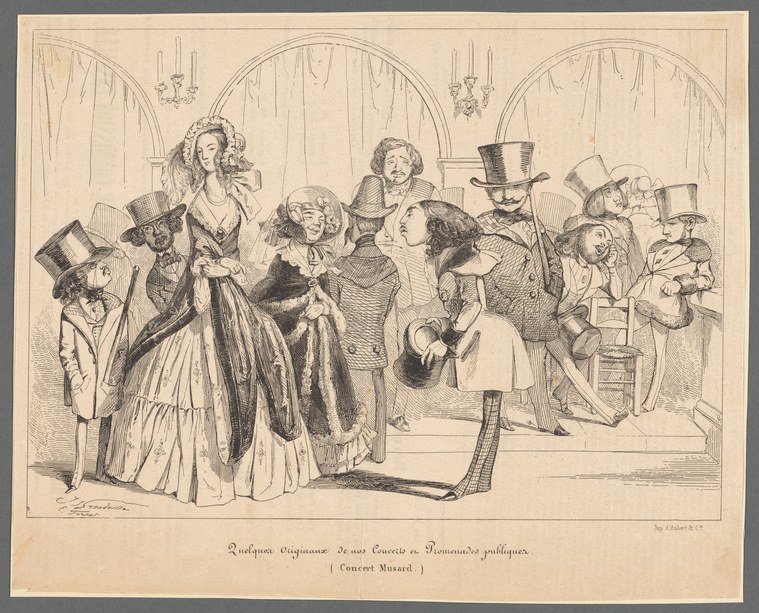
Quelques originaux de nos concerts et promenades publiques (Concert Musard)
Unknown artist
- Collection:
- Prints depicting dance
- Source:
- New York Public Library
- Rights:
- Public domain — free to use, share and adapt.
- Recorded as:
- Public Domain
This print is a rare document of how mid-19th-century people understood and critiqued their own dance culture. It tells us that Musard's concerts were seen as popular, slightly ridiculous affairs attended by the pretentious and the fashionable, not as a refined elite practice—and that professional satirists found the scene rich enough to warrant careful, expensive printmaking. It is also evidence of the tension between the cultural aspiration to elegant ballroom dancing and the physical reality of doing so in tight corsets and enormous skirts.
What you are looking at
This is a satirical engraving of a fashionable public concert or promenade scene, likely from the 1840s–50s, depicting what appears to be a Musard concert—the famous dance orchestras of Second Empire Paris. The composition shows an interior with arched vaults decorated with hanging drapery and suspended chandeliers. A diverse crowd of elegantly dressed figures occupies the space: men in tall top hats and tailcoats, women in bell-shaped skirts with fitted bodices, bonnets, and elaborate hair arrangements. The figures are arranged in a roughly circular formation, some dancing, some standing in conversation, some observing. The artist has exaggerated the proportions and postures of the dancers and onlookers for comic effect—some figures appear stiff or awkward, others contorted or overly animated. The setting is crowded and lively, capturing the social energy of mid-19th-century public dance venues, but with a clear note of mockery aimed at the fashionable crowd and their pretensions.
The dancing
The dancers occupy various positions: some appear to be waltzing or in closed partnered positions, while others stand isolated or in small clusters. The artist emphasizes ungainly or exaggerated posture—necks craned, arms akimbo, bodies tilted at comic angles—rather than capturing technically proficient movement. The women's voluminous skirts dominate the visual space, constraining the leg and hip mobility necessary for actual dancing. Several male figures are shown with stiff, elongated limbs that suggest satire of the fashionable gentleman dancer. The overall impression is of social awkwardness and physical discomfort masked by fashionable dress and pretence.
The dance depicted
This appears to depict the social dances of a Musard concert or public promenade, the enormously popular commercial dance entertainments that drew Paris crowds in the 1840s–50s. Musard's orchestras played waltzes, quadrilles, and other ballroom dances for mixed social dancing in public halls and garden venues. The title explicitly references 'concerts and public promenades' (concerts et promenades publiques). The engraving is satirical, mocking the participants rather than documenting dance technique—the primary concern is the social comedy of fashion, pretension, and the collision of movement with elaborate dress. No specific dance step is identifiable; the work targets the scene and the crowd rather than the choreography.
How it was made
This is a black-and-white engraving or etching on paper, executed in fine parallel and cross-hatched lines that suggest mid-to-late 19th-century commercial print production. The technique allows fine detail in the rendering of clothing, facial expression, and spatial architecture, and the medium's reproducibility means this was made for circulation to a broad urban audience—likely appearing in a satirical periodical or sold as a separate print. The delicate line work and careful composition indicate a skilled printmaker, though the catalogue record does not identify the artist. The technique is characteristic of French satirical printmaking from the 1840s–50s, a period of high output in this genre.
About this work
This is a mid-19th-century French satirical engraving depicting a Musard concert or public dance promenade—one of the most popular and commercially successful dance entertainments of the Second Empire. Rather than celebrating the dancing itself, the print mocks the social pretensions, physical awkwardness, and sartorial excess of the fashionable crowd that attended these events. The exaggerated postures and ungainly figures suggest that the artist viewed the participants as objects of ridicule rather than admiration. It belongs in a gallery of dance imagery because it documents not what elegant dancing looked like, but how the public, fashionable dancing of mid-century Paris was perceived and satirized—and because it captures the social and commercial context in which ordinary people actually danced.
How to look at it
Look first at the exaggerated postures and proportions: the artist has systematically distorted the bodies to create comedy and critique. Notice how the women's enormous skirts dominate the spatial composition and how little of the dancers' actual bodies or footwork is visible—a comment on both fashion and the physical constraints it imposed on movement. Examine the faces and expressions: many figures wear expressions of strain, absurdity, or unconscious vanity. The setting (the vaulted hall with hanging decoration) is rendered in architectural perspective that emphasizes the crowd and creates a sense of claustrophobic confinement. The title's reference to 'originals' (originaux) suggests that specific individuals or character types are being caricatured, though without documentary knowledge we cannot identify them. The overall compositional strategy is to make the scene itself—not the dancing—the subject of satire.
The artist
The artist is not recorded in the catalogue, but the print bears the signature or mark of a commercial printmaking shop (visible as 'lith' or printer's name on the lower margin). The style and subject matter are consistent with French satirical printmaking of the 1840s–50s, particularly the work of caricaturists and social commentators like Honoré Daumier and the studios that produced satirical prints for periodicals and independent sale. The quality of execution and the target audience (urban, fashionable Parisians) suggest this was produced by a skilled commercial print atelier, not an amateur or fine artist.
The period
Musard's dance orchestras dominated Parisian entertainment from the 1830s to 1860s, operating large public halls where mixed crowds paid admission to dance to live music. These were commercial enterprises, not aristocratic salons or court events—they served the middle and upper-middle classes and were a site of social aspiration and self-display. Simultaneously, satirical printmaking was at its height in Paris, with publications and independent prints lampooning contemporary fashion, manners, and social pretension. The engraving sits at the intersection of these two phenomena: it documents the popularity of public ballroom dancing while expressing the ambivalence—even disdain—that artists and critics felt toward the fashionable crowds that inhabited these spaces. This was also a period of rapid change in dance itself: the waltz, quadrille, and polka were relatively recent imports, and their adoption by the fashionable was still contested and ridiculed in some quarters.
Where it lives
This print is held in the New York Public Library's collection of prints depicting dance. It is part of a broader archival collection of dance imagery spanning media and centuries, though the specific circumstances of its acquisition and cataloguing are not recorded in the bare catalogue entry.
Dance in this work
Questions about this work
What is a Musard concert?
Musard's were large public dance halls in Paris during the 1830s–60s, operated by the conductor and impresario Philippe Musard. They were commercial venues where the fashionable public paid admission to dance to live orchestral music—waltzes, quadrilles, polkas, and other ballroom dances. They were wildly popular and represented the first large-scale commercialization of ballroom dancing as a mass entertainment.
Why is the artist mocking the dancers?
The exaggerated postures and ridiculous proportions are satirizing both the pretension of the fashionable crowd and the physical reality of dancing in the costume of the period. The artist is suggesting that these people are ridiculous—vain, uncomfortable, and socially performative rather than genuinely enjoying themselves. This reflects a strain of cultural skepticism about the waltz and public dancing that persisted in some circles well into the 19th century.
Who made this print?
The artist is not identified in the catalogue record, but the style and commercial quality suggest it was produced by a professional satirical printmaking studio in Paris, likely during the 1840s or 1850s. Many such prints were created as commercial products without clear attribution to a single artist.
What kind of dances were danced at these concerts?
Primarily waltzes, quadrilles, polkas, and other European ballroom dances. These were couple or group dances performed in closed or semi-closed positions. The print does not show specific steps, but the engraving suggests that the fashionable dress and crowded conditions of the venue made elegant execution difficult.
More dance artwork





