49 works in this view — arrow keys or swipe to move between them.
Dance in Art
The Flower dance of the Viennoise children
Unknown artist
- Collection:
- Prints depicting dance
- Source:
- New York Public Library
- Rights:
- Public domain — free to use, share and adapt.
- Recorded as:
- Public Domain
This work illustrates a now-historical form of theatrical dance—the children's tableau vivant and group spectacle—that shaped nineteenth-century performance and visual culture but is rarely documented in dance archives. It provides concrete visual evidence of what children's theatrical dancing looked like in the 1870s–1890s, including costume, formation, apparent movement vocabulary, and the architectural and decorative framing of performance. For historians of dance, gender, and childhood, it raises important questions about the commodification of young bodies in entertainment and the relationship between dance, spectacle, and commercial culture.
What you are looking at
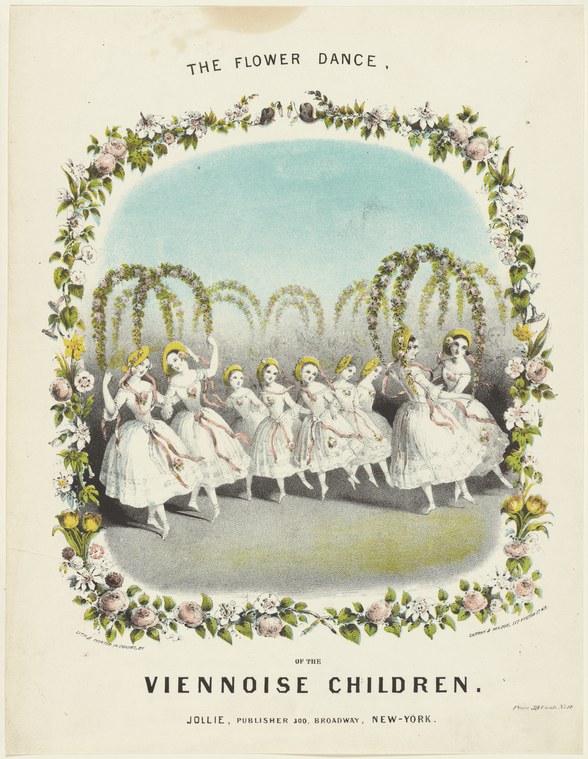
A group of young girls in white dresses performs a coordinated dance beneath an arch of flowering vines and greenery. The arch frames the scene against a pale blue sky, creating a theatrical proscenium effect. The children stand in a loose semicircular formation, their bodies angled toward the viewer, their white skirts suggesting motion and lightness. The ground beneath them is rendered in soft yellows and greens, suggesting a garden or outdoor stage. Garlands of flowers—roses, ivy, and other blooms—frame the entire composition, creating an ornamental border that enhances the gentle, decorative character of the scene. The overall effect is one of innocence, grace, and careful choreography, designed to delight through the combination of youth, whiteness, and coordinated movement.
The dancing
Approximately twelve to fourteen girls in identical or near-identical white dresses are arranged in a loose arc. Their bodies are upright and composed, with arms positioned at their sides or slightly extended. The girls appear to be moving through a synchronized sequence—some bodies suggest forward motion or a turn, while others show a more static, posed quality. The uniformity of dress and formation suggests carefully rehearsed group choreography. The scale of the figures—small and child-sized—emphasizes both the youth of the performers and the decorative, almost doll-like quality the composer has given them.
The dance depicted
This appears to be a Victorian or Gilded Age theatrical tableau, likely a choreographed children's production titled "The Flower Dance." The work shows characteristics of the spectacle-focused group dancing popular in the nineteenth century, where young girls in matching costumes performed synchronized or nearly synchronized movements, often to narrative or allegorical themes. The "Viennoise children" in the title suggests these may have been Viennese dancers or a troupe known by that name, and the style of dress and composition is consistent with European theatrical productions of the 1870s–1890s. The dance appears to be a formal, arranged piece designed for theatrical presentation rather than social dancing, executed with the precision and uniformity typical of professional or semi-professional children's theatrical companies of the period.
How it was made
This is a hand-colored lithograph, a reproductive printing technique well suited to theatrical and commercial promotion. The delicate hand-coloring—evident in the pale blue sky, the varied flower tones, and the subtle shading of the children's dresses—required skilled artisans and suggests this was produced for a fairly affluent or professional audience. Lithography allowed for the soft, precise rendering of both figures and decorative detail, and the technique was ideal for creating multiple copies for distribution and sale. The publisher, Jollié of Broadway, New York, indicates this was a commercial product circulating in the American market, likely sold as a souvenir or promotional print for a theatrical production.
About this work
"The Flower Dance of the Viennoise Children" is a hand-colored lithograph recording a nineteenth-century children's theatrical dance spectacle. The work captures a moment of posed, synchronized group movement by young girls in white dress, framed within a decorative floral arch that emphasizes both the delicacy and the artificiality of the scene. The print documents a form of theatrical dance that was central to the period's entertainment culture—the production of visual beauty and coordinated grace through the bodies of children, a practice that combined genuine dancing skill with the aesthetics of ornament, innocence, and refined entertainment. As a printed artifact from a major New York theatrical publisher, it testifies to the commercial circulation and popular appeal of such productions in the Gilded Age.
How to look at it
Attend to the uniformity and precision of the grouping—every child is dressed identically, and their formation creates a visual rhythm that suggests rehearsed, coordinated movement rather than improvisation. Notice the framing device of the floral arch: it transforms what might otherwise be a plain theatrical scene into something decorative and allegorical, turning the children themselves into part of an ornamental composition. The white dresses catch and reflect light, emphasizing the bodies as visual objects. The printing technique—the soft hand-coloring and the clarity of the lithographic line—was itself a form of visual promotion, designed to make the scene appealing and to suggest both the delicacy of the performance and the refinement of the theatrical experience.
The artist
The artist is not recorded. The work was published by Jollié, a Broadway publisher, and the hand-coloring was likely executed by workshop artisans. The lithographic printing and distribution network suggest a professional theatrical poster and promotional print house oriented toward the New York entertainment market.
The period
The late nineteenth century saw an explosion of children's theatrical productions in Europe and America, particularly in Vienna, Paris, and New York. Children's ballets and tableaux were a staple of both legitimate theatrical circuits and commercial entertainment venues. The aesthetic of the "Viennoise children"—trained young dancers in synchronized, grace-centered movement—drew on Romantic ballet conventions (particularly the image of the sylph and the ethereal female body) while democratizing access to professional dance performance through the appeal of youth and innocence. The lithographic print industry allowed theatrical producers to market these performances widely, creating both documentary records and advertisements that circulated independently of the performances themselves. Such works also reflected broader Victorian and Gilded Age anxieties and investments in childhood, feminine beauty, and the visual control and display of young bodies.
Where it lives
The print is held in the New York Public Library's collection of prints depicting dance, catalogued as part of their broader theatrical and commercial print holdings. It was published by Jollié, a New York publisher on Broadway, indicating distribution in the American theatrical market of the late nineteenth century.
Dance in this work
Questions about this work
What was a 'Flower Dance' in the nineteenth century?
Flower dances were a popular form of theatrical spectacle featuring young girls in coordinated, often allegorical movement, frequently accompanied by elaborate floral scenery and costuming. They combined elements of ballet training with the visual aesthetics of tableaux vivants and were designed to showcase grace, beauty, and disciplined ensemble work. They were particularly popular in Vienna, Paris, and America during the 1870s–1890s.
Were the Viennoise children a real performing group?
The catalogue record does not identify a specific troupe by that name, but the title suggests they were known as dancers from Vienna or as a Viennese-style children's company. Without additional documentation, their precise identity cannot be established, though the production and distribution of this print indicates they were professionally marketed and commercially successful.
How was this print made and distributed?
This is a hand-colored lithograph—a print made by drawing on a stone, inking it, and pressing paper against it to create an image. Each print was then hand-colored by artisans, a labor-intensive process that made such prints relatively expensive and typically purchased by theatergoers, collectors, or patrons of the arts. The publisher Jollié's location on Broadway indicates it was sold in New York's theatrical district, likely as a souvenir or promotional image.
More dance artwork





