49 works in this view — arrow keys or swipe to move between them.
Dance in Art
Diana
Unknown artist
- Collection:
- Prints depicting dance
- Source:
- New York Public Library
- Rights:
- Public domain — free to use, share and adapt.
- Recorded as:
- Public Domain
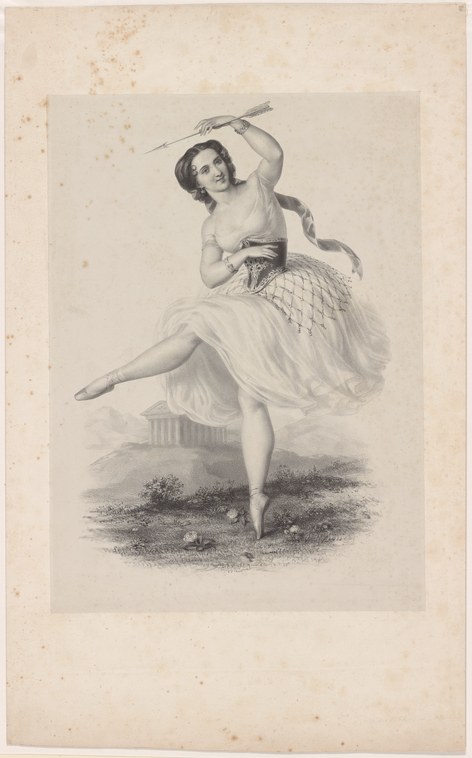
This print is evidence of how thoroughly ballet had absorbed classical mythology by the 1830s–40s, and how the balletic body—not narrative, not plot, but pure technique and line—became the primary means of representing heroic and divine femininity. For historians of dance technique, the image documents the codified arabesque and épaulement of the period, showing what 'classical' meant in practice at a time when ballet was becoming a formal academic pursuit.
What you are looking at
A young woman in classical dress stands alone in a landscape, captured mid-leap or arabesque against a hazy background suggesting a distant temple or classical ruin. She wears a diaphanous, high-waisted gown with a fitted bodice and full skirt that falls to mid-calf, her hair loose and flowing. Her right arm extends upward in a graceful arc holding what appears to be a laurel branch or wreath, while her left arm is positioned across her body. Her left leg is extended behind her in the line of the movement, her right supporting the body in a balletic pose. The ground beneath her is rendered sketchily, with rocks or rough terrain suggesting a natural setting. The entire composition is rendered in fine pencil or engraving technique with delicate cross-hatching and tonal modulation, creating an ethereal quality suited to the mythological subject.
The dancing
A single female figure dominates the composition in an extended balletic pose suggesting trained classical dance. The body is lifted and weightless, with the left leg extended behind in line with the torso—a classic arabesque or attitude position. The right arm reaches upward with the fingers extended, holding a branch, while the left arm curves gracefully inward. The head is turned slightly, gazing upward in the direction of the raised arm. The pose displays the pulled-up posture and elongated line characteristic of early 19th-century ballet training, with particular emphasis on the extension of the working leg and the verticality of the spine.
The dance depicted
This is a representation of Diana, the Roman goddess of the hunt, rendered as a figure of classical ballet rather than a literal dance. The pose and vocabulary are explicitly balletic—the arabesque, the épaulement, the lifted carriage—yet the subject is mythological rather than narrative. The image likely depicts the dancer as the goddess herself, a common conceit in the Romantic era when ballet heroines embodied legendary and supernatural characters. The artist has chosen a moment of ascension or triumph, with the figure poised weightlessly in space, which was a signature goal of Romantic ballet technique: the illusion that the dancer transcended earthly heaviness.
How it was made
This is a fine engraving or steel-engraved plate, likely created for commercial circulation as a print. The technique allows for precise linear detail and subtle tonal gradation through fine cross-hatching and stippling, visible especially in the rendering of fabric and the atmospheric background. The monochromatic medium and the formal composition suggest this was produced for a middle-class audience—affordable, reproducible, and suitable for framing or binding in collections. The quality of line and finish indicates skilled professional work, characteristic of early 19th-century commercial theatrical prints documenting dancers and roles.
About this work
This engraving documents a dancer in the guise of Diana, posed in the classical balletic vocabulary that defined Romantic-era theatre dance. The image is neither a literal record of a specific performance nor a freestanding mythological illustration, but rather a theatrical portrait—the dancer as the goddess, the pose as the dance. It belongs in a gallery of dance in art because it captures a foundational conceit of 19th-century ballet: that technique and the body could embody myth, that a single suspended moment could contain both narrative and abstraction, and that a trained dancer was the instrument through which classical ideals were made visible.
The work represents a widespread practice of documenting theatrical dancers in their principal roles, a genre that flourished in the 1830s–1850s as ballet expanded its popular audience. Such prints served both as souvenirs of performances and as evidence of the expanding technical and expressive vocabulary available to the female dancer on stage.
How to look at it
Notice the moment the artist has chosen: not descent, but the instant of suspension—the body at its highest, the leg fully extended, the gaze upward. This is the peak moment of the movement, the fraction of a second when the illusion of weightlessness is most convincing. The artist has rendered the fabric of the dress in motion, swirling around the figure, which gives the pose narrative energy while the pose itself remains formally balanced. Observe how the line of the body is continuous from the extended foot through the spine to the raised arm and the gaze—this unity of line was the explicit goal of Romantic ballet training, and this print documents what that goal looked like in flesh and training.
The period
This engraving was produced during the height of Romantic ballet (1830–1850), when the female dancer had become the central theatrical commodity and when ballet had established itself as a respectable middle-class art form in cities across Europe and North America. Diana was among the repertory of mythological and supernatural heroines—along with sylphs, nixies, and odalisques—through which Romantic dancers explored themes of otherness, grace, and transcendence. The aesthetic of weightlessness, elongation, and upward reach visible in this image was actively pursued through the technical innovations of the period: the use of the blocked pointe shoe (though not yet the reinforced modern pointe shoe), the cultivation of turned-out positions, and the suppression of the body's natural weight. Commercial prints of dancers in role were produced in large quantities by London, Paris, and New York publishers, functioning as celebrity images and technical documents simultaneously.
Where it lives
This work is held in the New York Public Library's collection of prints depicting dance. It is a commercial engraving, likely published in the 1830s–1840s, though the specific publisher, date, and dancer it commemorates are not recorded in the catalogue.
Dance in this work
Questions about this work
Is this a record of an actual performance?
Not directly. It is a theatrical portrait—a pose struck for the engraver or artist, representing the dancer in the character of Diana. Such prints were often created years after a performance or even independently, as advertisement and documentation of a dancer's signature roles. What it does record reliably is the balletic technique and vocabulary of the era.
Why is Diana posed in a ballet move?
By the Romantic era, ballet had become the primary theatrical language for representing heroic and mythological characters. The pose—an arabesque—was not a 'realistic' gesture a hunter goddess would make, but rather the distilled classical vocabulary through which a trained dancer could embody the character's grace and power.
What does the laurel branch mean?
It is one of Diana's traditional attributes in classical imagery, signifying her role as a huntress and goddess of the wild. Here it also serves to anchor the upper body's line and to give the composition narrative content—this is not a pure technical display but a character study.
More dance artwork





