49 works in this view — arrow keys or swipe to move between them.
Dance in Art
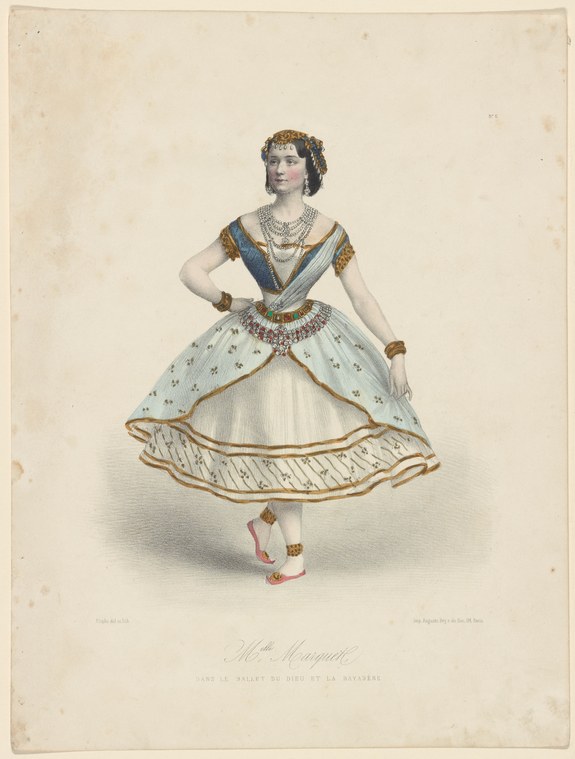
Melle Marquet, dans le ballet du Dieu et la bayadère
Unknown artist
- Collection:
- Prints depicting dance
- Source:
- New York Public Library
- Rights:
- Public domain — free to use, share and adapt.
- Recorded as:
- Public Domain
This image documents a canonical Romantic ballet and a specific performer's interpretation of a famous role, preserving visual evidence of how the bayadère costume was worn and presented in the mid-19th century. It is also a rare record of a named female performer from the Romantic era, making it valuable for theater historians working on the history of women dancers and the dissemination of dance through print media.
What you are looking at
A young woman in theatrical costume stands in a balletic pose against a plain background, her weight on one leg in a graceful stance. She wears an ornate ensemble: a short white skirt with a scalloped hem and gold thread detail, worn over a longer underskirt; a dark blue shoulder cape or overdress draped asymmetrically across her torso; gold brocaded short sleeves; multiple strands of jeweled necklaces; and a jeweled headdress. Her hair is dark and arranged in ringlets. The pose is frontal and composed for display, with one arm extended and the other at her side. The figure is rendered with careful attention to the richness and fall of fabrics, particularly the layered skirts and their decorative borders. The style of dress and the title reference *Le Dieu et la Bayadère* (*The God and the Bayadère*), a famous ballet of the Romantic era. The image is a hand-colored engraving or lithograph, with fine lines defining form and subtle shading suggesting volume in the fabrics.
The dancing
A single female dancer is shown in a theatrical pose of display rather than action—a classical ballet attitude, with her weight centered and her limbs arranged for visual harmony rather than captured mid-movement. Her frame is upright and composed; there is no sense of strain or dynamic energy, but rather the formal presentation typical of mid-19th-century dance portraiture. The arm positions are graceful but restrained. The pose suggests the dancer as a spectacle for the viewer's gaze, consistent with the conventions of Romantic-era ballet imagery, where the dancer's body was arranged to show off costume, poise, and idealized beauty.
The dance depicted
*Le Dieu et la Bayadère* (The God and the Bayadère) was a famous ballet created by Jean-Auguste Vestris in 1830, with music by Auber, and remained in the repertory throughout the 19th century. The bayadère (devadasi, or temple dancer) was an exotic figure in the European imagination—a woman of the East who combined sensuality with grace. Melle Marquet performed this role, and this portrait captures her in the costume associated with it: the short skirt characteristic of ballet costume, the jeweled Eastern-inspired overdress, and the headdress suggesting an Indian temple dancer. The pose itself conveys the Romantic ideal of the ballerina as a creature of ethereal grace and controlled beauty, not the athleticism or narrative action we might see in a later era. The image documents both the role and the performer within a tradition of theatrical portraiture.
How it was made
This is a hand-colored engraving or lithograph, a print medium common for dance portraiture in the 19th century. The delicate line work establishes form and drapery folds, while the color—applied by hand or tinted lithographic stone—brings richness to the costume details: the deep blue of the cape, the gold of the trim, the jeweled tones of the headdress and necklaces. This technique allowed for relatively inexpensive reproduction and wide distribution to theaters and collectors, making it a key medium for documenting performers and roles. The fine detail and finish indicate a print intended for a middle-class audience interested in theater and fashion.
About this work
This is a theatrical portrait of Melle Marquet in the role of the Bayadère from the celebrated Romantic ballet *Le Dieu et la Bayadère*. The work documents both a famous role and a performer at a moment when dance and theater were increasingly documented through such prints. It captures the aesthetic and costume conventions of Romantic ballet—the idealized female dancer, the exotic subject, the careful display of fabric and ornament—and it serves as both a souvenir of performance and a record of how Romantic ballet imagined and presented female dancers on stage. As a hand-colored print, it is a window into both the visual culture of 19th-century theater and the circulation of dance imagery to a broad public.
How to look at it
Attend to the costume as the primary subject: the layering and fall of the skirts, the gold and jeweled details, the asymmetrical draping of the cape. Notice the pose itself—frontal, composed, with no sense of movement or strain—which is typical of dance portraiture of this era: the dancer is arranged for maximum visual effect rather than captured mid-gesture. The engraver has lavished detail on the fabrics and ornaments, a choice that tells us that the costume was integral to the role's appeal and to the image's commercial value. The restrained, classical pose contrasts with the rich ornamentation, a tension that defines Romantic ballet aesthetics.
The period
*Le Dieu et la Bayadère* premiered in 1830, during the height of the Romantic ballet movement, when exoticism, Eastern imagery, and fantasy narratives dominated the Paris Opéra and European stages. The 1830s through 1860s saw an explosion of hand-colored theatrical prints—souvenirs for theatergoers and documents of performers and roles. These prints were published by Parisian firms and distributed widely, making them a major form of artistic circulation and a key medium for disseminating images of dancers. The bayadère figure—a Hindu temple dancer—was a stock Romantic exotic, appearing in multiple ballets, and the costume as shown here represents the conventions of how Europeans imagined and staged "the East." This print sits within a vast apparatus of Romantic visual culture, where dance, costume, exoticism, and female beauty were tightly linked.
Where it lives
This print is held in the New York Public Library's collection of prints depicting dance, part of a large archive of 19th-century theatrical imagery. It is a hand-colored engraving or lithograph, one of thousands of such souvenir prints produced in Paris during the Romantic era.
Dance in this work
Questions about this work
What was a bayadère?
A bayadère (from the Portuguese bailadeira, via French) was a temple dancer or devadasi in India. To 19th-century Europeans, the bayadère was an exotic fantasy figure—sensual, graceful, Eastern, and erotic. She became a staple subject in Romantic ballet and opera, where European performers danced the role in imaginative Eastern costumes.
Who was Melle Marquet?
The catalogue record does not provide biographical information about her. She was a theatrical performer of the mid-19th century who danced the role of the Bayadère, likely on the Paris Opéra or a major European stage. This print, intended as a theater souvenir, is one of the main records of her performance.
Why are there so many 19th-century prints of dancers?
Dance prints were inexpensive to produce and distribute, and they appealed to a large theatergoing public. They served as souvenirs of performances and popular roles, as fashion references, and as collectibles. They also helped promote performers and theaters. The hand-coloring was done by hand or on the printing block itself, making each print a small object of decorative value.
What does the pose tell us?
The frontal, composed stance is typical of Romantic ballet portraiture. Rather than capturing a moment of action, it presents the dancer as an idealized figure for contemplation—a creature of grace, beauty, and poise. The pose emphasizes the costume and the body's lines, not the dynamics of movement.
More dance artwork





