49 works in this view — arrow keys or swipe to move between them.
Dance in Art
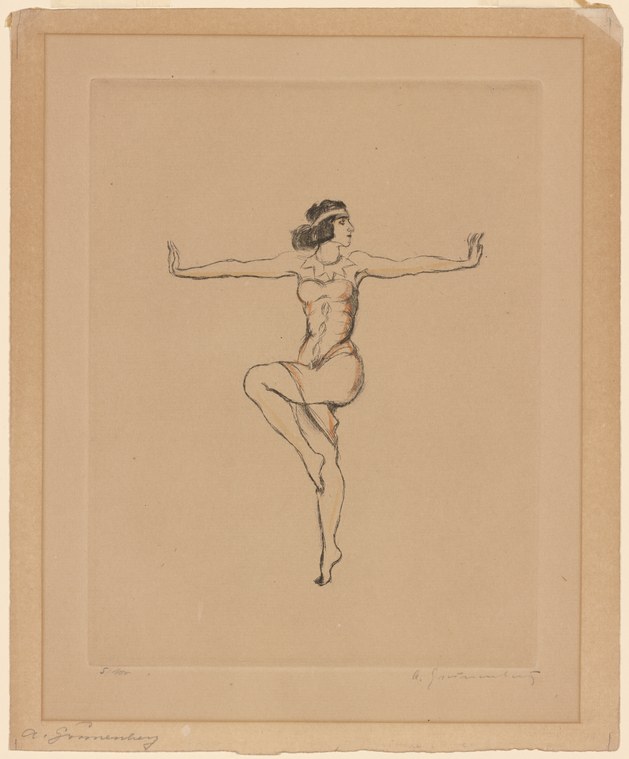
Vera Fokina in Cleopatra
Unknown artist
- Collection:
- Prints depicting dance
- Source:
- New York Public Library
- Rights:
- Public domain — free to use, share and adapt.
- Recorded as:
- Public Domain
Vera Fokina was a significant figure in the Diaghilev Ballets Russes and the broader history of Russian Imperial ballet; this drawing preserves a visual record of her embodiment of the Orientalist roles that were central to early 20th-century ballet's appeal and aesthetic. The work demonstrates how ballet technique was understood and valued by visual artists of the period, and offers a window into the physical vocabulary of the early Fokine era, before the radical innovations of the 1910s.
What you are looking at
A single female figure stands in a three-quarter view against a plain tan background, her body positioned in a striking asymmetrical pose. She wears what appears to be a draped costume suggestive of ancient Egypt—minimal drapery across the torso with the characteristic silhouette of early 20th-century theatrical dress for Orientalist roles. Her weight is carried on one leg while the other extends in a fluid line; her arms spread wide at shoulder height with palms facing forward in a gesture of openness or supplication. Her gaze is directed downward and to the side, creating a sense of introspection or dramatic reverie. The figure's musculature is rendered with careful attention, the line work suggesting trained physicality. The drawing is executed in a restrained palette—black or dark ink line on paper, with subtle tonal shading that articulates the body's form.
The dancing
The pose displays the hallmark vocabulary of Romantic-era ballet and early 20th-century theatrical dance: the dancer stands en relevé (or nearly so) on one leg, with the supporting limb extended in a clean line. The free leg is placed in a lifted position that suggests elevation and control. The arms are held high and open, a classical frame that conveys both grace and emotional expression. The body's alignment suggests thorough training in the ballet vocabulary, with attention to the carriage of the torso and the elongation of the neck. The asymmetry of the pose—one side lifted, the other grounded—creates a sense of suspended movement characteristic of the ballet aesthetic.
The dance depicted
This is almost certainly a Romantic or early 20th-century ballet study, most likely the title figure from a work in the Orientalist mode that was popular in European theatre of that era. Vera Fokina was a Russian prima ballerina and wife of Michel Fokine, the influential choreographer. If the catalogue attribution is correct, this drawing documents a theatrical role she performed. The pose—asymmetrical, with the body in a moment of elegant suspension—is consistent with the ballet technique of the early 1900s as codified through the Vaganova and Italian methods. The Orientalist costume and the classical ballet frame together suggest a work from the period when ballet was mining Exotic and historical themes, as seen in works like Fokine's *Cléopâtre* (1909), which featured Anna Pavlova. The pose itself is characteristic of the moment of apotheosis or emotional climax in such works: the dancer lifted, open, in a gesture of revelation or submission.
How it was made
This is a pen or ink drawing on paper, likely executed with line and wash or fine tonal hatching to model the figure's form. The technique is economical and assured—the artist works primarily in line, with selective shading to define musculature and create volume. The restraint of the medium suits the subject: a study of the human figure in motion or in a held pose, prioritizing the clarity of the silhouette and the articulation of joints and limbs. The quality of the line work suggests this is either a finished study or a preparatory drawing for a larger work or print. The paper support and the archival condition suggest this was made as a standalone work or part of a portfolio of dancer studies.
About this work
This is a drawing of a dancer in a classical ballet pose, identified in the record as Vera Fokina, a prominent Russian ballerina of the early 20th century. The work captures a moment of theatrical grandeur in the pose of a female dancer, likely in an Orientalist or historically themed ballet role. The artist demonstrates thorough knowledge of ballet technique and the conventions of theatrical portraiture of the period. The drawing is a historical record of both a specific performer and the aesthetic values of early 20th-century European ballet as it was practiced by the Diaghilev circle and other major companies. It exemplifies the tradition of artist-made studies of dance, documenting not just the performer but the specific poise and physical intelligence required by the choreography of the era.
How to look at it
Attend to the moment of the pose: this is not a step but a held position, likely from the climactic moment of a scene—a moment of arrival, revelation, or emotional intensity. The artist has chosen to show the dancer in a configuration that displays both her training and her emotional expression, with the open arms and lifted chest conveying a mood of supplication or exultation. The symmetry of the pose is deliberately broken—one side higher, one side lower—which creates dynamism and suggests the body in the instant before or after a movement. Notice how the line work describes the musculature of the legs and torso, affirming the physical labor behind the apparent effortlessness of the pose.
The artist
The artist is not recorded in the catalogue. The quality of the line work and the assured knowledge of ballet anatomy and pose suggest a trained draftsman with access to dance studios or the theatre, but without further documentation the artist cannot be identified. The signature or inscription on the drawing may provide additional evidence; the work bears marks at the bottom that may be an artist's name or a collector's mark, but these are not legible in the image.
The period
This drawing dates to the early 20th century, during the height of the Russian Imperial Ballet's influence on European dance and art. The Ballets Russes, founded by Sergei Diaghilev in 1909, was at its peak of cultural influence during the 1910s and 1920s. The Orientalist aesthetic evident in the costume and pose was a dominant mode in ballet during this period, drawing on European fascination with Egypt, India, and the Islamic world. Visual artists of the era—including painters, sculptors, and printmakers—were intensely engaged with dance as a subject, attending performances, making studies, and collaborating directly with choreographers and dancers. The classical ballet technique shown here was taught through the Vaganova method in Russia and the Cecchetti method internationally.
Where it lives
The work is held in the New York Public Library's collection of prints depicting dance. It is catalogued with minimal information: the title and subject are known, but the artist, date, and medium are not formally recorded. This is consistent with many works in institutional collections of dance imagery, where the focus has historically been on the dancer rather than the maker.
Dance in this work
Questions about this work
Who was Vera Fokina and why is she important?
Vera Fokina (1886–1942) was a Russian prima ballerina of the Imperial Ballet and a principal dancer with the Ballets Russes. She was married to choreographer Michel Fokine, one of the most innovative artists of the early 20th century. She performed in many of his groundbreaking works, including *Cléopâtre* (1909), and was known for her dramatic power as well as her classical technique. She represents the bridge between the Imperial Ballet tradition and the modernist innovations of the Diaghilev era.
What is a Romantic ballet pose and why does this matter?
The pose shown here—asymmetrical, elevated, with the body open and the gaze lowered—derives from the Romantic ballet tradition of the 19th century (ballets like *Giselle* and *La Sylphide*) but is executed here in the more athletic and dramatically expressive manner favored by the Ballets Russes in the 1910s. Romantic ballet prioritized grace, effortlessness, and otherworldliness; the early 20th-century version maintained the aesthetic but emphasized the dancer's power and control. This drawing captures that evolution.
What does the Orientalist costume tell us?
The minimal, draped costume suggests a role based on a historical or geographical "other"—in this case, Egypt, as indicated by the title. Orientalism was a dominant aesthetic in early 20th-century ballet, reflecting both European fascination with non-European cultures and the theatre's appetite for exotic spectacle. Fokine, despite his modernist innovations, worked extensively in this mode. The costume shown here—economical, suggestive rather than realistic—represents the theatrical shorthand of the period.
How can you identify this as ballet rather than another form of dance?
Several formal elements mark this as ballet: the turned-out leg position, the lift and carriage of the torso, the arm placement and frame, and the relevé (or near-relevé) position of the supporting leg. The classical training is evident in every line. Additionally, the theatrical costume, the elevated aesthetic, and the moment of emotional intensity captured in the pose all align with ballet performance of the period, not with modern dance, interpretive dance, or other theatrical forms of the time.
More dance artwork





