49 works in this view — arrow keys or swipe to move between them.
Dance in Art
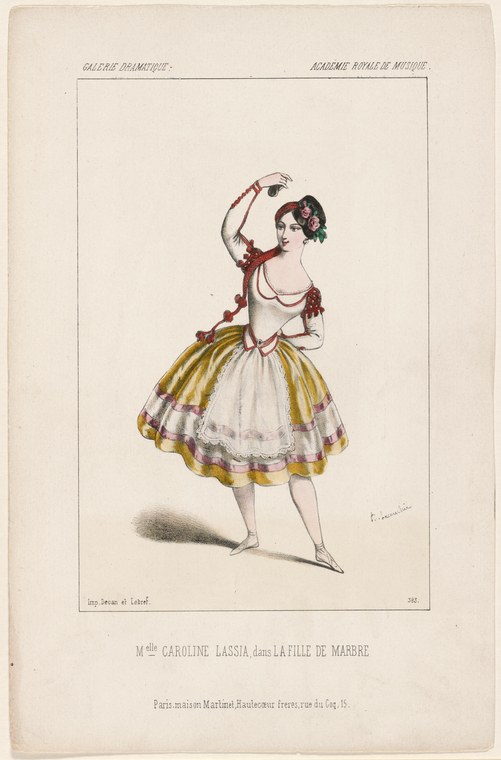
Melle Caroline Lassiat, dans La fille de marbre.: Academie Royale de Musique
Unknown artist
- Collection:
- Prints depicting dance
- Source:
- New York Public Library
- Rights:
- Public domain — free to use, share and adapt.
- Recorded as:
- Public Domain
Romantic-era ballet prints like this one are among the primary visual sources for understanding how nineteenth-century dancers moved, what they wore, and how theatrical narrative was conveyed through the body. The image documents both the technical vocabulary of classical ballet training (evident in posture and port de bras) and the character-driven, more naturalistic vocabulary that Romantic choreographers were introducing. For dance historians and practitioners, such portraits are invaluable evidence of how the balance between abstract movement and dramatic storytelling was struck in the mid-nineteenth century.
What you are looking at
A solo female dancer in performance costume stands against a plain background, captured in a moment of dynamic movement. She wears a pale silk dress with a full skirt decorated with gold and purple striped panels and white lace trim at the hem, the skirt caught mid-swirl. Her bodice is a deep wine-red silk with short puffed sleeves, cut low across the chest in the style of 1840s theatrical dress. She has dark hair arranged with green foliage or jeweled ornament, and holds a curved sword or scimitar raised in her right hand, its blade catching light. Her left arm extends gracefully, and her body is twisted in a contrapposto pose that suggests the height of a dramatic moment—perhaps a pas d'action from a narrative ballet. The figure casts a shadow on the ground, emphasizing the stage lighting convention of the era. The print is finely hand-colored, with careful attention to fabric texture and the play of light on silk.
The dancing
A single dancer depicted in a moment of arrested motion, her weight shifted to one leg in a pose that suggests both balletic training and theatrical drama. Her upper body twists away from the direction of her lower body, the sword held aloft in a warrior's gesture that reads as both strength and vulnerability. The raised arm is extended with the fingertips soft rather than rigid, the opposite arm reaching into the space around her. Her posture combines the formal épaulement of ballet training—the careful placement of shoulders and torso—with a more naturalistic, character-driven arm vocabulary than classical ballet would typically employ at this date.
The dance depicted
This is a scene from *La Fille de marbre* (The Marble Daughter), performed at the Académie Royale de Musique (the Paris Opéra) in the 1840s. The dance costume, pose, and dramatic action—a woman wielding a sword—belong to the Romantic ballet tradition, but the specific narrative context (suggested by the weaponry and the character's intensity) indicates this is a character role or mime scene rather than a pure ballet divertissement. The title and performer's name, Caroline Lassia, appear below the image. The work sits at the boundary between classical ballet vocabulary and the more dramatically inflected theatrical dance of French Romantic opera-ballet.
How it was made
This is a hand-colored engraving or lithograph, a print technology that allowed mass circulation of images of famous dancers and performances. The original design is engraved or lithographed in black line, then hand-tinted with watercolor or gouache—a labor-intensive process that produced works suitable for sale to theatre-goers, dance students, and collectors. The signature visible in the lower right suggests the work was issued by a commercial publishing house, likely in Paris. This medium and distribution method made images of celebrated dancers widely available and helped establish the visual vocabulary of Romantic ballet across Europe.
About this work
This is a theatrical portrait of the dancer Caroline Lassia in a role from the opera-ballet *La Fille de marbre*, created for the Paris Opéra in the 1840s. The image captures a moment of dramatic intensity within a Romantic-era ballet, showing the dancer in character costume wielding a sword, her body twisted in a pose that combines classical ballet training with the more naturalistic gesture vocabulary of mid-nineteenth-century theatre. The hand-colored engraving was produced for commercial circulation, allowing audiences to take home images of celebrated performers and roles.
The work belongs to a rich tradition of theatrical portraiture that documented the Romantic ballet repertoire and its stars. Such prints served multiple audiences: dancers studied them as records of successful interpretations, theatre-goers collected them as souvenirs, and dance historians today use them to reconstruct the visual culture of the period. Lassia was an active performer in the Paris opera-ballet world, and this image preserves not only her likeness but the costume, pose, and character vocabulary of a now-lost work.
How to look at it
Attend to the moment the artist has chosen to freeze: not a poised arabesque or a moment of stillness, but a dynamic twist of the torso that suggests action in progress—the sword raised, the body turning, the skirt caught mid-swirl. This is a moment of dramatic intensity, not classical repose. Notice how the posture combines elements you would recognize in ballet training (the turned-out legs, the lifted torso, the careful placement of the arms) with a more emphatic, character-driven quality—the way the torso twists away from the line of the legs, the intensity of the raised arm. This hybrid vocabulary is characteristic of Romantic ballet, which had begun to soften the austere geometry of neoclassical dance in favor of a more emotionally expressive, narratively engaged movement vocabulary. The hand-coloring is also worth attending to: the care taken to render the silk of the dress and the texture of lace, and the use of shadow on the ground to suggest stage lighting, are conventions that made these prints feel like windows onto the actual stage.
The artist
The print is unsigned as to author, listed only with the publisher's mark. It was produced by a commercial printing establishment in Paris—likely one of the major theatrical print publishers of the 1840s such as Martinet or Benoist. These firms employed engravers and colorists as part of a division of labor, creating theatrical portraiture as a profitable enterprise. The style is typical of Parisian commercial theatrical prints of the period: competent draughtsmanship in capturing likeness and costume detail, careful hand-coloring to enhance the luxe quality of fabric and ornament, and composition focused on a single figure in a moment of dramatic or balletic significance.
The period
This print dates to the height of the Romantic ballet period in France, approximately 1840s. The Paris Opéra was the leading venue for ballet in Europe, and the Romantic movement in dance—emphasizing ethereal female beauty, narrative drama, and the supernatural—was at its cultural peak. Works like *La Sylphide* and *Giselle* had recently premiered, and the taste for ballets with dramatic storylines, exotic or supernatural settings, and virtuoso female performers was dominant. Theatrically, the 1840s saw increasing attention to historical and character-specific costume, moving away from the generic 'ballet dress' of earlier decades toward more dramatically motivated costuming—as evidenced here by the armor-adjacent details and the sword. Commercial dance portraiture flourished during this period as a way to capitalize on the fame of celebrated performers and the public's appetite for images of theatre.
Where it lives
The print is held in the New York Public Library's collection of prints depicting dance. It was produced as a commercial theatrical portrait, part of the large body of such ephemera generated by Paris's publishing industry in the 1840s. The catalogue designation 'Academie Royale de Musique' confirms this is tied to the Paris Opéra's operations.
Dance in this work
Questions about this work
Who was Caroline Lassia?
Caroline Lassia was a dancer active in the Paris Opéra during the 1840s, part of the ecosystem of performers who danced in the opera-ballet tradition. Beyond this image and archival references, little is widely documented about her career, but her appearance in a published theatrical portrait suggests she held a notable enough position to merit commercial portraiture.
What is *La Fille de marbre*?
The Marble Daughter was a ballet-opera work performed at the Paris Opéra during the Romantic period. Like many works of the era, it combined sung drama with ballet divertissements and dramatic mime scenes. The plot is now obscure, and the work is not in the active repertoire, but this portrait preserves a memory of one of its dramatic moments.
Why is she holding a sword?
The sword suggests a character role—likely a warrior woman, a foreign or exotic character, or a supernatural being defending something or someone. In Romantic-era narrative ballets, such dramatic props and costumes helped audiences follow the story and defined the character's role within it.
How do I know this is actually from a real performance?
The specificity of the title, the performer's name, the venue (Académie Royale de Musique), and the professional quality of the print all indicate this was a documented performance. Theatre records and archive catalogues confirm the work and performer existed, though detailed documentation of Romantic-era opera-ballets is often fragmentary.
More dance artwork





