49 works in this view — arrow keys or swipe to move between them.
Dance in Art
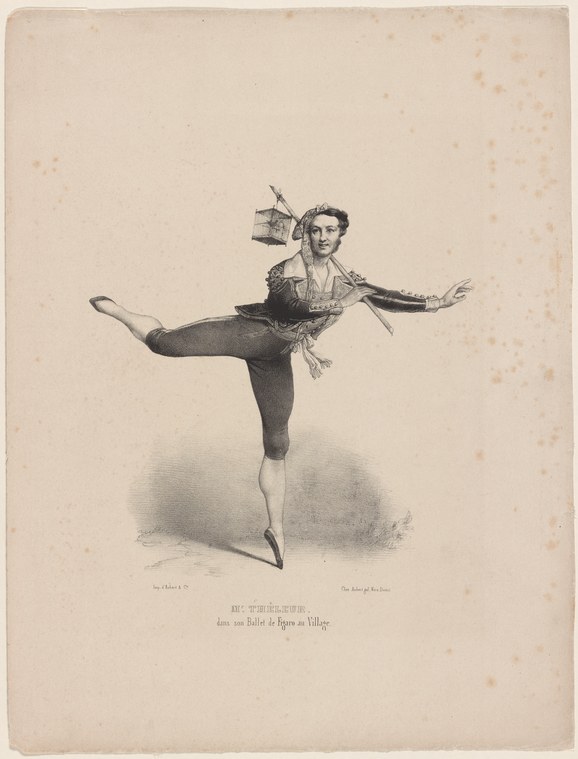
Mr. Théleur dans son ballet de Figaro au village
Unknown artist
- Collection:
- Prints depicting dance
- Source:
- New York Public Library
- Rights:
- Public domain — free to use, share and adapt.
- Recorded as:
- Public Domain
For historians of dance, this engraving is a rare visual record of a named performer in a named role, showing how the vocabulary of early Romantic ballet combined classical technique with character and pantomimic gesture. For art historians, it exemplifies the role of the theatrical portrait print in documenting and promoting popular entertainment to a urban audience.
What you are looking at
A male dancer in early 19th-century dress performs a solo gesture against a plain background. He wears a dark coat with ornate frogging or military-style trim, white breeches, and white stockings with dark shoes. His posture is theatrical and exaggerated: one leg is extended high to the side in an arabesque or attitude position, while his torso twists dramatically and both arms are raised and gesturing outward. His face is animated and expressive, gazing toward his raised hand. The figure is rendered in fine engraving technique with subtle cross-hatching to model form and create depth through a soft shadow beneath his feet. The pose suggests a moment of comic or character choreography—perhaps a mime of surprise or theatrical flourish—rather than classical ballet technique.
The dancing
A single male figure stands on one leg (the supporting foot pointed downward) with the other leg raised high and extended laterally, approaching or achieving a horizontal line at the hip. The torso is rotated, creating a spiral twist through the spine, while both arms are raised to roughly shoulder height with palms open in an expressive, conversational gesture. The upper body shows the flexible, gestural range of character or comedic dance rather than the rigid control of classical ballet. The pose combines elevation with rotational play and manual expression, suggesting a trained but pantomimic vocabulary.
The dance depicted
This depicts a scene from a ballet or theatrical entertainment titled *Figaro au village* (*Figaro in the Village*), performed by the dancer Théleur. The work appears to be either a character piece or a comedic ballet interlude from the early Romantic era, when such village-themed pantomime ballets were popular theatrical fare. The pose—a high leg extension combined with gestural mime—is characteristic of the French demi-caractère (half-character) dance vocabulary of the period, a middle ground between pure classical technique and full comic character dance. Without additional documentation, the specific choreographic identity cannot be confirmed, but the costume, technique, and theatrical framing suggest this was a performed work known well enough to warrant an engraved portrait.
How it was made
This is a steel or copper engraving, identifiable by the fine parallel lines (hatching) used to model form and shadow, the clean linear edges, and the uniform tonal gradations. The technique allows precise rendering of costume detail—the frogging, buttons, and fabric texture—and captures the liveliness of the pose through dynamic line work. Engravings of this type were produced in significant quantities during the early 19th century and distributed as single prints to theatregoers, serving as souvenirs and publicity for popular performers and roles. The print's legible scale and theatrical subject suggest it was aimed at a middle-class urban audience with access to theaters and the disposable income to purchase performance prints.
About this work
This is an engraved portrait of a specific dancer—Monsieur Théleur—performing in a named theatrical work. It documents an early 19th-century French ballet or pantomime-comedy, capturing both the individual performer and a moment of demi-caractère choreography that blended classical elevation with comic gesture. The work belongs to the substantial corpus of theatrical portraiture and performance documentation from the Romantic ballet era, when such prints served as both artistic record and commercial advertisement. The engraving format and theatrical subject place it within the wider print culture of European theater in the 1820s–1840s, when images of celebrated dancers were collected by theater enthusiasts.
How to look at it
Observe the rotational energy of the pose: the extended leg pulls the eye upward and outward, while the twisted torso and open-palm gestures project intention and personality outward. This is not a pose of pure classical balance but of narrative or comedic communication—the dancer is not simply demonstrating technique but 'saying' something through the body. Notice how the engraver has captured the moment of greatest extension and expressivity, freezing the movement mid-thought. The formal costume and theatrical framing (the signature at bottom) establish this as a documented performance event, not a dance study.
The period
The early 19th century saw the rise of the theatrical portrait engraving as a commercial genre, with celebrated opera singers, actors, and dancers becoming subjects of wide distribution prints. The Romantic ballet era (approximately 1830–1860) favored narrative and character-driven works—often set in exotic, rural, or comic locations—that required a broader choreographic vocabulary than the strict classical style. Pantomime and demi-caractère dancing, which combined high extensions and classical positions with expressive mime and character physicality, became central to these narratives. The village setting in *Figaro au village* reflects this taste for scenes of everyday or folk life, often treated with irony or charm.
Where it lives
The print is held in the New York Public Library's collection of prints depicting dance. It is identified in the catalogue by title and performer name but without recorded artist, date, or medium, suggesting it entered the collection as a loose theatrical print without full documentation.
Dance in this work
Questions about this work
Who was Théleur?
Monsieur Théleur was a dancer active in early 19th-century Paris. Beyond this engraving, documentary evidence is limited, but his presence in a theatrical print collection suggests he was a known performer in Parisian theaters, likely specializing in comic or character roles given the style of this pose and the rural comedy title of the work.
What is demi-caractère dance?
Demi-caractère (half-character) was a 19th-century category of theatrical dance that combined high extensions, turns, and elevations from classical ballet with the expressive mime and exaggerated gesture of comic character dance. It occupied a middle ground between pure classical technique and full comic acting, and was used in pantomime ballets, comedies, and character roles.
What was *Figaro au village*?
Likely a ballet or theatrical interlude based on Beaumarchais' comic plays about the character Figaro, set in a village. The work capitalized on the popularity of both the literary character and the Romantic era's taste for rural and folk-themed narratives in dance theater. Without surviving choreographic notation, the specific content cannot be confirmed.
Why do theatrical prints like this matter?
Before photography and film, engraved portraits were the primary means of documenting and circulating images of celebrated performers. They served as souvenirs, publicity, and visual records, and are now invaluable sources for understanding which roles were iconic, how performers were physically understood, and what the commercial dance theater looked like.
More dance artwork





