49 works in this view — arrow keys or swipe to move between them.
Dance in Art
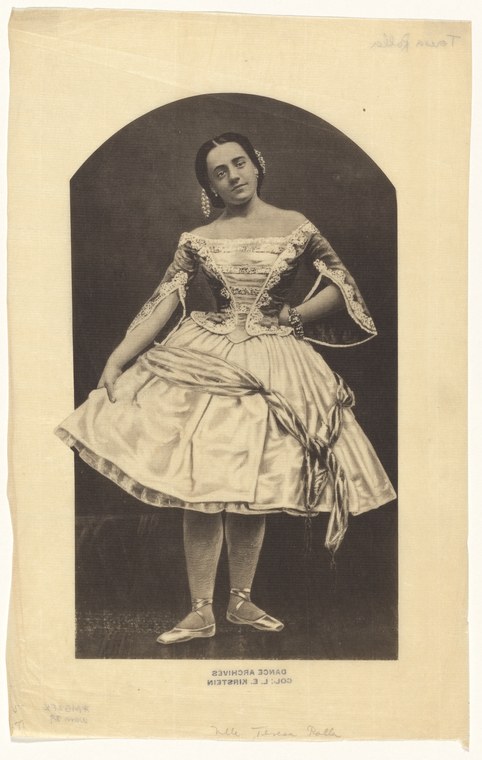
Mlle. Teresa Rolla
Unknown artist
- Collection:
- Prints depicting dance
- Source:
- New York Public Library
- Rights:
- Public domain — free to use, share and adapt.
- Recorded as:
- Public Domain
Studio portraits of named dancers are rare primary documents of performance history, especially from the Romantic era when most dancers' images survive only as lithographs. This photograph provides direct evidence of how a specific professional ballerina presented herself, the exact cut and fit of Romantic-era costume, and the conventions of pose and presentation that shaped how audiences understood ballet technique and beauty. It is simultaneously a work of theatrical art and a historical record.
What you are looking at
A young woman in mid-19th-century theatrical dress stands in a classical contrapposto pose against a dark background framed by an arched opening. She wears a white Romantic-era ballet costume: a fitted bodice with lace sleeves ending mid-forearm, a full skirt reaching just below the knee, white silk pointe shoes, and drop earrings. Her dark hair is pulled back smoothly. She holds the skirt's fabric gathered in her left hand, lifting it slightly to reveal her legs and feet—a pose that displays both the line of the body and the technical footwear central to the dance of her era. The lighting is dramatic, with strong definition between figure and void, characteristic of theatrical portraiture of the period. The composition emphasizes verticality and elongation of the body, conventions of ballet representation.
The dancing
The dancer stands with weight placed on her right leg in a slight turnout; her left leg appears relaxed and ready for movement. Her torso is upright and poised, shoulders level and open. The left arm is bent and raised to gather the skirt, displaying grace and control. The pose is neither frozen mid-movement nor a formal stance, but rather a composed presentation of the dancer's body and costume—a moment of readiness rather than action. The elegant S-curve of the silhouette and the pointed foot visible through the lifted skirt emphasize the balletic vocabulary of the Romantic period.
The dance depicted
This is a theatrical portrait of a professional ballet dancer in the Romantic era, likely dating to the 1840s–1860s based on costume details and photographic printing technique. The dancer is identified as Mlle. Teresa Rolla, a performer of this period. The costume—fitted bodice, full skirt, and pointe shoes—places her squarely in the Romantic ballet tradition. The pose itself was a conventional way of presenting a ballerina to a public audience, combining formality with evidence of technical training (the lifted skirt, the pointe shoes). The image documents both the aesthetic ideal of the period and a specific performer's professional identity.
How it was made
This appears to be a photographic print, likely from the carte de visite or cabinet card tradition that flourished in the mid-19th century. The printing technique—toned or albumen print on card stock—was the standard medium for theatrical portraiture of performers in this era, allowing mass circulation of images to fans and critics. The arched frame and careful studio lighting are typical of professional theatrical photography. The technique permitted detail and fidelity impossible in engraving alone, yet retained the compositional formality of earlier portraiture traditions.
About this work
This is a professional studio portrait of a mid-19th-century ballet dancer, Mlle. Teresa Rolla, captured in the costume and pose conventions of Romantic-era theatrical performance. The image documents the visual culture of professional ballet in the 1840s–1860s, preserving both the aesthetic ideals of the period and evidence of the technical training required. It belongs in a gallery of dance because it captures not a moment of performance but the controlled presentation of the dancer's body, costume, and technique to a public audience—a central form of how dance was understood and circulated in this era.
How to look at it
Attend to the dancer's feet: the lifted skirt deliberately reveals the pointe shoes, which were not merely functional but a visual declaration of training and status. Notice the pose is neither dynamic nor stiff—it is a composed presentation designed to display the body's line and the costume's construction. The arched frame and dark background are studio conventions that isolate the figure and emphasize verticality. The slight turn-out of the supporting leg and the elongated silhouette reflect the balletic aesthetic of the Romantic era.
The artist
The photographer is not recorded in the catalogue. The style and printing technique are consistent with professional theatrical photography studios of London, Paris, or other major European performance centers in the 1840s–1860s. Such studios typically employed skilled photographers and retouchers who specialized in ballet and opera portraiture, developing stock poses and compositions that performers and audiences recognized as authoritative representations of the ballet aesthetic.
The period
The Romantic ballet era (1830s–1870s) was defined by the dominance of female dancers, ethereal and otherworldly aesthetics, and the pointe shoe as a technical and visual marker of professional status. Mlle. Rolla's career falls within this period of European ballet's international expansion, when major dancers toured extensively and their images circulated through prints and photographs as commodities. The photograph documents the transition from hand-made theatrical prints to photographic documentation, a shift that allowed for unprecedented fidelity in preserving the appearance of specific dancers and their costumes.
Where it lives
The print is held in the New York Public Library's collection of prints depicting dance. It is catalogued as a theatrical portrait from the mid-19th century with the subject identified as Mlle. Teresa Rolla.
Dance in this work
Questions about this work
Was Teresa Rolla a famous dancer?
The catalogue does not record biographical details. Based on the quality of the portrait and professional printing, she was a performer of sufficient standing to merit a studio photograph, likely active in the 1840s–1860s. Many such dancers are now known only through their portraits.
Why is her skirt lifted in the pose?
Lifting the skirt was a standard convention in Romantic-era ballet portraiture, serving multiple purposes: it displayed the technical footwear (pointe shoes), revealed the dancer's leg and alignment, and demonstrated the ease and elegance with which a trained dancer controlled her costume. It was both a practical demonstration of technique and an aesthetic convention.
What do the pointe shoes tell us?
Pointe shoes were not universal in early Romantic ballet; their adoption marked a dancer's professional status and technical achievement. By the 1840s–1860s, they were nearly universal for female ballet dancers in Europe and were instantly recognizable to audiences as a marker of serious training and classical allegiance.
Is this a photograph or a print?
This is a photographic print, likely an albumen or toned print on card stock, typical of the carte de visite or cabinet card format popular for theatrical portraits in the mid-19th century. The technique allowed for detail and circulation that hand-made prints could not match.
More dance artwork





