49 works in this view — arrow keys or swipe to move between them.
Dance in Art
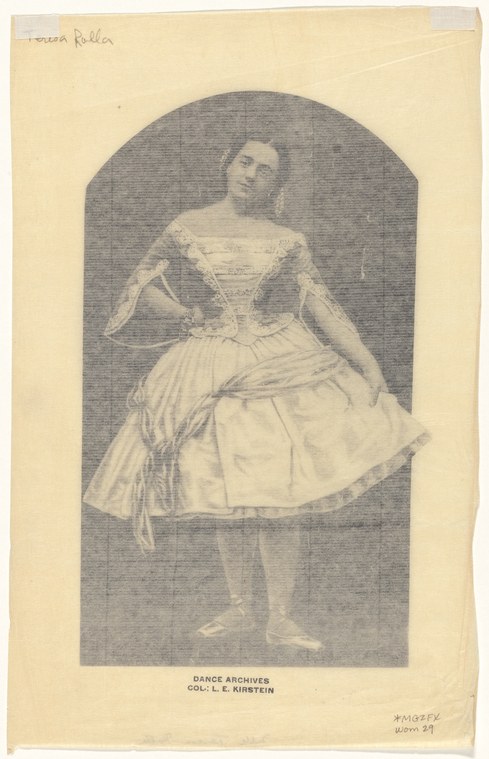
Mlle. Teresa Rolla
Unknown artist
- Collection:
- Prints depicting dance
- Source:
- New York Public Library
- Rights:
- Public domain — free to use, share and adapt.
- Recorded as:
- Public Domain
This engraving provides visual documentation of romantic-era ballet costuming and the physical presentation of a professional dancer at the height of the tradition's popularity. For historians and dancers, it is evidence of how the body was shaped, dressed, and presented in performance, and how the image of the dancer was constructed and circulated as a form of celebrity during this pivotal period in ballet history.
What you are looking at
A young woman in mid-nineteenth-century ballet costume stands posed within an arched frame that suggests a theatrical proscenium. She wears a white romantic tutu with a fitted, boned bodice that sits off the shoulders, the skirt constructed in layers of tulle that fall to mid-calf. Her posture is upright but graceful, with her weight appearing to rest primarily on her left leg while her right leg extends slightly forward and to the side, the foot pointed. Her arms are positioned asymmetrically—the left arm hangs at her side while the right arm is raised and bent, the hand positioned near the bodice. Her dark hair is pulled back smoothly, and her gaze is directed downward and to her left, lending the figure an introspective quality. The engraving technique renders her form in fine parallel lines that model the volume of the tutu and the contours of her body, while the arch framing device isolates her against a neutral background, emphasizing her as the sole subject of regard.
The dancing
The dancer stands in a position that recalls the classical ballet vocabulary of the mid-nineteenth century—a stance between standing and preparation for movement. The weight distribution and the angle of the extended leg suggest either a moment of stillness or the suspended instant between steps. The off-shoulder neckline of the bodice and the placement of the arms are characteristic of romantic-era ballet costuming, which prioritized a graceful, elongated line from shoulder through arm. The pose is fundamentally still and presentational rather than caught mid-action; this is a portrait of a dancer in her professional form rather than a document of a specific movement phrase.
The dance depicted
This is a romantic ballet dancer, most likely as she appeared in a role or during a performance in the mid-nineteenth century. The tutu length, neckline, and overall silhouette place her firmly within the romantic ballet tradition that dominated European stages from roughly the 1830s to 1860s. Teresa Rolla was an Italian ballerina active during this period, and this engraving likely documents either her performance costume or her professional likeness as a ballet performer. The pose and presentation are typical of celebrity portraiture of performing artists from this era—a formal, dignified rendering designed for circulation as a print or for inclusion in theatrical ephemera.
How it was made
This is an engraving, identifiable by the fine parallel hatching lines that model form and shadow, the precision of the line work, and the even tonal range characteristic of the medium. The technique allowed for precise rendering of costume detail and the refinement of line essential to capturing the elegant elongation valued in ballet imagery of the period. Engravings of this type were relatively inexpensive to produce in multiples and were circulated widely as prints, sold individually at theaters, included in periodicals, or collected as celebrity portraiture. The scale and presentation suggest this was intended for a general theatrical audience rather than a specialized or luxury market.
About this work
This is a mid-nineteenth-century engraved portrait of the Italian ballerina Teresa Rolla, presented in the professional costume and pose conventions of romantic ballet. The work documents both the material reality of ballet costume—the construction and silhouette of the tutu, the fitted bodice, the movement vocabulary implied by stance and arm position—and the broader cultural practice of circulating images of celebrated dancers through prints. The arched frame device and the formal, frontal presentation locate this within the tradition of theatrical portraiture that made individual performers into celebrities and allowed their images to circulate far beyond the theaters in which they performed. This is simultaneously a document of dance practice, a portrait of a celebrated artist, and an artifact of nineteenth-century print culture.
How to look at it
Attend to the costume first—the structure and construction of the tutu, the off-shoulder neckline, the fitted bodice, and how these elements frame and support the body. Then observe the stance and the direction of the gaze: this is not a moment of exertion or spectacle, but rather a composed, formal presentation designed to display the dancer as a professional and a celebrity. Notice how the arched frame isolates the figure and draws attention to her as the sole object of interest. The downward gaze and the subtle asymmetry of the pose create a sense of introspection or readiness rather than direct engagement with the viewer—a convention of romantic-era portraiture that emphasized the dancer's ethereal quality and distance from the everyday world.
The artist
The artist is not recorded. However, the style and execution are consistent with mid-nineteenth-century theatrical engravers working in Europe, likely in France or Italy. Such engravings were produced by established print workshops that specialized in theatrical portraiture, working from live observation, performance sketches, or posed sittings with the performers themselves. The quality of the execution suggests a skilled practitioner with knowledge of both the technical demands of engraving and the conventions of ballet costume and pose.
The period
The romantic ballet era (roughly 1830–1860) was the period of greatest cultural dominance for ballet in European artistic life. Female dancers became celebrated celebrities, and their images were circulated through prints, lithographs, and engravings as forms of theatrical publicity and popular portraiture. The tutu itself evolved during this period from a shorter, stiffer garment into the longer, layered romantic tutu visible here, which became one of the most iconic silhouettes in dance history. This was also the era in which ballet technique standardized around the vocabulary we recognize today—the turn-out, the five positions, the vocabulary of classical ballet. Engravings and lithographs of dancers were among the most popular prints of the period, circulated in the same markets as prints of actors, opera singers, and other celebrities.
Where it lives
This engraving is held in the New York Public Library's Dance Archives collection, a major repository of dance-related prints, photographs, and ephemera. It is catalogued as part of the broader holding of prints depicting dance, a category that includes theatrical portraits, costume studies, and performance documentation from multiple centuries and traditions.
Dance in this work
Questions about this work
How do we know this is romantic ballet and not classical ballet?
The tutu length is the primary indicator. Romantic tutus, as worn here, extend to mid-calf and are composed of multiple layers of tulle, creating a bell-like silhouette. Classical ballet tutus, which came later in the nineteenth century, are much shorter and sit at the hip in a flat, horizontal plane. The off-shoulder neckline is also characteristic of romantic ballet costuming, which emphasized a graceful, elongated line from the neck through the arm.
Why is the dancer's gaze directed downward?
This reflects the conventions of romantic-era ballet portraiture and the broader aesthetic of romanticism. The downward gaze, combined with the formal pose, creates an impression of introspection, grace, and a kind of ethereal remove from the everyday world. This was not a spontaneous choice but a deliberate artistic convention designed to present the dancer as a figure of refinement and elevated status.
What was Teresa Rolla known for?
The record does not provide detailed information about Rolla's career. However, her inclusion in the Dance Archives suggests she was a professionally celebrated dancer of the mid-nineteenth century. The quality of the engraving and its formal presentation indicate she held sufficient celebrity status to warrant distribution of her image as a print.
What does the arched frame suggest?
The arched frame is a theatrical device that references the proscenium arch—the frame of the stage itself. By placing the dancer within this arch, the engraver emphasizes that this is a theatrical figure, presented as if on stage. This was a common convention in theatrical portraiture and serves to locate the subject within the space of performance.
More dance artwork





