49 works in this view — arrow keys or swipe to move between them.
Dance in Art
Mlle. Rosati
Unknown artist
- Collection:
- Prints depicting dance
- Source:
- New York Public Library
- Rights:
- Public domain — free to use, share and adapt.
- Recorded as:
- Public Domain
Prints like this one are primary evidence of how nineteenth-century ballet dancers were marketed, remembered, and venerated—they shaped the image of the dancer in public consciousness. The hand-colored souvenir portrait was a crucial medium for spreading knowledge of ballet style and technique to audiences who could not attend performances, making works like this foundational to the history of dance as a popular visual culture.
What you are looking at
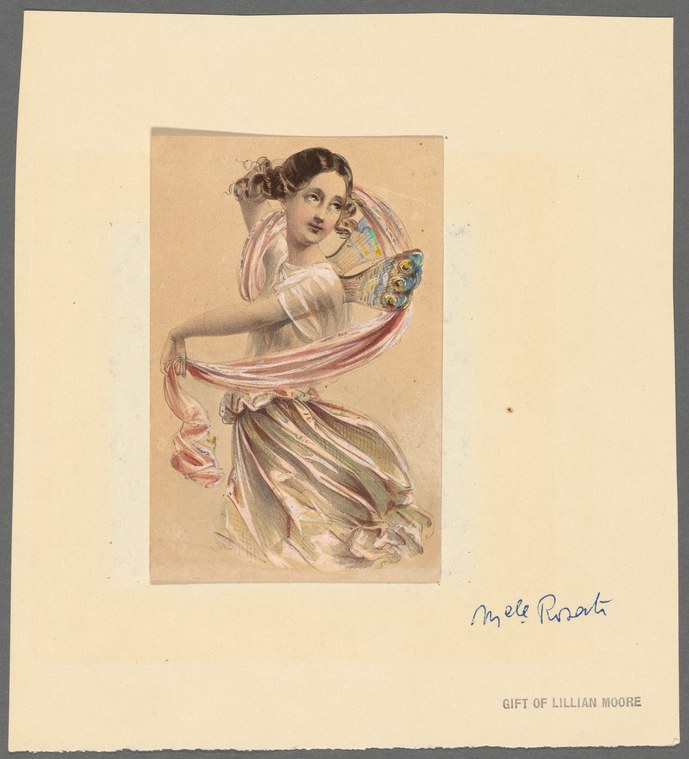
A young woman in Romantic-era dress is shown in a moment of theatrical gesture, her body caught in an expressive pose against a warm, neutral background. She wears a pale tulle skirt with darker accents at the hem and a fitted bodice, her dark hair arranged in period curls at the crown. Her arms are lifted in an elegant, curved line—the left arm raised and bent, the right extended—and her gaze is directed upward and to the side in a characteristic attitude of reverie or aspiration. Colored ribbons or drapery in pink and blue wind around her figure, creating a sense of movement and ethereality. The composition is a three-quarter length portrait, isolating the figure against the pale ground in a manner typical of theatrical prints and souvenirs of the era.
The dancing
The figure is captured in a single, sustained pose of lifted arms and upright carriage. The left arm curves upward with the elbow bent and hand near the face; the right arm extends diagonally across the body. The torso is straight and elongated, the weight appears centered, and the legs are not visible. The pose suggests a moment of sustained, controlled elevation rather than active step-work—a held attitude of the kind typical of Romantic ballet tableaux.
The dance depicted
This is a Romantic ballet image, almost certainly a souvenir portrait of a professional dancer. The pose, costume, and deportment are consistent with the vocabulary of mid-nineteenth-century ballet—specifically the kind of ethereal, vertically-oriented stance favored in works like La Sylphide or Giselle. The raised arms in a soft curve, the lifted gaze, and the tulle skirt are all hallmarks of Romantic ballet aesthetics. The inscription 'Mlle. Rosati' identifies the subject as a named professional dancer, whose image was being circulated as a commercial print.
How it was made
This is a hand-colored lithograph or engraving, executed with delicate precision and enriched with watercolor or chromolithographic tinting. The technique allowed for soft modeling of the figure, subtle gradation of tone, and the addition of bright color accents in the ribbons and dress details. Such prints were mass-produced and sold to theater audiences as affordable souvenirs and collectibles—a significant market in the mid-nineteenth century for fans of the ballet.
About this work
This is a portrait souvenir of Mlle. Rosati, a professional Romantic-era ballet dancer, printed as a theatrical keepsake. The image captures the aesthetic vocabulary of mid-nineteenth-century ballet: the ethereal tulle costume, the lifted and curved arm position, the upward gaze, and the sense of weightlessness and aspiration. Such prints were among the primary ways that dance imagery circulated beyond the theater, shaping public understanding of ballet technique and the glamour of professional dancers. The work belongs in a dance collection as a record of both Romantic ballet practice and the visual culture that surrounded it.
How to look at it
Attend to the refinement of the arm position and the upward tilt of the head—these convey the dancer's control and her aspiration, which were central values in Romantic ballet. Notice the treatment of the tulle skirt, which is rendered with enough detail to suggest its weight and texture while still appearing weightless. The colored ribbons are not incidental decoration but part of the vocabulary of Romantic theatricality. The pose itself is held and static, not captured mid-step; this was a common choice for souvenir portraits, emphasizing the dancer's ability to sustain an ideal line rather than to move.
The artist
The artist is not recorded. Hand-colored theatrical prints of this kind were often produced by commercial lithography shops and print publishers rather than signed artists; the focus was on the subject—the named dancer—rather than the maker. The inscription 'Gift of Lillian Moore' on the verso indicates the print was part of a significant dance archive, but does not identify the original publisher or artist.
The period
This print dates to the height of Romantic ballet, approximately 1840–1860, when the art form was at peak popularity in European and American theaters. Ballet had shifted from the classical court tradition to a new aesthetic emphasizing ethereality, otherworldly characters, and technical virtuosity in pointe work. Lithography and hand-coloring had become the dominant commercial print media, allowing theaters and dancers to produce affordable souvenirs that fed a growing consumer appetite for images of celebrated performers. Mlle. Rosati was a prominent dancer of the mid-nineteenth century, likely Italian or French, and her image would have circulated among ballet enthusiasts.
Where it lives
The print is part of the NYPL's collection of prints depicting dance, acquired as a gift from Lillian Moore, a significant twentieth-century dance historian and collector whose archive became foundational to the study of nineteenth-century ballet.
Dance in this work
Questions about this work
Who was Mlle. Rosati?
Mlle. Rosati was a professional ballet dancer active in the mid-nineteenth century. The exact dates of her career and her full name are not established in this record, but she was notable enough to have her portrait published as a commercial souvenir print, indicating she was a celebrated performer of her era. Such prints were issued for popular dancers whose images sold to theater audiences.
What was this print for?
This was a souvenir portrait sold to ballet audiences. Such prints allowed fans to own an image of their favorite dancers and were a significant form of popular culture in the nineteenth century. They functioned much as photographs and printed posters would later—as affordable, portable mementos of performers and performances.
How do we know this is ballet?
The tulle skirt, the lifted arms in a soft curve, the upright carriage, and the ethereal pose are all characteristic of Romantic ballet aesthetics. The dancer's deportment and costume are consistent with the vocabulary of mid-nineteenth-century ballet technique and theatrical style. The commercial souvenir format also confirms this was a professional dancer being marketed to theater audiences.
What technique was used to make this print?
This appears to be a lithograph or engraving that was hand-colored. The soft modeling of the figure, the delicate line work, and the watercolor or chromolithographic color all suggest a commercial print process designed for mass production. Such techniques were ideal for producing affordable, visually appealing theater souvenirs.
More dance artwork





