49 works in this view — arrow keys or swipe to move between them.
Dance in Art
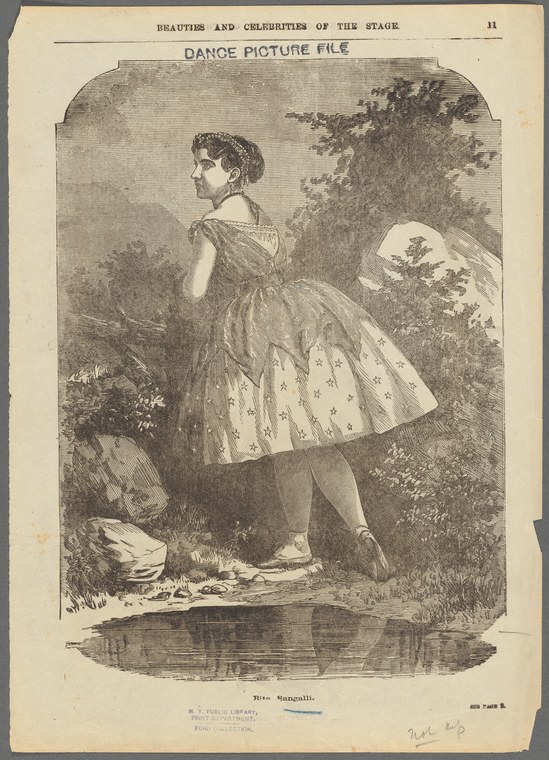
Rita Sangalli; Beauties and celebrities of the stage [on the verso: Madame La Grange]
Unknown artist
- Collection:
- Prints depicting dance
- Source:
- New York Public Library
- Rights:
- Public domain — free to use, share and adapt.
- Recorded as:
- Public Domain
This image documents both a specific dancer of international fame and the visual and choreographic vocabulary of Romantic ballet at its height. It is one of thousands of such engravings produced in the mid-nineteenth century, yet each one is evidence of how a particular movement phrase looked, what audiences paid to see, and how dance was circulated and remembered before photography.
What you are looking at
A young woman in mid-nineteenth-century dress stands alone beside a woodland stream, turning to gaze over her shoulder toward the viewer. She wears a pale printed cotton dress with a fitted bodice and full skirt gathered to her waist, the skirt adorned with a small-scale floral or geometric pattern across the lower half. Her dark hair is pinned up in the style of the 1840s–50s. She has thrown a shawl or light wrap across one shoulder, and her posture suggests arrested motion—the weight rests on one leg while the other appears ready to move. The setting is Romantic in mood: trees frame the composition on both sides, their foliage rendered in deep shadows, and the foreground opens onto still water that reflects the dim landscape. The image is an engraving, printed on aged paper, with the title "Rita Sangalli" inscribed below and a collection mark visible at bottom left.
The dancing
The figure stands in a pose of turning or half-pivot, with her weight shifted onto the back leg and her upper body rotated to face the viewer. The forward arm hangs loosely at her side; the rear arm is drawn back, the hand positioned near her skirt. Her head is tilted slightly in the direction of turn, and her gaze is direct and engaging. The pose suggests a moment of suspension between steps—neither fully frontal nor fully in profile, but caught mid-rotation. The lightness of her frame and the fluency of the turn suggest trained movement.
The dance depicted
This is almost certainly a moment from Romantic ballet, depicting a solo of the kind that dominated the European stage in the 1840s–50s. The costume, pose, and Romantic woodland setting all point to the sylph or nature-spirit roles that Rita Sangalli would have danced. The turn suggests the kind of épaulement and port de bras characteristic of ballet of this period—the rotation of the torso controlled and deliberate, the arm carriage refined. Whether this engraving documents an actual performance or is a stylised portrait-pose in costume cannot be determined from the image alone, but the precision of the positioning and the theatrical context suggest it may record a known choreographic moment.
How it was made
This is an engraving, executed in the wood or steel engraving technique that allowed fine detail and clean reproduction. The image shows the characteristic parallel hatching and careful gradation of tone used to model flesh, fabric, and shadow. Engravings of this type were widely reproduced and distributed as illustrated supplements to journals and collected in volumes like the one from which this sheet came—making them a principal form of dance documentation and publicity in the mid-nineteenth century. The paper is aged and shows foxing typical of the period.
About this work
This engraving depicts the celebrated dancer Rita Sangalli in a moment from Romantic ballet—a solo turn executed in a woodland setting that embodies the spirit and visual language of mid-nineteenth-century theatrical dance. Sangalli was a major international star of the 1860s–70s, celebrated for her technical brilliance and dramatic presence; this image circulated as a souvenir and promotional portrait, freezing a single moment of performance that audiences would have known from the theatre. The work belongs to the rich tradition of dance portraiture that used engraving to distribute images of celebrated dancers to subscribers and opera-goers across Europe and America.
How to look at it
Look at the precision of the pose: the engraver has captured the exact degree of rotation in the torso, the angle of the head, and the carriage of the arms. This level of specificity suggests either a known choreographic position or a careful study from life. Notice too the material detail—the pattern of the skirt, the texture of the shawl, the way the weight of the body settles into the stance. The woodland setting was not accidental: it placed the dancer in the Romantic world her audience inhabited imaginatively during the performance. The artist chose a moment of stillness and turning rather than a leap or extreme extension, which suggests a preference for épaulement and control over virtuosity.
The artist
The artist is not recorded in the catalogue. The engraving comes from a series titled "Beauties and Celebrities of the Stage," a commercial publication that employed skilled reproductive engravers to create portraits of famous performers from live performance, costume sketches, and photographs. Such series were produced throughout Europe and America by commercial print houses and sold to theatregoers and collectors.
The period
The 1840s–50s were the height of the Romantic era in ballet, when the female dancer—often depicted as a sylph, spirit, or otherworldly being—dominated the stage. The aesthetic emphasised weightlessness, long skirts, and settings of nature and fantasy. Rita Sangalli danced in this tradition and later became a major figure in the Paris Opéra, where she introduced elements of Italian virtuosity to the French repertoire. Engraving was the dominant form of dance reproduction before lithography and photography; while photographs existed by the 1860s, engravings remained the medium of choice for theatrical publications because they could be easily mass-produced and combined with type.
Where it lives
This engraving comes from the New York Public Library's collection of prints depicting dance and is part of the series "Beauties and Celebrities of the Stage." The holding suggests it was a commercial publication assembled and distributed to subscribers or sold at theatres and print shops.
Dance in this work
Questions about this work
Who was Rita Sangalli?
Rita Sangalli (1831–1909) was an Italian-born dancer and choreographer who became a leading star of European ballet in the mid-nineteenth century. She was celebrated for her technical virtuosity, dramatic presence, and beauty, and performed extensively in Paris, London, and across Europe. She later returned to Italy as a choreographer and teacher, influencing the development of Italian ballet.
What is Romantic ballet?
Romantic ballet (c. 1830–60) was characterised by the dominance of the female dancer, often portrayed as a supernatural or ethereal being. It emphasised pointe work, long tutus, ethereal movement quality, and exotic or fantastical settings. Major works include La Sylphide and Giselle.
How do we know this is ballet and not another kind of dance?
The costume is the primary clue: the fitted bodice, full skirt, and pointe work visible in the stance are all conventions of mid-nineteenth-century ballet. The woodland setting and the graceful, controlled posture align with the Romantic aesthetic. The theatrical context (a series of "celebrities of the stage") and the artist's name confirm this is a commercial dance portrait.
Is this from an actual performance or a posed portrait?
It is likely a theatrical portrait in costume—a carefully posed image made for reproduction and sale, rather than a document of a specific moment in a specific performance. However, the precision of the position suggests it may represent an actual choreographic phrase that Sangalli performed regularly.
More dance artwork





