49 works in this view — arrow keys or swipe to move between them.
Dance in Art
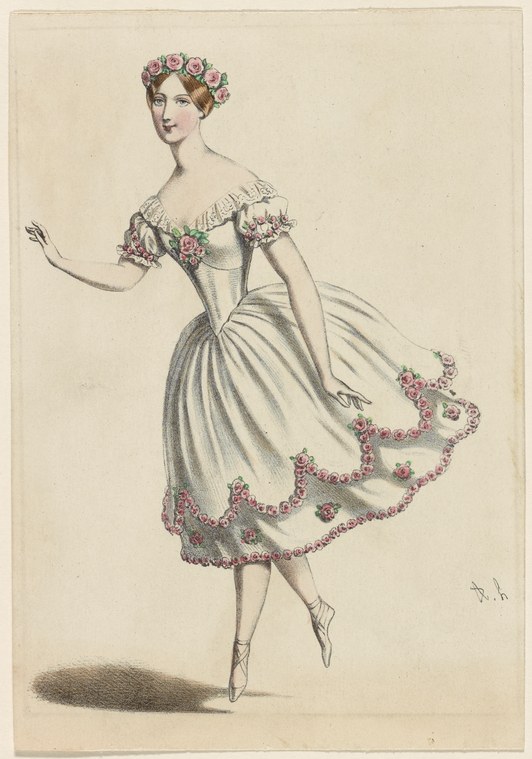
Acad. Royale Musique. Mlle Carlotta Grisi dans Le diable à quatre (acte 2e)
Unknown artist
- Collection:
- Prints depicting dance
- Source:
- New York Public Library
- Rights:
- Public domain — free to use, share and adapt.
- Recorded as:
- Public Domain
This print preserves the visual record of one of the 19th century's most influential ballerinas in a role that helped define Romantic ballet spectacle. It shows not only how Grisi's body was admired and idealized but how Romantic ballet itself was marketed, consumed, and circulated through popular prints that shaped public memory of the art.
What you are looking at
A single female dancer in a pale tulle skirt adorned with pink roses is shown in a moment of graceful elevation or near-weightlessness, poised on the ball of one foot with the other leg extended behind her. She wears a fitted bodice with off-shoulder sleeves trimmed with matching roses, and a floral wreath crowns her head. The skirt, cut with a distinctive scalloped hem also decorated with clustered pink flowers, billows around her in soft vertical pleats. Her raised right arm gestures expressively outward with an open palm; her left arm hangs at her side. She faces slightly left, her expression serene and upward-gazing. The figure is rendered against a plain cream ground with a subtle shadow beneath her feet, emphasizing her aerial suspension. The drawing technique combines fine linear work with delicate hand-coloring of the floral elements.
The dancing
A single dancer en relevé or in a pose suggesting a moment of flight. Her weight is supported on one pointed foot while her other leg extends behind in a balletic line. The torso is upright and elegant; the raised arm frames the body in an attitude of lyrical expression rather than technical display. The positioning and the softness of the gesture suggest a Romantic rather than strictly classical technical vocabulary. The dancer's frame conveys weightlessness and grace—key conventions of mid-19th-century ballet aesthetics.
The dance depicted
This is a portrait of Carlotta Grisi, the Italian prima ballerina of the Romantic era, in the role of Diabolo from the opera-ballet *Le Diable à quatre* (1845), a comic work by Adolphe Adam. The image captures the character in Act II, where the ballet scenes were prominently featured. Grisi was celebrated for her technical brilliance and dramatic presence, and this image emphasizes the ethereal, weightless quality that defined Romantic ballerina imagery—pointe work, the floating tutu, and an emotional rather than purely virtuosic display.
How it was made
This is a hand-colored engraving or lithograph—the fine parallel lines visible in the drapery and the precise linear definition of the figure are characteristic of reproductive printmaking of the 1840s. The floral details were added with watercolor or hand-applied pigment, a common practice for theatrical portraits of this era. Such prints were widely distributed as souvenirs of successful opera-ballet performances and as celebrity portraits, making them accessible to a broad middle-class audience beyond those who could attend the theatre.
About this work
This is a souvenir print documenting Carlotta Grisi's performance in a leading role of the Romantic ballet era. It belongs to a well-established tradition of theatrical portraiture—cheap, colorful, widely circulated—that celebrated the stars of opera and ballet in the 1840s. The work is as much a document of celebrity culture and print technology as it is evidence of how Romantic ballet was visualized and remembered: graceful, weightless, emotional, and decorative. The floral ornamentation is not merely costume detail but a statement about the ideal feminine body as conceived in mid-19th-century dance.
How to look at it
Notice the artist's choice to freeze the dancer in a moment of near-weightlessness rather than a grounded or technical moment—the floating leg, the off-balance arm gesture, the soft focus on emotion over precision. The abundant floral ornamentation is significant: it transforms the dancer's body into a living bouquet, a Romantic conflation of feminine beauty and natural beauty. The scalloped hem of the skirt and the climbing roses are not merely decorative but ideological, encoding contemporary values about grace, delicacy, and the body of the ballerina.
The artist
The artist is not recorded in the catalogue. However, the quality of the engraving and the colorwork suggest a professional theatrical print publisher, likely Paris-based, where such souvenirs of Opéra performances were a standard commercial product in the 1840s. Such prints were often produced by publishing houses that employed multiple engravers and colorists rather than single named artists.
The period
The 1840s were the height of the Romantic ballet era, when ethereal, weightless movement and emotionally charged narratives replaced the technical virtuosity of earlier classical ballet. Carlotta Grisi embodied this aesthetic and was a central figure alongside Marie Taglioni. *Le Diable à quatre* (1845) was a comic opera-ballet that showcased Grisi's versatility. Theatrical prints of this period were the principal way most people encountered ballet dancers; they were affordable, reproducible, and widely displayed in homes, shops, and studios.
Where it lives
This print is held in the New York Public Library's collection of prints depicting dance. It is a mass-produced theatrical souvenir from the 1840s, one of likely many thousands issued during the run of the opera and afterward as a celebrity portrait.
Dance in this work
Questions about this work
Who was Carlotta Grisi?
An Italian ballerina (1819–1899) who became one of the most celebrated dancers of the Romantic era. She premiered the role of Giselle in 1841 and was known for her technical skill, dramatic presence, and beauty. She performed across Europe and was a fixture of the Paris Opéra during the 1840s.
What is *Le Diable à quatre*?
A comic opera-ballet by Adolphe Adam (music) and Eugène Scribe (libretto), premiered in 1845 at the Paris Opéra. The plot involves a devil (Diabolo) causing mischief among mortals. It was a popular vehicle for virtuosic dancers and featured extensive ballet scenes.
Why are there so many flowers?
Flowers were a signature visual element of Romantic ballet imagery, symbolizing grace, beauty, femininity, and otherworldliness. They adorned both the stage costumes and the prints that circulated afterward, making the dancer's body itself a floral object of beauty.
How was this print made?
It is a hand-colored engraving or lithograph, a reproductive printmaking technique that allowed a single image to be multiplied many times. The fine line work was printed, then watercolor or pigment was applied by hand, making each print slightly unique while keeping production costs low.
More dance artwork





