49 works in this view — arrow keys or swipe to move between them.
Dance in Art
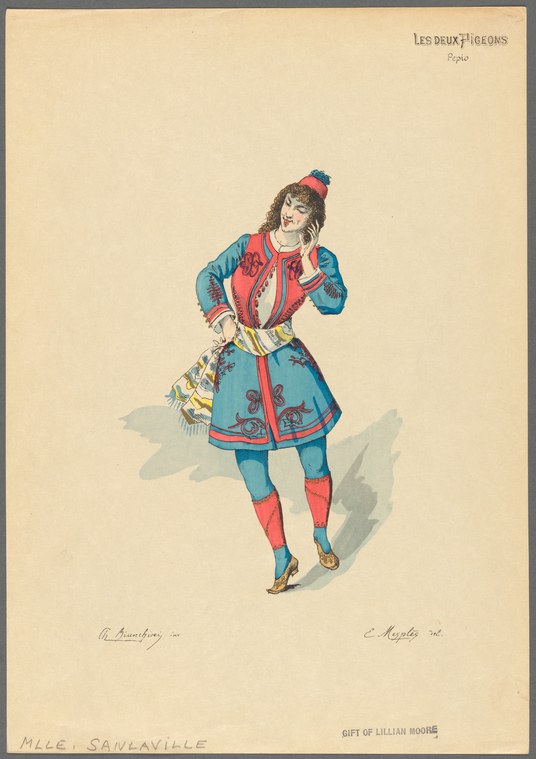
Les deux pigeons, Pepio
Unknown artist
- Collection:
- Prints depicting dance
- Source:
- New York Public Library
- Rights:
- Public domain — free to use, share and adapt.
- Recorded as:
- Public Domain
This document preserves the physical presence and costume of a historical performer in a specific role, offering insight into how character and comedy were constructed in theatrical dance of the period. For dancers and historians, it provides concrete visual evidence of what a named role actually looked like in performance—what was worn, how the body was positioned, and what kind of energy or personality the movement conveyed.
What you are looking at
A single female dancer occupies the center of the composition, posed in a moment of spirited motion against a pale cream background. She wears a striking costume combining blue and red: a blue dress with red trim and ornamental details at the hem, blue stockings, and red socks or ankle cuffs. A red hat with a plume sits atop her dark curled hair. In her left hand she holds what appears to be a fan or decorative accessory with gold or yellow detail. Her right arm is bent and held at her side in a relaxed posture, while her left arm extends slightly outward. Her weight appears to rest on her right leg, with the left leg bent or raised in a casual, jaunty manner. The figure is rendered in a delicate chromolithographic style with subtle watercolor shading that gives dimensional quality to the costume and a soft shadow beneath the dancer's feet.
The dancing
A single female dancer is captured mid-movement in what appears to be a playful, confident stance. Her weight rests primarily on one leg while the other is bent or slightly raised, suggesting a moment of pause or transition between steps rather than a formal ballet position. Her arms are held loosely at her sides and slightly away from her body, contributing to an air of casual ease. The dancer's posture and facial expression convey personality and animation rather than the rigid formality of classical technique.
The dance depicted
This appears to be a costume study or theatrical character dance from the late 19th or early 20th century, likely from a pantomime or narrative ballet. The title *Les deux pigeons* (The Two Pigeons) refers to a comic ballet pantomime popular in European theaters during this period, and "Pepio" may refer to a specific character role. The figure's playful stance, decorative costume, and the work's function as a sketch or reference document suggest this documents a performer's interpretation of a comedic or character role rather than classical ballet vocabulary.
How it was made
This is a chromolithograph—a color printing process that allowed for multiple colors to be printed from separate stone or metal plates. The delicate hand-coloring and the subtle gradations visible in the costume and background suggest this may be a hand-tinted or enhanced print rather than a purely mechanical reproduction. This technique was economical enough to allow for wide distribution as theatrical documentation or fan materials, yet fine enough to preserve the grace of the original design. The precision of line-work and the soft modeling of form indicate skilled production.
About this work
This is a theatrical costume plate documenting a character role from *Les deux pigeons*, a pantomime ballet that enjoyed lasting popularity across European stages in the 19th and early 20th centuries. The work functions as both a record of stage fashion and a study of character movement, capturing a moment of playful energy that defines the comic spirit of the role. Such prints served multiple purposes: as souvenirs for theatergoers, as reference materials for costume makers and performers, and as evidence of how specific roles were physically embodied and presented. The work belongs in a dance archive because it preserves not only the aesthetic of a historical performance but also the physical vocabulary—the stance, the gesture, the bearing—that distinguished a particular character interpretation.
How to look at it
Observe the dancer's weight distribution and the angle of the planted leg—this is not a balletic fifth position or a rigid classical pose, but rather a moment of relaxed confidence that suggests narrative or character work. Notice how the costume's visual drama—the color contrast, the plumed hat, the decorative fan—directs attention toward personality and stagecraft rather than pure movement technique. The slight tilt of the head and the overall buoyancy of the pose convey playfulness and charm, qualities central to comic pantomime. This is a character captured as a personality, not as a technical demonstrator.
The artist
The artist is not recorded in the catalogue, but the quality and signature style of the work suggest professional theatrical documentation. The inscription at the bottom includes what appear to be a performer's name or character designation (partially legible) and possibly a costume or stage designer's credit. The work's production values and circulation (held by the New York Public Library as a theater print) indicate it was created within the established theatrical supply chain of the period.
The period
This work dates to the era when pantomime ballet and comic character dances were central to European and American entertainment, particularly in the decades around 1900. The costume's style—the silhouette, the trim, the hat—aligns with Edwardian or Belle Époque fashion. *Les deux pigeons* itself dates in its most famous version to 1886 (choreography by Louis Mérante), and the work enjoyed multiple revivals and regional productions well into the 20th century. The print medium and the theatrical documentation practice reflect a period when dance was increasingly documented and circulated through visual culture as entertainment, publicity, and historical record.
Where it lives
This print is held in the New York Public Library's collection of theatrical prints and ephemera. The gift attribution to Lillian Moore, a prominent dance historian and curator of the 20th century, suggests it entered the collection as part of her personal archive or through her curation and indicates its recognized value as dance documentation.
Dance in this work
Questions about this work
What is *Les deux pigeons* and why was it performed so often?
*Les deux pigeons* (The Two Pigeons) is a comic ballet pantomime, most famously choreographed by Louis Mérante in 1886. It tells the story of two peasants and their romantic entanglements with broad humor and slapstick elements. Its popularity stemmed from its blend of classical ballet technique with accessible comedy and character work, making it suitable for a wide range of theaters and audiences. It remained in active repertory across Europe and America for decades, with multiple regional productions and revivals.
How do theater prints like this one get used?
Theatrical prints served multiple functions: they were sold to audiences as souvenirs after performances, distributed to costume makers and set designers as reference materials, used by theaters as publicity, and collected by dance enthusiasts and historians. They were affordable enough to circulate widely but detailed enough to preserve important information about how roles were actually performed and costumed on specific stages at specific times.
What can you tell from the dancer's posture about her training?
The dancer's stance—weight on one leg, relaxed arms, a casual bent-knee position—suggests a performer comfortable with character and pantomime work rather than purely classical technique. This does not mean she was untrained; rather, it shows she was trained to shift between the formal vocabulary of ballet and the naturalistic, personality-driven movement of comic theater. The elegance of her bearing and the control evident in her balance indicate solid technical foundation.
More dance artwork





