31 works in this view — arrow keys or swipe to move between them.
Dance in Art · 2019
The polka
Unknown artist
- Medium:
- Lithograph
- Dance:
- Polka
- Era:
- Late 1800s (Victorian Ballroom)
- Source:
- New York Public Library
- Rights:
- Public domain — free to use, share and adapt.
- Recorded as:
- public_domain
This work illustrates how ballroom dances were promoted and romanticized through popular prints in the nineteenth century, particularly the polka's status as a major social phenomenon. It shows that dance documentation of this period was often more concerned with costume, posture, and appeal than with capturing the actual mechanics or partnership of the dance itself.
What you are looking at
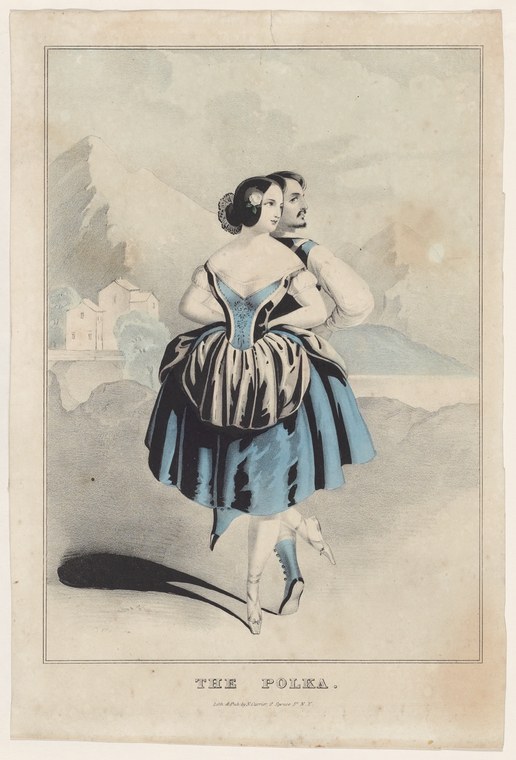
A single female dancer stands in three-quarter pose against a pale, atmospheric background suggesting an outdoor setting with distant architecture. She wears a blue dress with a fitted bodice and voluminous skirt, paired with a dark striped shawl or cape draped across her shoulders. Her dark hair is styled close to her head in the fashion of the mid-nineteenth century. She gazes over her shoulder with a contemplative expression, her body twisted slightly, one arm raised to her neck or shoulder in a graceful gesture. The lithograph employs subtle wash tones to create depth and volume in the fabric, while her shadow falls distinctly across the ground, anchoring the figure in space. The composition isolates the dancer as a study of both costume and posture, presenting her as a subject of artistic interest rather than in a narrative scene.
The dancing
The dancer stands with weight on one leg in a relaxed but elegant stance, her body turned away from the viewer while her head looks back. Her raised arm traces a curved line from her body to her neck, suggesting ease and poise rather than active movement. The other arm hangs at her side. Her posture is upright but not rigid, the kind of arrested moment that might occur between phrases of dance rather than at its peak of action. She appears to be a soloist rather than part of a couple or group.
The dance depicted
This is a polka, one of the most popular ballroom dances of the nineteenth century. The polka is traditionally a couple dance in closed or semi-closed hold, making this solo presentation of a female dancer unusual. The image likely shows either a moment between dances, a costume study for theatrical performance, or the kind of promotional or decorative image used to popularize the dance. The costume—the full skirt, the fitted bodice, the shawl—reflects how women performed the polka in mid-century ballrooms and on stage. The contemplative pose suggests the image may be a romanticized portrayal of the dancer as subject, rather than a document of the dance itself in action.
How it was made
This is a hand-colored lithograph, a reproductive medium that allowed mass circulation of dance imagery in the nineteenth century. Lithography's capacity for fine tonal gradation is evident in the soft modeling of the fabric and the atmospheric background. The coloring—blue for the dress, subtle flesh tones, muted blues for the shawl—appears to be applied by hand or in a limited number of color passes, a standard practice for popular dance prints of this era. Such images circulated as theatrical souvenirs, sheet music covers, or fashion plates, reaching audiences beyond theater and ballroom.
About this work
This hand-colored lithograph is a character study of a female dancer in mid-nineteenth-century polka costume. The work presents the dance not as action but as a moment of repose or contemplation, the dancer's elegant bearing and fashionable dress on display. It belongs to the vast body of promotional and decorative imagery that made the polka one of the defining social dances of the Victorian era, reaching the public through prints, periodicals, and theatrical programs. The image documents both the dance's popularity and the conventions of how women's ballroom dancing was depicted and consumed as entertainment and fashion.
How to look at it
The artist has chosen a moment of stillness rather than action, inviting the viewer to admire the dancer's bearing and dress rather than to read movement or technique. The pose—turned away, looking back—was a conventional gesture of feminine grace in the period, and the raised arm creates an elegant line that emphasizes posture. The background is deliberately vague, pushing attention toward the figure. Notice how the lithograph's soft tones and the draping of the shawl create a sense of ease and refinement, qualities that made the polka appealing to respectable Victorian society despite its origins as a popular, somewhat rowdy dance.
The period
The polka emerged in Bohemia in the 1830s and swept across Europe and America by mid-century, becoming the dominant social dance of the 1840s–1870s. Unlike the stately waltz, the polka's quick, bouncy tempo and lively character appealed to a broader and more mixed social audience. Its popularity coincided with a boom in dance prints, lithographed sheet music covers, and theatrical dance imagery. This print reflects that moment when the polka was no longer a novelty but an established feature of ballroom culture and popular entertainment. Female dancers began to appear regularly in theatrical polka performances, and their costumes became part of the visual identity of the dance.
Where it lives
This print is held by the New York Public Library, part of their collection of dance, theatrical, and popular imagery from the nineteenth century.
Dance in this work
Questions about this work
Was the polka a solo dance?
No—the polka was primarily a couple dance, typically performed in closed hold or in pairs facing each other. This image presents a solo study, likely made for promotional or theatrical purposes rather than as a document of how the polka was actually danced in ballrooms. Such single-figure prints were common ways to publicize dances and the performers who embodied them.
Why is she looking over her shoulder?
The over-the-shoulder glance was a conventional pose in mid-nineteenth-century portraiture and costume studies, conveying grace, refinement, and a sense of approachable elegance. It was a popular attitude in theatrical imagery of the period and does not necessarily correspond to any moment in the actual dance.
What is the shawl for?
The shawl was practical and fashionable wear for women in the 1840s–1860s, worn indoors and in ballrooms. In this image it serves both to show costume detail and to create visual interest through its draped folds and striped pattern, demonstrating the aesthetic appeal of the polka dancer as a fashionable figure.
More Polka artwork