49 works in this view — arrow keys or swipe to move between them.
Dance in Art
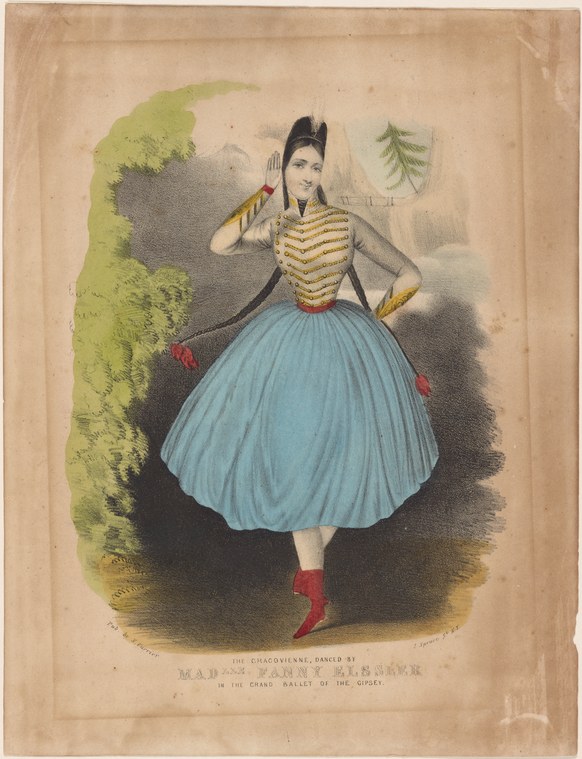
The cracovienne, danced by Madlle Fanny Elssler in the grand ballet of The gipsey
Unknown artist
- Collection:
- Prints depicting dance
- Source:
- New York Public Library
- Rights:
- Public domain — free to use, share and adapt.
- Recorded as:
- Public Domain
Fanny Elssler was a major star of the Romantic ballet, and images of her in character roles are rare and valuable documents of 19th-century performance practice and costume. The Cracovienne was a signature vehicle for her, and this print preserves the visual record of a now-lost theatrical tradition. For dance historians, it shows how national dances were adapted, performed, and represented to European and American audiences in the pre-photographic era.
What you are looking at
A young female dancer stands in a three-quarter pose against a softly rendered background of green foliage and gray shadow. She wears a striking military-inspired jacket with horizontal gold and white striped banding across the torso, fitted sleeves, and what appears to be decorative buttons or frogging. Below this she wears a voluminous pale blue skirt gathered into deep vertical pleats, which falls to mid-calf and suggests considerable freedom of movement. Her feet are shod in bright red ankle boots. Her dark hair is swept up and styled with a pronounced forward sweep or pompadour. Her right arm is raised to shoulder height with the hand near her head in a graceful, slightly coquettish gesture; her left arm rests at her side. The pose is alert and engaging, turned slightly toward the viewer, with a composed expression. The composition is intimate and focused entirely on the figure; no musicians, stage setting, or other dancers are visible.
The dancing
A single dancer occupies the frame in a relaxed contrapposto, weight settled on one leg with the other free. The raised arm and hand-to-head gesture suggest a moment of repose or playful self-presentation rather than active movement. The posture is upright and dignified despite the coquettish hand position. The voluminous skirt and its deep pleating indicate a garment designed for rotation and lift, though the dancer is shown stationary rather than in motion.
The dance depicted
This is a representation of the Cracovienne (also Krakowiak), a Polish national dance of lively character that was incorporated into Romantic-era ballet and popular theatrical entertainment. The title attributes it to Fanny Elssler, the celebrated Austrian ballerina who danced principal roles in the 1830s–1840s and was known for her interpretations of character dances and national styles. The image shows her in character costume—the striped jacket and red boots are distinctly Eastern European in flavor—but the moment chosen is one of pause rather than active dancing. The blue skirt and its construction suggest a theatrical adaptation of folk dress designed for the stage rather than ethnographic accuracy.
How it was made
This is a hand-colored lithograph, a reproductive medium that allowed for mass production and distribution. The colored portions—the green foliage, blue skirt, gold striping, red boots, and flesh tones—have been applied by hand or in successive stone passes, giving the print a softer, more painterly quality than an engraving. The gray background and subtle modeling of the figure show the lithographic stone's capacity for tonal subtlety. Such prints were the primary means of circulating images of famous performers to a broad audience in the 1830s–1840s, before photography.
About this work
This is a lithographed portrait of Fanny Elssler performing the Cracovienne from the ballet *The Gipsey* (or *La Gipsy*), a work that exemplified the Romantic era's fascination with national character and folk dance. Elssler was one of the most celebrated dancers of her generation, known for roles that showcased technical brilliance and dramatic character work. The Cracovienne was part of a wider 19th-century balletic fashion for incorporating peasant and national dances into theatrical spectacle, often in sensationalized or romanticized form.
The print captures not a moment of frenetic movement but a composed portrait of the dancer in character, as if she has stepped out of the stage action to present herself to the audience. The attention to costume detail—the unusual military-inspired jacket, the precise pleating of the skirt, the red boots—reflects the visual importance of theatrical dress to the Romantic ballet audience. This object is both a souvenir of a famous performer and evidence of how national identity and exoticism were packaged and consumed as entertainment.
How to look at it
The artist has chosen a moment of stillness and self-presentation rather than action, inviting the viewer to examine the costume and the performer's presence rather than her technique. The forward-facing, three-quarter pose is typical of theatrical portraiture and allows the costume details—the striped jacket, the skirt's pleating, the boots—to be fully visible and legible. The raised hand and composed expression create a sense of personality and theatrical charm; this is a portrait of a star, not a technical display. The soft, tonal background keeps attention on the figure without the distraction of a detailed stage setting.
The artist
The artist is not recorded. The print is a commercial theatrical souvenir, likely produced by a professional lithographic shop in London or New York in the 1830s–1840s. Such prints were standard merchandise associated with touring dancers and were sold at theaters, in street markets, and by print dealers. The quality and finish suggest a reputable urban publisher rather than a hack operation, and the hand-coloring shows professional care.
The period
The 1830s–1840s were the height of the Romantic ballet era, when ballets centered on supernatural, exotic, or emotionally turbulent subjects and when the ballerina—rather than the male dancer—became the dominant figure on stage. This was also the era of Romantic Orientalism and primitivism in European art and culture: fascination with distant lands and peoples, expressed through costumes, musical motifs, and choreography that were more theatrical fantasy than ethnographic fact. National dances from Poland, Spain, Scotland, and the Middle East appeared regularly in ballets of this period, often danced by European ballerinas in character costume. Fanny Elssler's tour of the United States (1840–1842) made her one of the first international celebrities, and prints like this one flooded the market to meet demand.
Where it lives
The print is held in the New York Public Library's collection of prints depicting dance. It is a commercial theatrical souvenir of the 1830s–1840s, likely printed in Europe or America and sold as a standalone item or in collected series of performers.
Dance in this work
Questions about this work
Who was Fanny Elssler?
Fanny Elssler (1810–1884) was an Austrian ballerina and one of the most famous dancers of the Romantic era. She was celebrated for her technique, her dramatic presence, and her interpretations of character dances and national styles. She performed throughout Europe and made a triumphal tour of the United States in 1840–1842, where she became a celebrity and cultural icon.
What is a Cracovienne?
The Cracovienne (or Krakowiak) is a lively Polish national dance in duple meter. It was popular among the Polish nobility and became fashionable in European ballrooms and theaters during the 19th century. In theatrical dance, it was often adapted and stylized, performed by ballerinas in national costume as a character divertissement or solo.
What is *The Gipsey*?
*La Gipsy* (The Gipsey) was a ballet choreographed by Joseph Mazilier with music by Ambroise Thomas, premiered in Paris in 1839. Fanny Elssler danced the title role. The ballet was part of the Romantic-era fashion for exotic and picturesque subjects; it told a melodramatic story featuring a gypsy heroine, and included national dances and colorful local-color scenes.
Why was this print made and who bought it?
Theatrical prints were mass-produced souvenirs sold to fans and admirers of famous performers. They served as both mementos of a performance and advertisements for the dancer's talent and popularity. They were sold at theaters, in print shops, and in the streets, and were affordable enough for a wide audience. For wealthy collectors, they might be bound into albums or displayed in the home.
More dance artwork





