49 works in this view — arrow keys or swipe to move between them.
Dance in Art
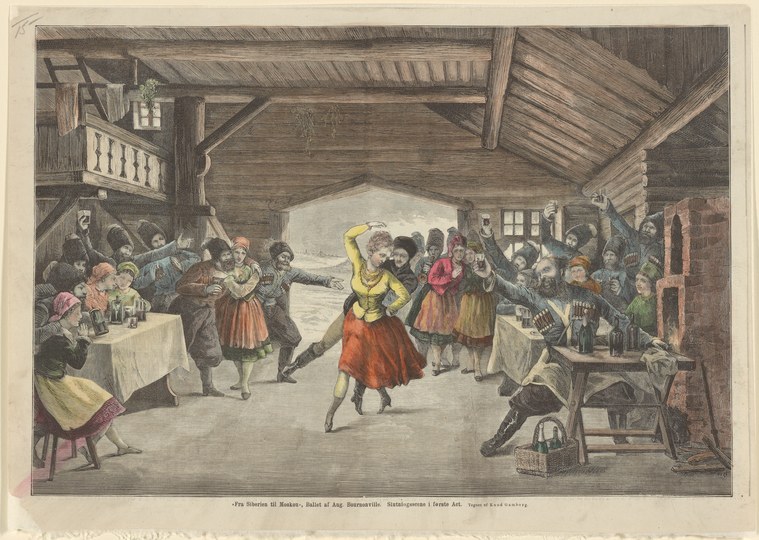
Fra Siberien til Moskou, Ballet af Aug. Bournonville, Slutnings-scene i første Act
Unknown artist
- Collection:
- Prints depicting dance
- Source:
- New York Public Library
- Rights:
- Public domain — free to use, share and adapt.
- Recorded as:
- Public Domain
Bournonville was one of the two or three most influential ballet makers of the 19th century, yet his work survives primarily in notation and in accounts like this one. The image is evidence of what Romantic-era folk-character ballet looked like in motion—the body position, the spatial arrangement, the relationship between soloist and crowd—and documents a performance tradition largely invisible after the dancer who embodied it retired. For historians of Bournonville style, this print is a primary source.
What you are looking at
A wood-beamed barn or hall fills with festive dancers in a Romantic-era ballet scene. The space is deep and shadowed, lit from a bright doorway or opening at the center-back that creates strong chiaroscuro and draws the eye inward. The crowd is dense and animated: figures in period dress—women in long skirts, men in coats and breeches—cluster on both sides of the floor, some seated at tables with bottles, others standing and gesturing. At the center, a woman in a striking yellow-trimmed costume and red skirt executes a prominent solo step, her body in a spirited, off-balance attitude that reads as exuberant folk celebration rather than court formality. The composition is theatrical and crowded, with the solo figure commanding attention against the watching crowd and the dramatic light from behind.
The dancing
The central dancer stands in an energetic, asymmetrical pose with her weight shifted and arms raised in a folk or character style—not the turned-out alignment of classical ballet. Her extended leg and off-vertical carriage suggest vigorous, naturalistic movement rather than strict technique. The surrounding figures are more static: onlookers in various attitudes of attention, some seated, some standing with arms at rest or gestures of encouragement. The composition emphasizes the solo dancer's prominence and the collective witnessing of the crowd rather than synchronized partnering or formation.
The dance depicted
This depicts a scene from Auguste Bournonville's ballet *Fra Siberien til Moskva* (From Siberia to Moscow), specifically the finale of the first act. Bournonville, the dominant ballet master of the Copenhagen Royal Ballet in the 19th century, specialized in blending classical technique with folk character and earthy naturalism—a departure from the ethereal Romantic ideal. The image shows the folk-celebration moment that his narratives often climaxed: a village dance or feast scene where peasant energy and joy break through the story. The dancer's off-balance carriage and the rustic wooden hall setting are consistent with Bournonville's use of character dance within a classical frame.
How it was made
This is a hand-colored engraving or aquatint, a reproductive print technique of the 19th century. The fine parallel lines of the hatching and the careful tonal modeling in the shadows confirm engraving; the coloring has been applied by hand to highlight the costumes (the red skirt and yellow trim stand out sharply) and create narrative clarity. Such prints were made for theatrical promotion and cultural documentation, circulating among dancers, patrons, and the general public interested in stage spectacle. The technique allowed for wide distribution of scenes that would otherwise be visible only to those who attended performances.
About this work
This hand-colored engraving documents a moment from a major Danish ballet of the mid-19th century, capturing Bournonville's signature blend of classical ballet with folk character and vernacular energy. The image is an artifact of theatrical promotion and remembrance—a way for audiences who saw the performance (or hoped to) to hold the moment and the work in memory. It belongs in a dance gallery because it shows not only what a Bournonville ballet scene looked like, but what the 19th century chose to commemorate and circulate about its own dance practice: a celebration of communal joy and earthy character as a climax to dramatic action.
How to look at it
Notice the central dancer's off-vertical stance and raised, unstudied arms—classical ballet of the same period emphasized turnout, upright carriage, and restrained port de bras. The artist has frozen a moment of exertion and joy, not poise. Look also at the crowd: the artist uses the watching figures to frame and validate the solo dancer's action, turning the stage into a shared social space rather than a romantic vision. The light from the rear opening is deliberately theatrical and painterly—it is not realistic barn light, but the artist's way of telling you this is a stage and a spectacle.
The artist
The artist is not recorded. The print was made for theatrical promotion or for inclusion in illustrated accounts of the Royal Theatre productions. Such reproductive engravings were typically made by specialized theatrical print workshops in Copenhagen, often under contract to the theatre itself or to publishers documenting the Romantic stage.
The period
The mid-19th century saw ballet split between the ethereal, otherworldly Romantic aesthetic (ghosts, sylphs, supernatural beings) and a parallel tradition of character and folk dance set in everyday or peasant contexts. Bournonville, trained in the French ballet tradition but based in Copenhagen from 1830, developed a particular synthesis: he used folk idioms, comedy, and earthy naturalism to ground his narratives and to celebrate the body in motion for its own sake, not as a vehicle for tragedy or the supernatural. This print was likely made in the 1840s or 1850s, when Bournonville's fame was at its height in the Nordic region and when such promotional prints were a standard part of theatrical marketing.
Where it lives
The print is held in the New York Public Library's collection of prints depicting dance. It is an artifact of 19th-century theatrical documentation and promotion, circulated to audiences and preserved as a record of an important performance and a celebrated work.
Dance in this work
Questions about this work
Is this a real scene or did Bournonville make it up?
The ballet *Fra Siberien til Moskva* was a full narrative work first performed in 1847. The plot involved a journey and various encounters, and like most Bournonville ballets, it culminated in a village celebration or festa. The scene shown here is a real moment from the actual ballet as performed, not invented for this print, though the print's artist chose which moment to commemorate.
How do I know this is actually Bournonville choreography and not just a dance scene?
The title inscribed on the print names the work and the choreographer explicitly. The style of the central dancer—the character dress, the folk-derived movement vocabulary, the integration with a crowd scene—is consistent with what we know of Bournonville's practice from other sources, notation, and accounts.
Why did they make prints of ballets?
In the 19th century, before film or photography, prints were the primary way to document and circulate images of stage spectacle. They served as publicity, souvenirs, and historical records, allowing people who had not seen the ballet to imagine it, and giving those who had seen it a tangible memory.
More dance artwork





