49 works in this view — arrow keys or swipe to move between them.
Dance in Art
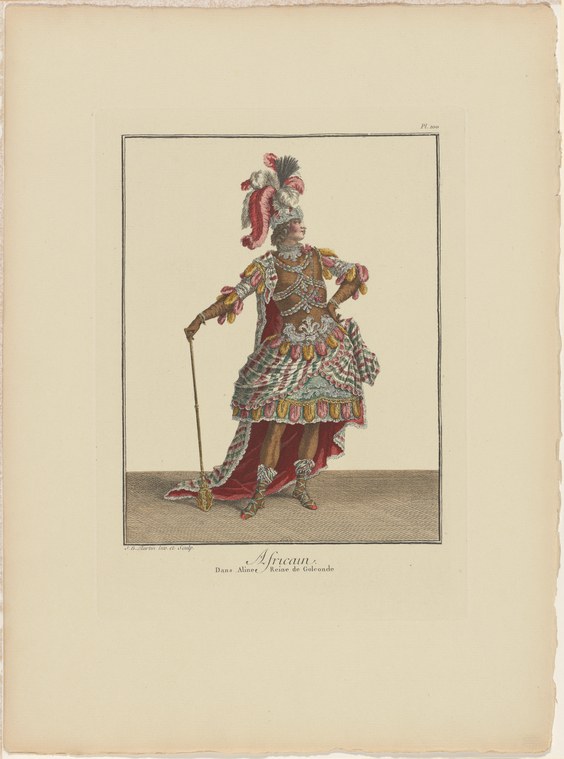
Africain dans Aline, reine de Golconde
Unknown artist
- Collection:
- Prints depicting dance
- Source:
- New York Public Library
- Rights:
- Public domain — free to use, share and adapt.
- Recorded as:
- Public Domain
This print reveals how non-European characters were imagined and performed in European courts and commercial theaters during the age of empire: not as autonomous cultural actors but as decorative, exoticized roles within a European theatrical grammar. The work demonstrates the tight connection between costume, character type, and the visual documentation of dance and theater; it also marks a moment when theatrical printing and hand-coloring made performance images available to a broad audience.
What you are looking at
A single figure in elaborate dress stands in a shallow stage space against a neutral background, holding a slim cane or stick in the right hand. The dancer wears a richly patterned costume of red, gold, and decorative trim: a fitted jacket with ornate embroidery and jeweled detail over a full skirt with bold geometric or scalloped borders in red, white, and gold. A tall feathered headdress, red and white, rises from the head. The left hand is raised and bent, the right leg extends slightly forward, and the stance suggests a moment of courtly pause or address rather than active motion. The figure appears androgynous or exaggerated in the manner of 18th-century theatrical caricature. The print is hand-colored with delicate work on fabric patterns and metallic tones.
The dancing
A single performer in a standing pose with weight held upright and formal. The right arm drops with hand resting on a cane; the left arm rises with elbow bent and hand positioned at chest height—a gesture of presentation or address. The right leg steps slightly forward. The posture is static and stately rather than dynamic, suggesting a moment of display or pronouncement rather than active dance movement. The proportions and exaggeration of the figure suggest theatrical artifice and costume spectacle.
The dance depicted
The work depicts a character in the 18th-century theatrical tradition, most likely from the opéra-comique or ballet-pantomime repertory. The inscription 'Africain dans Aline, reine de Golconde' identifies this as a character role from Aline, reine de Golconde (Aline, Queen of Golconda), a work that circulated in French theaters of the period. The figure is presented as an 'African' character—a common device in European Enlightenment theater—in exotic, elaborate court dress. The pose captures a theatrical moment of display or speech rather than an active dance step, consistent with the dramaturgy of opéra-comique and its integration of sung dialogue, pantomime, and stylized movement.
How it was made
This is a hand-colored engraving or etching, executed with fine line work and careful cross-hatching for shading and texture. The engraved line defines contour and ornament with precision; the hand-coloring—applied in transparent washes and opaque pigments—renders the rich fabrics and jeweled effects of the costume. The technique allows both the fine detail of embroidery and the broader decorative patterns of the skirt. As a hand-colored theatrical print, it belongs to the tradition of disseminating costume designs and character portraits for the stage, circulating among theater enthusiasts, dancers, and the fashionable public.
About this work
This is a hand-colored engraving of a theatrical character from the 18th-century French opéra-comique, preserved in the New York Public Library's print collection. It documents not primarily a dance in motion but a moment of theatrical presentation: a single figure in elaborate, exoticized costume addressing the viewer or waiting offstage. The work belongs to the visual archive of European theater costume and character types, where the staging of racial and exotic difference was a standard feature of popular entertainment. It captures the intersection of dance, theater, costume design, and the visual politics of the age.
The print format and hand-coloring indicate it was made for circulation, not as a unique work. It served as both a record of a performed role and a commodity for fashionable collectors and theater patrons. It is one of many such prints documenting the repertory and star performers of the period, making it valuable evidence of what dancers wore, how characters were conceived, and what the public saw.
How to look at it
Look at the posture: the stillness and formality of the stance, the cane as an accessory of address and authority, the raised hand as a gesture of presentation rather than motion. The artist has frozen not an active step but a moment of theatrical display—a pause in which the character announces itself to the audience. Attend to the costume: every surface is pattern and ornament, from the jeweled jacket to the geometric skirt border to the feathered headdress. This excess of decoration is itself a marker of exoticism and spectacle, a visual language that the contemporary audience would have read as 'other' and 'foreign.' The print's hand-coloring emphasizes this richness, making the costume the primary subject.
The period
This work dates to the period of the opéra-comique and its greatest popularity in France, likely mid-to-late 18th century. Aline, reine de Golconde was a successful work in this genre, which combined spoken dialogue, sung airs, and pantomime in vernacular French. The theatrical exotic—the staging of distant lands, non-European characters, and tropical fantasy—was a dominant theme in European entertainment of the Enlightenment and after. Such roles were performed by professional actors and dancers in comedic or decorative parts. The hand-colored print was a commercial product, part of the expanding market for theatrical imagery alongside the growth of commercial theater and a reading and viewing public with disposable income.
Where it lives
The work is held in the New York Public Library's collection of prints depicting dance, a collection organized by subject rather than medium or artist. It is catalogued by title and iconography rather than artist attribution, suggesting either that the maker was unknown to the archive or that the emphasis fell on the theatrical character and work rather than the printmaker's name.
Dance in this work
Questions about this work
What is 'Aline, reine de Golconde'?
Aline, reine de Golconde was an opéra-comique, a French theatrical work combining dialogue, song, and staged action, popular in the 18th century. The story involved exotic settings and magical or fantastical elements, typical of the genre. Prints like this one documented the costumes and characters audiences saw, making them objects of collection and fashion reference.
Why is this figure labeled 'Africain' (African)?
In 18th-century European theater, characters designated as 'African' were stock types in exotic or comedic roles, usually performed by European actors in costume. This was a visual and narrative convention of European entertainment that reflected the period's hierarchies of race and empire, not a documentary record. The label tells us how the European theater imagined and staged difference.
Is this a record of an actual dancer?
Not necessarily. The print may document a specific performer in a specific production, or it may be a generalized design for the character type. Without additional archival records, we cannot know whether this represents a particular star or a stock role that many dancers performed. The print preserves the costume and character conception rather than a unique performance.
How was this made and who would have owned it?
This is a hand-colored engraving, made by first incising lines into a metal plate and then printing the image, followed by hand-painting with watercolor or gouache. It was a luxury product for theater enthusiasts, collectors, and fashionable households. Such prints circulated among patrons interested in theater, costume, and the latest entertainments of Paris or other major cities.
More dance artwork





