49 works in this view — arrow keys or swipe to move between them.
Dance in Art
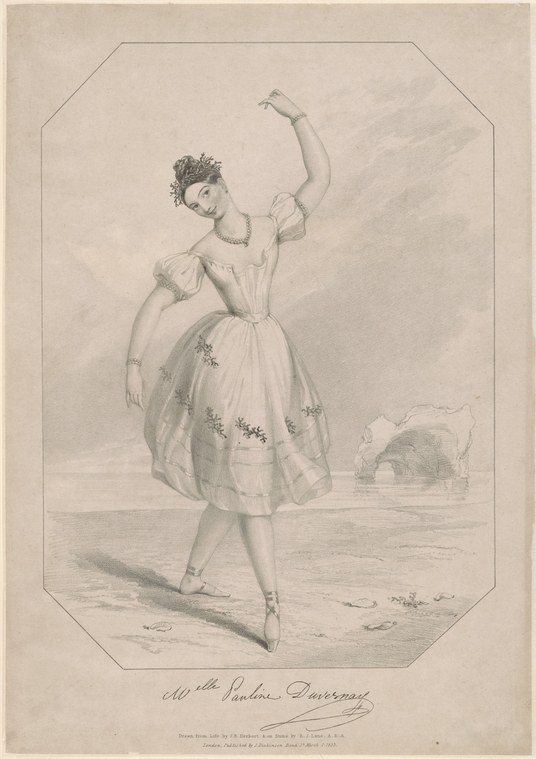
Melle Pauline Duvernay [facsimile signature]
Unknown artist
- Collection:
- Prints depicting dance
- Source:
- New York Public Library
- Rights:
- Public domain — free to use, share and adapt.
- Recorded as:
- Public Domain
Duvernay was a major star whose career bridged the late Romantic and early modern ballet eras; this image is contemporary documentation of how she was seen and presented to the public. The pose and costume are direct evidence of the actual movement vocabulary and visual codes of Romantic ballet as it was danced and understood in this period, not as it is now reconstructed.
What you are looking at
A young woman in a neoclassical dress stands alone on a stage or bare floor, captured mid-movement in a pose of arrested motion. She wears a high-waisted white or pale muslin gown with a fitted bodice and short puffed sleeves, the skirt decorated with small floral sprigs and caught up asymmetrically as if mid-pirouette. Her dark hair is styled up with a decorative band or wreath. Her right arm extends upward in an elegant curve while her left hangs at her side; her weight is lifted onto the ball of one foot in a pose suggesting elevation or balance. In the background, barely sketched, lies a prone figure—possibly a piece of scenery or a recumbent dancer. The composition is drawn in fine pencil on paper, with soft shading that gives the figure dimensional form while keeping the background minimal and atmospheric.
The dancing
A solitary female dancer stands in a lifted, balletic posture with significant weight through one leg and the other foot pointed or arched beneath her. The raised arm follows a line of elegant extension; the pose suggests either preparation for or recovery from a jump or turn. The proportions and deportment—the long neck, the alignment of the torso, the articulation of the feet—are those of a trained dancer of the early nineteenth century. The minimal musculature and the extreme lightness of the pose convey the ethereal quality demanded by the Romantic ballet aesthetic.
The dance depicted
This is a portrait of the Romantic-era ballet dancer Pauline Duvernay, one of the celebrated ballerinas of the 1830s–1840s. The pose and costume align with the aerial, weightless ideal of Romantic ballet: the pale dress, the pointe work suggested by the arch of the foot, the elevated carriage. The small floral decorations on the skirt and the overall delicacy of presentation are consistent with the sylph-like aesthetic of works such as *La Sylphide* (1832). The signature at the bottom confirms the subject, though the artist's name is not recorded. This is a celebrity portrait in the form of a dance image—Duvernay was a major star, and such prints were sold to the theatre-going public as souvenirs.
How it was made
This is a lithographic or engraved print (the technique cannot be established with certainty from the image alone, though the fine parallel hatching and the delicate line are consistent with lithography or steel engraving). The pale tone, the careful modulation of shadow, and the careful preservation of white paper for the muslin dress suggest a print meant for wide circulation—these were inexpensive compared to oil paintings and reached middle-class homes. The signature of the subject is printed as part of the image, a common practice for celebrity dance prints of the period, which served as both artistic documents and commercial memorabilia.
About this work
This is a celebrity portrait of Pauline Duvernay, one of the most celebrated ballet dancers of the Romantic era, captured in a pose that embodies the aesthetic ideals of her time and company. The image documents not only Duvernay's fame but the conventions of Romantic ballet as they appeared to the public: the weightless grace, the pale costume, the uplift and extension of the body. As a printed image distributed to theatre audiences, it is a document of how dancers were marketed and remembered, and of what audiences understood by the term 'ballet' in the 1830s and 1840s.
How to look at it
Notice the extreme lightness of the pose: almost no weight seems to rest on the supporting leg, and the raised arm is held without tension, as if the dancer were floating rather than working. This is the visual signature of Romantic ballet, achieved through years of training but designed to appear effortless. The artist has chosen a moment of suspension—neither the takeoff nor the landing of a jump, but the pause in between—which was the defining moment of Romantic aesthetics. The minimal setting and the gentle shading focus all attention on the body and its relationship to gravity.
The artist
The artist is not recorded in the catalogue. The signature on the print is that of the subject (Pauline Duvernay), not the printmaker. The style and finish suggest a professional theatrical portraitist working in Paris or London in the 1830s or 1840s, when such celebrity dance portraits were a significant commercial genre.
The period
Pauline Duvernay was a leading dancer of the 1830s–1840s, the golden age of Romantic ballet. This was the era of *La Sylphide* (1832), *Giselle* (1841), and the rise of the ballerina as the central figure of ballet spectacle. The pale muslin dress, the pointe work, the weightless pose, and the solitary presentation of the female dancer all reflect the Romantic ballet aesthetic: the fascination with the supernatural, the ethereal, the unattainable. In the same period, lithography and steel engraving made such images widely available, democratizing access to the iconography of theatre and contributing to the cult of the ballerina.
Where it lives
The work is held in the New York Public Library as part of its collection of prints depicting dance. It is a commercial lithographic or engraved print, one of many such dance portraits produced for theatrical circulation and public sale in the nineteenth century.
Dance in this work
Questions about this work
Who was Pauline Duvernay?
Duvernay (1813–1894) was a French-Italian ballerina who became one of the great stars of the 1830s and 1840s. She was known for her technical brilliance, her dramatic intensity, and her role in establishing the ballerina as the central figure of ballet spectacle during the Romantic era. She danced in Paris, London, and across Europe, and her fame was such that portraits of her, like this one, were sold as theatrical merchandise.
How were ballet dancers represented and marketed in this period?
Celebrity dance portraits were a major form of theatrical publicity and fan culture in the nineteenth century. Lithographs and engravings of famous dancers were sold in theatre lobbies and shops, signed by the dancer and often dedicated to patrons or other dancers. These images shaped public understanding of ballet and created a visual language of elegance and refinement that was central to the ballet's appeal to middle-class audiences.
What does the pose tell us about Romantic ballet technique?
The lifted, weightless posture, the delicate arm placement, and the apparent effortlessness of the pose reflect the core aesthetic of Romantic ballet: the illusion of the body freed from gravity, often achieved through pointe work (dancing on the tips of the toes). This image is evidence that the technique was already central to ballet performance in the 1830s–1840s, not a later development.
Why is this print important as a historical document?
It is contemporary visual evidence of how a major ballet star was seen, dressed, and presented to the public. Unlike written descriptions or later reconstructions, it shows the actual costume conventions, the pose language, and the visual codes of Romantic ballet as audiences experienced it. It is also evidence of the commercial machinery around dance in the nineteenth century—how dancers were marketed and how images of dance circulated.
More dance artwork





