49 works in this view — arrow keys or swipe to move between them.
Dance in Art
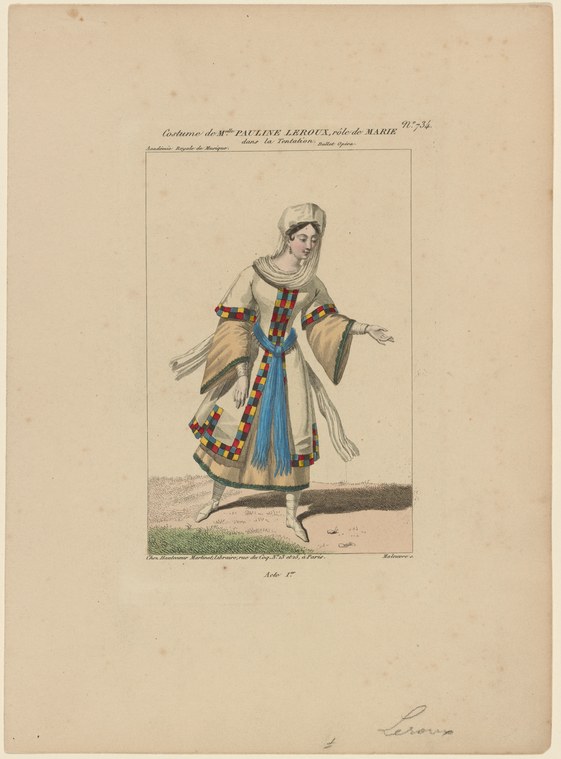
Costume de Melle. Pauline Leroux, rôle de Marie, dans La tentation, ballet opéra, Académie royale de musique, acte 1er
Unknown artist
- Collection:
- Prints depicting dance
- Source:
- New York Public Library
- Rights:
- Public domain — free to use, share and adapt.
- Recorded as:
- Public Domain
This work is a primary source for understanding how Romantic-era ballet dancers were costumed and promoted to the public. The tartan and Eastern European elements offer specific clues about the narrative content and visual exoticism of *La Tentation*—information often lost in historical summaries. For dance historians, costume reconstructors, and performers researching historical roles, this print is a rare named record of an actual dancer in an actual role, with precise rendering of cut, material, and trim that no written description could convey.
What you are looking at
A single female dancer in mid-performance is shown in three-quarter view against a plain background. She wears a long white chemise or undergown topped by a sleeveless tunic or overdress in pale tan or cream with a deep rolled collar. Over this sits a short cloak or cape in the same material, lined and bordered with a bold plaid or tartan pattern in red, yellow, and black. The garment is cut to fall from the shoulders and catch at the arms, creating wide, dramatic folds. She wears what appears to be a white head covering or kokoshnik (a traditional Slavic headdress) pulled forward. Her left arm is extended outward with palm open, the gesture relaxed and expressive. Her right arm hangs at her side. Her posture is upright but the overall carriage is graceful and animated; her weight appears to settle on her right foot, with the left leg slightly bent and advanced, suggesting a moment of gentle forward motion or a pause in stepping. The setting is minimal: a thin green ground line suggests a stage or platform. The whole work is rendered in hand-colored engraving or lithographic technique with delicate tonal shading.
The dancing
A single female dancer in a classical theatrical pose. Her frame is open and frontal, with both arms away from her body—left extended and slightly upward, right relaxed at her side—suggesting a position of poise between steps. Her spine is straight but not rigid; the bent left knee and engaged forward hip suggest she is neither at rest nor in rapid motion but captured in a moment of graceful transition. The costume's wide sleeves and swept cloak create a visual amplification of her arm position. Her head is slightly lifted, face in profile, gaze directed outward—a typical convention of Romantic-era ballet portraiture.
The dance depicted
The inscription identifies this as a costume design for Pauline Leroux in the role of Marie from the ballet-opéra *La Tentation* (The Temptation), Act 1, performed at the Académie royale de musique (the Paris Opéra). The work belongs to the early nineteenth-century ballet tradition, almost certainly Romantic ballet given the light, ethereal costume and the theatrical portraiture convention. The tartan or plaid pattern of the cape and the Eastern European or Russian character of the headdress suggest this may be a nationalist or character role within the ballet. Pauline Leroux was a dancer of the mid-nineteenth century; the style and execution place this image firmly in that era, likely created as a rehearsal or promotional document for the production.
How it was made
This is a hand-colored engraving or lithograph, a reproductive print technique standard for theatrical costume documentation in the nineteenth century. The delicate linear work, especially in the folds of fabric, suggests engraving or fine lithography; the hand coloring is selective and restrained, using watercolor or gouache in soft tones (cream, tan, green, and the bold plaid pattern). The technique allowed for multiple impressions to be distributed to patrons, press, and the theater archive, making costume records accessible and durable. The refinement of the rendering—careful attention to fabric weight, fold pattern, and material distinction—indicates this was a formal design record, not a sketch.
About this work
This is a costume design print for a named historical performer in a named ballet production of the early nineteenth century. It documents not a performance captured in the moment but a designed role: Pauline Leroux as Marie in *La Tentation*, a work mounted at the Paris Opéra during the Romantic era. The print serves as both a theatrical record and a work of fashion and design documentation, combining the conventions of ballet portraiture (the posed figure, the lightness of carriage) with the precision of costume drafting (the careful rendering of seams, hems, and material). Its inclusion in a dance gallery depends on recognizing it as evidence of how roles were presented, how dancers were promoted, and what the visual language of early Romantic ballet costume was.
How to look at it
Pay attention to the moment the artist chose: Leroux is neither in a classical position nor in rapid movement, but in a moment of quiet expressiveness—the open arm, the slight forward motion, the calm face. This is typical of how Romantic ballet dancers were portrayed: not as athletes performing a technical feat, but as graceful, composed, slightly mysterious figures. Notice also how the costume is rendered: the artist distinguishes between the smooth chemise, the structured tunic, and the voluminous, patterned cloak. The tartan border and the Eastern European headdress are not incidental decoration but the key to the role's character—this is not a classical nymph but a named, localized character, and the costume announces that.
The artist
The artist is not recorded in the catalogue. The inscription credits only the performers and the theater; the engraver or lithographer's name is absent. This was common practice for theatrical costume prints, where the costume designer and production company were more visible than the print maker. The work's quality and precision suggest a professional theatrical print shop, likely Parisian, operating in the mid-nineteenth century.
The period
This print emerges from the height of French Romantic ballet, a period when the Paris Opéra was the center of European dance innovation and when ballet began to emphasize fantasy, exoticism, and ethereal femininity. The 1840s–1860s were the era of *La Sylphide*, *Giselle*, and *Le Corsaire*—ballets that drew on folklore, orientalism, and nationalism for subject matter and visual style. The tartan and Slavic headdress here fit that pattern: they signal a character or regional origin, a common strategy for creating visual hierarchy and narrative clarity in ballet. At the same time, the careful documentation of costume through hand-colored prints reflects the professionalization of theater and the growing market for theatrical imagery among ballet enthusiasts.
Where it lives
This print is held in the New York Public Library's collection of prints depicting dance, a collection formed to document theatrical and social dance history. The inscription and typography indicate it was a publication or production document from the Académie royale de musique, likely distributed during or after the premiere of *La Tentation*.
Dance in this work
Questions about this work
Who was Pauline Leroux?
Pauline Leroux was a dancer of the mid-nineteenth century who performed at the Paris Opéra. Little detailed biography of her career survives in standard references, which is why costume prints like this one are valuable: they document her in specific roles and allow researchers to track her work. She was engaged enough to have her roles formally documented in print, suggesting she was a recognized, if not leading, performer.
What was *La Tentation*?
No complete record of this ballet survives in standard histories, but the title and the costume suggest it was a Romantic-era narrative ballet with exotic or folkloric elements. The Act 1 designation indicates a multi-act structure typical of grand ballets of the period. The presence of a tartan-and-Slavic-costumed character named Marie suggests a story drawing on Central or Eastern European sources, possibly a peasant heroine or a supernatural figure from folklore.
How was this print made?
This is a hand-colored engraving or lithograph, a reproductive technique that allowed multiple impressions to be made from a single plate or stone. The engraver first rendered the design in fine lines, then each print was individually colored by hand using watercolor or gouache. This was the standard method for creating theatrical costume and performance records in the nineteenth century.
Why does the costume have a tartan pattern?
In Romantic ballet, tartan and plaid patterns signaled Scotland, the Highlands, or more broadly 'the North' and 'the folk'—markers of exoticism and authenticity that appealed to audiences. The costume here likely signals that Marie is a peasant, a foreigner, or a character from a legendary or folkloric world, not a classical mythological figure.
More dance artwork





