49 works in this view — arrow keys or swipe to move between them.
Dance in Art
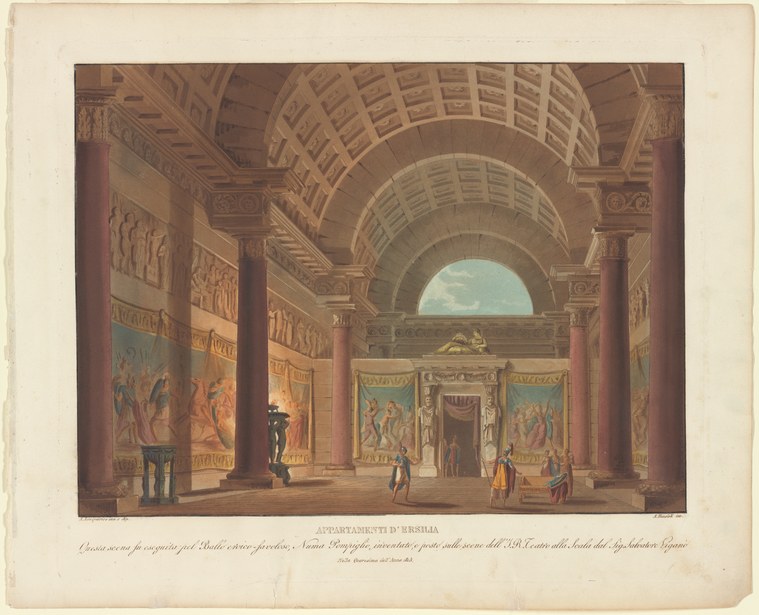
Appartamenti d'Ersilia: Questa scena fu eseguita pel ballo eroica-favoloso, Numa Pompilio, inventato, e posto sulle scene dell' I. R. Teatro alla Scala dal Sig. Salvatore Viganò, nella quaresima dell'anno 1815
Unknown artist
- Collection:
- Prints depicting dance
- Source:
- New York Public Library
- Rights:
- Public domain — free to use, share and adapt.
- Recorded as:
- Public Domain
Viganò was a towering figure in early 19th-century dance reform, and his works were celebrated and imitated across Europe. This print circulated knowledge of his staging methods, spatial design, and integration of classical architecture into narrative dance. For historians, it shows how Romantic-era choreographers were moving away from pure technique toward storytelling and archeological spectacle.
What you are looking at
This is a perspectival rendering of a grand interior space, most likely a theatrical stage set. A coffered barrel vault with a central oculus dominates the composition, its deep geometry receding into luminous distance. The space is flanked by massive Corinthian columns supporting ornate entablatures. The walls are covered in fresco painting depicting classical figures and narrative scenes in warm ochres and blues. In the foreground, small figures in neoclassical dress—some in classical drapery, some in contemporary silhouettes—occupy the floor. A central architectural feature resembles a shrine or temple front with a pediment. The lighting is warm and even, suggesting interior illumination or the golden light of late afternoon, creating strong shadow patterns within the vaulted ceiling. The overall effect is of an archaeological recreation or neoclical fantasy rather than lived reality.
The dancing
The human figures are rendered at small scale relative to the architecture, emphasizing the monumentality of the setting. Several figures stand in relaxed, upright postures; at least two appear to be in gentle motion across the floor, moving with the easy stride of contemporary walking rather than formal dance positioning. The nearest figures wear classical Greek or Roman-inspired drapery; others are in Regency-era dress. No closed holds, lifted positions, or codified dance frames are evident. The figures move singly or in loose groupings rather than as couples or formal ensembles.
The dance depicted
The title references Numa Pompilio, an invented heroic-mythological ballet (ballo eroica-favoloso) choreographed by Salvatore Viganò and staged at La Scala Milan in Lent 1815. Viganò was a major reformer of ballet d'azione, emphasizing pantomime and narrative coherence over pure technique. This set design shows no codified ballet vocabulary—no turned-out positions, no relevé, no pointe work. Instead, it depicts a narrative tableau or scene of classical encounter within an archaeological interior. The dance content here is likely gestural pantomime and processional movement rather than balletic choreography, consistent with Viganò's emphasis on expressivity and storytelling.
How it was made
This is a hand-colored engraving or etching, identifiable by its fine linear hatching, the precision of architectural perspective, and the restrained palette of ochres, blues, and earth tones applied over printed line work. The technique allowed wide circulation of stage designs across Europe, enabling theater practitioners in other cities to study Viganò's influential work and La Scala's celebrated productions. The hand-coloring suggests either a deluxe original or a later colored impression. Such prints were common documentation of significant theatrical productions in the early 19th century and were collected by connoisseurs of dance and design.
About this work
This is a record of a scene from Salvatore Viganò's Numa Pompilio, a significant ballet d'azione performed at La Scala Milan in 1815. It is not a depiction of dance in the balletic sense—no one is performing virtuosic steps—but rather a theatrical tableau showing actors and dancers in character within an imagined archaeological space. Viganò's reform of ballet prioritized drama, pantomime, and ensemble movement over technical display; this image documents that shift. The engraving served as a widely distributed advertisement of La Scala's production and as a model for other theaters attempting to mount similar ambitious narrative ballets.
How to look at it
Attend first to the architectural framing: the print uses classical perspective to place the viewer as if standing in the theater, looking at the stage. The small figures are not the focal point; they are narrative elements within a constructed archaeological vision. Note how the artist has rendered the vault with careful cross-hatching to convey depth and shadow—this was the technical showcase of the engraver's skill. The figures themselves are rendered simply, without great detail, because they are secondary to the architectural spectacle. This was a common visual strategy for publicizing neoclassical theater design: the stage design itself was the achievement being advertised.
The artist
The artist is not recorded in the catalogue. The print bears an Italian inscription crediting Viganò as the inventor (inventato) and noting its execution at La Scala. It may have been designed by the theater's resident scene painters or a collaborator, with engraving by a professional print workshop in Milan or elsewhere in Italy. Early 19th-century opera and ballet prints were often produced anonymously or with credits limited to the choreographer or impresario.
The period
By 1815, ballet d'azione—a narrative form emphasizing mime and ensemble movement—was fully established, pioneered by Gasparo Angiolini and Jean-Georges Noverre in the late 18th century and perfected by Viganò. The Napoleonic era had created a taste for neoclassical themes drawn from ancient history and literature. La Scala, rebuilt after the 1776 fire and reopened in 1778, had become Italy's premier house for such productions. The Lenten season (quaresima) was traditionally a time for serious, morally edifying works rather than frivolous entertainments. Numa Pompilio, the legendary second king of Rome, was a standard subject for neoclassical artists seeking to illustrate virtue and civilization.
Where it lives
The print is held in the New York Public Library's collection of prints depicting dance. It is part of a significant archive of 18th and 19th-century theatrical designs and stage records, many of which document now-lost productions.
Dance in this work
Questions about this work
Is this actually a dance scene, or just a theatrical interior?
It is both. This is a scene from a ballet—a narrative dance drama—but Salvatore Viganò's style emphasized pantomime and character interaction over visible ballet technique. What you see are dancers in costume, moving through a dramatic space. The 'dancing' here is gestural and processional rather than balletic in the technical sense.
Who was Salvatore Viganò?
Viganò (1769–1821) was a Milanese choreographer and dancer who revolutionized ballet by prioritizing dramatic narrative and expressive gesture. He trained under Jean Dauberval and worked across Italy and Europe before settling at La Scala, where he created over 30 ballets that were celebrated and imitated throughout Europe. He is considered one of the founders of modern narrative ballet.
Why would a dance print show the stage set more clearly than the dancers?
In the early 19th century, theatrical design was a form of visual spectacle and a mark of a theater's ambition and resources. Prints advertising productions were often showcasing the architect or scenic designer's work as much as the choreographer's. The set design was reproducible and teachable in a way that choreography—transmitted only through notation or live performance—was not.
What does 'ballo eroica-favoloso' mean?
It translates as 'heroic-fabulous ballet' or 'heroic-mythological ballet.' It was a subgenre of ballet d'azione that drew its plots from classical history, legend, and mythology and aimed at noble, elevated subject matter. Such works were considered superior to comedic or frivolous ballets.
More dance artwork





