49 works in this view — arrow keys or swipe to move between them.
Dance in Art
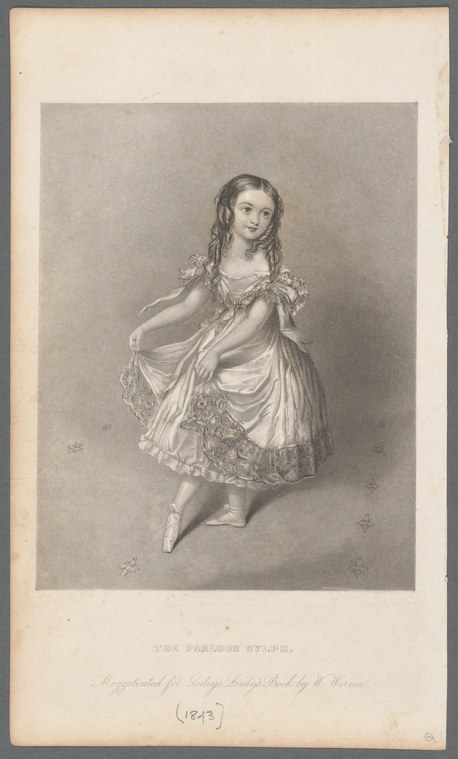
The parlor sylph
Unknown artist
- Collection:
- Prints depicting dance
- Source:
- New York Public Library
- Rights:
- Public domain — free to use, share and adapt.
- Recorded as:
- Public Domain
The Sylph character was transformative for European dance culture in the nineteenth century, marking a fundamental shift in what ballet could express and how female dancers were perceived. This engraving documents that shift visually: it shows the dancer not as a virtuoso demonstrating technical feats but as a vessel for fantasy and emotion. For historians and practitioners of ballet, the image is a primary document of romantic aesthetics and the physical ideals of the period.
What you are looking at
A young female dancer stands in a three-quarter pose against a neutral gray ground, her body weight shifted onto her right leg in a balletic stance. She wears a white or pale silk dress with a fitted bodice and full skirt trimmed with lace at the hem; the skirt is caught mid-motion, billowing away from her body to reveal the line of her leg and pale dancing slippers. Her dark hair is long and loosely waved, adorned with what appears to be flowers or ribbon. Her left arm extends gracefully outward and slightly upward, while her right arm is positioned at her side; her gaze is directed away from the viewer with a rapt, theatrical expression. The figure is isolated in space with no setting or supporting dancers—a portrait of the dancer rather than a scene of social dancing. The print is finely executed in the neoclassical academic style, with careful attention to the fall of fabric, the modeling of the form, and the ethereal quality of the pose.
The dancing
The dancer stands in an elevated balletic position, with her supporting leg extended and her free leg flexed, creating an elongated line from hip to toe. Her torso is held upright with the shoulders relaxed and squared; her arms are positioned in a soft, open frame typical of romantic-era ballet—extended but not rigid, with the hands held in a graceful, naturalistic manner rather than in a formal geometric hold. The overall carriage suggests a dancer trained in the refined academic ballet technique of the nineteenth century, with an emphasis on lightness, grace, and ethereality rather than technical virtuosity.
The dance depicted
The image almost certainly depicts romantic ballet of the mid-nineteenth century, the period in which the 'sylph' became an iconic figure in European dance culture. The title 'The Parlor Sylph' likely refers to a parlor scene or domestic performance (the term 'parlor' suggests an indoor, drawing-room setting), but the sylph character itself comes from the supernatural ballet tradition—most famously from *La Sylphide* (1832), in which a ghostly, ethereal female spirit dances with a mortal man. The dancer's costume, pose, and the entire aesthetic of the image evoke this tradition: the pale dress, the bare arms, the lifted, weightless quality of the stance, and the faraway gaze all signal a character from the world of romantic fantasy rather than human society. The print may represent an actual performance or a generic idealization of the sylph dancer type.
How it was made
This is an engraving or possibly a steel engraving, a reproductive print technique widely used in the nineteenth century to disseminate images of celebrated dancers and theatrical productions. The fine lines, careful tonal modeling, and the signature inscription visible at the bottom of the print are characteristic of engraving. The technique allowed for precise rendering of fine details—the lace trim, the hair, the expression—and made the image reproducible and affordable for a broad audience of theater-goers and dance enthusiasts. Engravings of dancers were collected and displayed in middle-class homes as both artistic objects and mementos of celebrated performances.
About this work
This is a mid-nineteenth-century engraved portrait of a dancer in the character of a Sylph, a supernatural being from the romantic ballet tradition. The print captures the aesthetic ideals of romantic-era dance: ethereality, grace, weightlessness, and a kind of melancholic otherworldliness. The dancer is shown in a parlor context—likely a domestic performance or a scene from a ballet set in a drawing room—but the character herself is a creature of fantasy. The work is both a record of a specific theatrical tradition and a visual statement about what nineteenth-century audiences valued in dance: the illusion of effortless, weightless movement, and the power of the female dancer to embody supernatural beauty.
The print belongs to a rich tradition of dance portraiture that flourished in the nineteenth century, when ballet became the dominant theatrical dance form in Europe and lithographic and engraved reproductions of celebrated dancers were mass-produced and widely circulated. This work is a particularly fine example of that tradition, combining technical skill with a deep understanding of the romantic ballet aesthetic.
How to look at it
The artist has chosen to freeze the dancer in a moment of suspended movement—not the apex of a jump or the dramatic climax of a scene, but a fleeting moment of stillness in which the costume is still settling and the emotional quality of the character shines through. Pay attention to the relationship between the figure and the surrounding space: the dancer occupies the frame completely, isolated against the gray ground, which emphasizes her ethereality and otherworldliness. The fall of the skirt is crucial—it is caught mid-swirl, suggesting motion and lightness rather than static poses. The print's soft tonal range and careful modeling of light and shadow create an almost dreamlike quality that aligns perfectly with the romantic ballet aesthetic of the period.
The period
This print dates to the romantic era in dance, approximately 1830s–1860s, when the sylph and the sylphide became central figures in European ballet. The most famous sylph is the title character of *La Sylphide*, choreographed by Filippo Taglioni for his daughter Marie Taglioni in 1832, which became one of the most celebrated ballets of the age and is considered the first great romantic ballet. The character of the sylph—a beautiful, ethereal, tragic creature from the supernatural world—embodied key romantic values: emotion over virtuosity, atmosphere over narrative, and the transcendence of physical law through dance. The print circulates in a culture of dance fandom and commercial reproduction; engravings and lithographs of celebrated dancers like Marie Taglioni became collector's items and were displayed in homes as tokens of devotion to the art form and its stars.
In the visual arts, the period was marked by romantic painting's interest in the ethereal, the nocturnal, and the world of dreams and spirits. The engraving technique was at its height as a form of art reproduction, and the dance print was a significant category within that market. The careful attention to light, fabric, and expression in this image reflects both the technical refinement of romantic-era printmaking and the cultural investment in dance as a subject worthy of fine art.
Where it lives
This print is part of the New York Public Library's collection of prints depicting dance. The inscription at the bottom of the print indicates the engraver and possibly the artist from whom the design was taken, though the record does not currently identify these figures.
Dance in this work
Questions about this work
What is a sylph in dance?
A sylph is a supernatural creature from folklore—a spirit of the air—and became a signature character in romantic-era ballet in the nineteenth century. The most famous sylph appears in *La Sylphide* (1832), a ballet in which a mortal man falls in love with a sylph and must choose between the mortal world and the spirit world. Sylphs are typically danced by women and are characterized by ethereality, grace, and a kind of sad beauty. The image shows the dancer embodying these qualities.
Why is this called 'The Parlor Sylph'?
A parlor is a drawing room or domestic sitting room, and 'parlor sylph' likely refers to a scene in a ballet set in a drawing room, or to a character of the sylph type seen in a domestic context. The sylph character, though supernatural, was often brought into the world of human habitation in ballet narratives, creating an eerie juxtaposition. The title may also simply indicate a parlor performance—a private or semi-public dance given in a drawing room rather than in a theater.
Who is the dancer in this print?
The record does not identify the dancer. The print was likely made as a portrait of a celebrated performer of the era, and may have circulated as a souvenir or commemorative image, but the dancer's name is not recorded here. Many such prints were made of celebrated sylphs of the nineteenth century, but without additional documentation, we cannot say which specific dancer is shown.
Why is she barefoot?
She is not barefoot—she is wearing pale dancing slippers, which are barely visible against the lighter skirt and ground. In the romantic era, ballet dancers wore soft, flesh-colored slippers that created the illusion of nearly bare feet, enhancing the ethereal quality of the movement. This was a deliberate aesthetic choice linked to the desire for weightlessness and otherworldliness.
More dance artwork





