49 works in this view — arrow keys or swipe to move between them.
Dance in Art
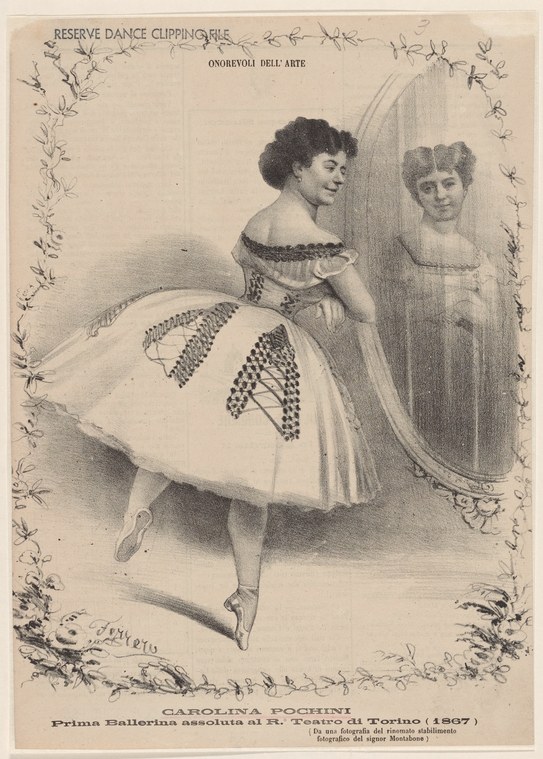
Carolina Pochini, prima ballerina assoluta al R. Teatro di Torino (1867)
Unknown artist
- Collection:
- Prints depicting dance
- Source:
- New York Public Library
- Rights:
- Public domain — free to use, share and adapt.
- Recorded as:
- Public Domain
This portrait documents the appearance and status of one of the 1860s' most celebrated Italian-Austrian dancers, preserving visual evidence of how the Romantic ballet aesthetic was embodied and marketed in the mid-Victorian era. As a mass-produced lithographic image, it also testifies to the celebrity culture that surrounded virtuoso dancers in the 19th century—the way their names, faces, and bodies were commodified, distributed, and desired across the cultural landscape.
What you are looking at
A young woman in pointe shoes stands in a studio or backstage setting, captured in a moment of graceful reflection. She wears a white tutu with decorative black geometric or scale-like patterning across the skirt, and a black off-shoulder bodice; her dark hair is arranged in the upswept style of the 1860s. She gazes downward and to the side, one arm curved expressively, in a pose suggesting a moment of repose or introspection between performances. Behind her, a mirror or glass surface reflects her image, doubling the figure and creating a sense of theatrical space. The composition is framed by delicate botanical borders—fine line drawings of flowering branches and climbing plants—that frame the image like an ornamental proscenium arch. The overall tone is one of intimate elegance: the young dancer is presented not in action but in a moment of stillness, a convention of 19th-century dance portraiture that celebrated the ballerina's grace and refined beauty.
The dancing
The dancer stands with her weight settled on one supporting leg in pointe, the other leg extended or relaxed, creating an asymmetrical, naturalistic pose rather than a formal classical position. Her torso is upright but not rigid; her arms are soft and curved, suggesting the languid arm ports of Romantic ballet. Her gaze is directed downward and inward, a contemplative angle that conveys emotional rather than athletic content. The reflected figure in the glass behind her echoes this posture, reinforcing the sense of a self-aware, introspective performer rather than a virtuoso mid-leap.
The dance depicted
This is an image of Romantic ballet as it was performed in the 1860s, the era when Carlo Cecchetti was systematizing classical technique across Europe and when the weightless, ethereal aesthetic of works like Giselle and Swan Lake dominated the ballet stage. The costume—the white tutu, the pointe shoes, the fitted bodice—is unmistakably that of a mid-Victorian ballerina. The pose, however, does not depict a moment of choreography; it captures what contemporaries called the ballerina's "repose"—the studied grace and poise she was expected to maintain at all times. The inscription identifies her as Carolina Pochini, prima ballerina assoluta (principal dancer) at the Royal Theatre of Turin, one of the major European ballet capitals. The decorative frame and sentimental composition suggest this was a prestige portrait, likely published as a lithograph for popular consumption and distribution among admirers.
How it was made
This is a lithograph or engraving (the catalogue record does not specify, but the tonal gradations and fine detailing are consistent with mid-19th-century lithographic printing). The technique allowed for soft modeling of shadow and light across the face and body, and for the delicate rendering of fabric texture—the translucent quality of the tulle skirt is carefully distinguished from the matte bodice. The botanical border was drawn separately, likely as part of the ornamental framing conventions that made such prints collectible and suitable for display in homes and studios. As a printed portrait, this work circulated widely among dance enthusiasts, wealthy patrons, and rival theaters—a form of celebrity imagery that helped establish the dancer's fame and desirability across Europe.
About this work
This is a mid-Victorian portrait of a celebrated prima ballerina, Carolina Pochini of Turin, rendered in the intimate, contemplative mode favored by 19th-century dance portraiture. Unlike images that capture dancers in the act of performance, this lithograph presents Pochini in stillness: poised on pointe, gazing inward, surrounded by ornamental framing that elevates her to the status of a refined aesthetic object. The work belongs to a vast tradition of printed dance celebrity—images produced for sale, collection, and public circulation that made the names and likenesses of great dancers available to theater audiences across Europe. It captures not a moment of choreography but the cultivated persona of the Romantic-era ballerina: ethereal, graceful, emotionally refined, and locked in a moment of apparent solitude that invites the viewer's admiration and fantasy.
How to look at it
Observe the moment the artist chose: not a leap or turn, but a pose of repose—the ballerina caught in stillness and self-reflection. This choice is itself theatrical, a convention of 19th-century portraiture that treated the dancer's natural grace and bearing as more significant than her technical feats. Notice the careful rendering of the pointe shoe and the arch of the supporting foot, evidence that the artist understood the technology of ballet. The decorative botanical frame, though ornamental, also serves a function: it isolates the dancer from ordinary space and presents her as a precious, cultivated object—a visual metaphor for how the Romantic era valued the ballerina as an ethereal, almost otherworldly being.
The artist
The artist is not recorded in the catalogue. The work is attributed only to the publisher or printer, a common convention for mid-19th-century commercial dance portraiture. The ornamental border, delicate modeling, and conventional composition suggest a studio practice devoted to celebrity and theatrical imagery, likely based in Italy or Austria given the identification of Pochini with Turin.
The period
This lithograph dates to 1867, a moment when Romantic ballet had reached its mature crystallization and when the star system that elevated individual dancers to celebrity status was at its height. The 1860s were marked by intense rivalry among European ballet capitals—Paris, Milan, Vienna, and Turin—each competing for the greatest dancers. Carolina Pochini's designation as prima ballerina assoluta (a title conferred only on the most celebrated performers) indicates her standing in this competitive landscape. The style of the portrait—the contemplative pose, the ethereal costume, the ornamental framing—reflects the aesthetics of Romantic ballet as codified in works like Giselle (1841) and the emerging Cecchetti method, which had begun to systematize classical technique across European conservatories.
Where it lives
The work is held in the New York Public Library's Prints collection, a major repository for 19th-century dance portraiture. It is catalogued as part of a broader archive of dance imagery and was likely acquired as a historical document of celebrated performers and theatrical practice.
Dance in this work
Questions about this work
Who was Carolina Pochini?
Pochini was an Italian-Austrian prima ballerina assoluta (principal dancer) at the Royal Theatre of Turin in the mid-19th century. The title "assoluta" was conferred only on the most celebrated and technically accomplished dancers of the era. Little detailed biographical information about her survives, but this portrait and the printed circulation of her image testify to her prominence in European ballet during the 1860s.
What do the decorative borders mean?
The ornamental botanical frames were a standard feature of mid-Victorian dance portraiture, reflecting both aesthetic conventions and publishing practices. They served to elevate and isolate the dancer's image, presenting her as a refined, precious object—a visual metaphor for the Romantic ballet aesthetic that valued ethereal beauty and grace over athletic virtuosity.
Why is she not shown dancing?
Romantic-era dance portraiture often favored poses of repose and stillness over action. This convention reflected both the artistic values of the period and practical concerns: the moment of stillness allowed for clearer representation of the costume, bearing, and facial features that identified the dancer and conveyed her refined aesthetic character.
What was a prima ballerina assoluta?
This title, rare even in the 19th century, was conferred by an opera house or ballet company on its most celebrated and technically accomplished female dancer. It signified not just principal status but exceptional artistry and international reputation. Only a handful of dancers per generation achieved this distinction.
More dance artwork





