49 works in this view — arrow keys or swipe to move between them.
Dance in Art
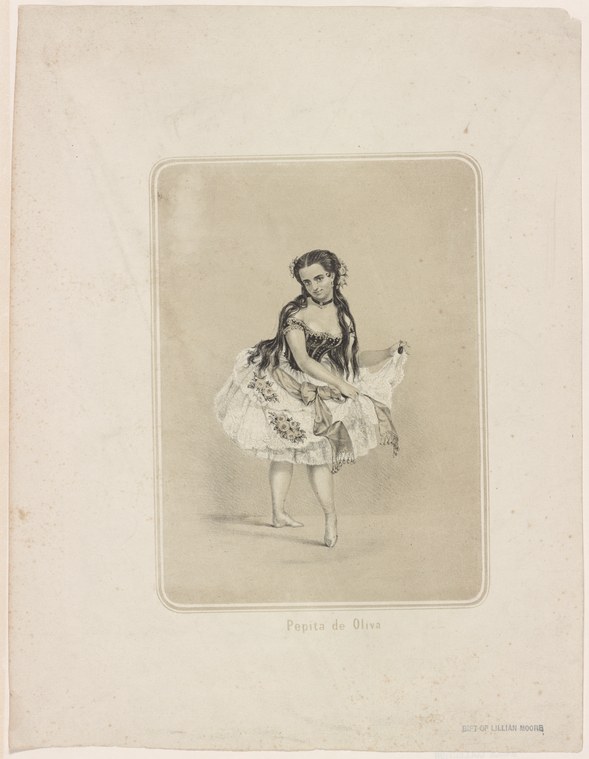
Pepita de Oliva
Unknown artist
- Collection:
- Prints depicting dance
- Source:
- New York Public Library
- Rights:
- Public domain — free to use, share and adapt.
- Recorded as:
- Public Domain
This print is one of the few surviving images of a named Spanish dancer from the romantic ballet period, providing visual evidence of a performer and a moment in dance history that would otherwise be nearly invisible. It shows how theatrical portraiture worked in the 19th century and how dancers' images circulated as commercial products, giving us insight into the economics and publicity of performance culture. The image captures the conventions of pose and presentation that shaped how dancers were seen and understood by their audiences.
What you are looking at
A young woman in theatrical dress stands alone against a plain background, captured in a moment of performance. She wears a dark corseted bodice with a full skirt of white or pale silk, decorated with floral embroidery or patterning at the hem. Her dark hair is styled up and back in the fashion of the mid-19th century. She stands in a turned-out position, her weight on one leg, the other extended or lightly planted, with one arm holding or gesturing with her skirt to display its full volume and ornamentation. The pose is neither fully frontal nor in profile, but presented at a slight three-quarter angle to the viewer. The composition is intimate and focused, with her figure centered in a simple rectangular frame printed on the page. The print is labeled below with her name: "Pepita de Oliva."
The dancing
A single female dancer, posed in a classical stance with pronounced turnout and an upright carriage. Her arms are positioned to frame and display the skirt—one arm bent and raised, the other extended, the hand gathering the fabric to show off the decorated hem. Her weight appears centered or shifted slightly, with one leg bearing support and the other in a position of ease rather than active extension. The posture suggests the vocabulary of 19th-century ballet or theatrical dance rather than folk or social dancing, though the emphasis here is on display and presentation rather than the execution of a specific step.
The dance depicted
This is almost certainly a print documenting a performer in romantic-era theatrical ballet, likely from the 1840s–1860s. Pepita de Oliva was a Spanish dancer of that period, and this image captures her as a stage character or in a signature pose. The style of dress—the corseted bodice, the full skirt with decorative embroidery, the way the fabric is held to showcase its embellishment—reflects the conventions of romantic ballet costuming. The print records her as a known theatrical performer, preserving her name and image for audiences who would have seen her in live performance or known her reputation. The pose itself is a convention of theatrical portraiture: the dancer presented in a moment of stillness that conveys elegance, poise, and the quality of her costume rather than the dynamism of actual movement.
How it was made
This is a lithographic print, characterized by the fine tonal gradations, the delicate line work, and the way light and shadow model the figure. The technique allowed for relatively quick and economical reproduction, making it possible to circulate images of performers to audiences and theaters across Europe and beyond. The simple frame and text label suggest this is from a series of theatrical portraits or memento prints—the kind of image theatergoers could purchase to commemorate a favorite performer or to assemble into a collection. The printing medium and commercial context indicate that Pepita de Oliva was a known performer of some fame or professional standing.
About this work
This is a lithographic portrait print of Pepita de Oliva, a 19th-century theatrical dancer, shown in full costume and posed in the classical stance and display conventions of romantic ballet. The print documents her as a historical performer and preserves both her image and the costume style of the mid-19th-century stage. As a commercial print, it is a artifact of the theatergoing culture of that era—a way audiences engaged with and remembered performers. For the history of dance, it offers concrete evidence of how dancers were costumed, how they carried themselves for the camera or lithographic artist, and how they were marketed and celebrated in their own time.
How to look at it
Look first at the pose itself: the turned-out stance, the lifted posture, the careful arrangement of the arms and skirt. This is not a natural or everyday position, but a deliberate composition designed to show off both the dancer's carriage and the ornament of her costume. The eye is drawn to the decorated hem of the skirt, which is the focal point of the pose—the fabric itself is the subject as much as the woman wearing it. Notice how the artist has used the white of the paper and the pale tones of the dress to create a luminous center, with darker shading around the figure to push it forward. The frame around the figure, and the printed name below, are conventions of theatrical or celebrity portraiture—they present this as an official image, a record of a known performer rather than an imaginative composition.
The period
This print dates to the height of romantic ballet, when dancers like Marie Taglioni and Fanny Elssler were international celebrities and when the image of the ethereal, corseted ballerina in a full skirt became an icon of theatrical femininity. Spain had its own tradition of dance performance and theatrical culture, and Pepita de Oliva appears to have been part of that landscape. Lithographic printing was the dominant commercial technology for reproducing images of performers, and such portrait prints were as ubiquitous then as theatrical photographs would become later in the century. The print was published or distributed through channels that brought it to the New York Public Library's collection, suggesting it circulated internationally or found its way into American institutional collecting.
Where it lives
This print is part of the New York Public Library's collection of prints depicting dance. The source attribution "NYPL" and the collection category suggest it was acquired as part of the Library's broader collecting of theatrical and dance imagery. The format and style indicate it is one of a series of similar prints, possibly a commercial portfolio or collected set.
Dance in this work
Questions about this work
Who was Pepita de Oliva?
Pepita de Oliva was a 19th-century theatrical dancer, likely Spanish or performing in Spain during the romantic ballet era. She appears to have been known and celebrated enough to warrant a published portrait print, which would have been sold to audiences and theater patrons. Beyond this image and the record of her name, little is documented in widely available sources, making prints like this one of the few surviving traces of her career.
What kind of dance is this?
This is theatrical ballet of the romantic era, as evidenced by the costume, the posed stance, and the conventions of the image. However, the print captures a moment of display and presentation rather than the execution of a specific step or technique. It shows how dancers were presented to audiences in portraiture and how their costumes were designed to be seen and admired.
Why would a dancer's portrait be printed and sold?
In the 19th century, theatrical imagery was a form of entertainment merchandise. Audiences would buy prints of famous or admired performers to keep as mementos, to assemble into collections, or to display. This served both as a souvenir of a live performance and as a way for the performer to maintain a public image and brand. Such prints were also distributed by theaters and print sellers as part of the publicity apparatus around theatrical performance.
More dance artwork





