49 works in this view — arrow keys or swipe to move between them.
Dance in Art
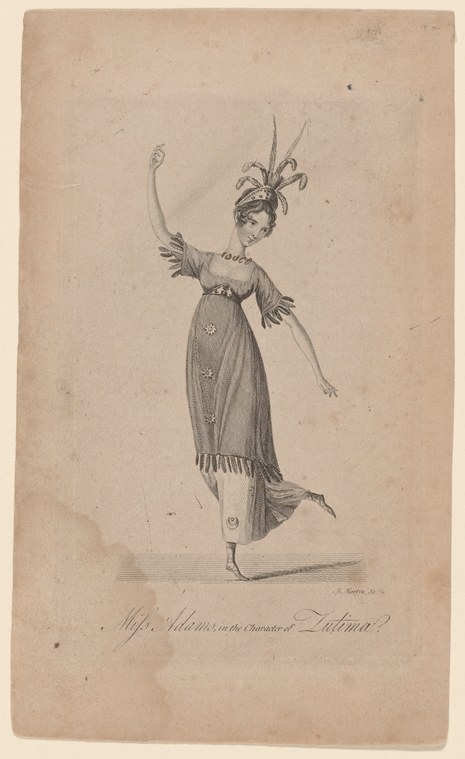
Miss Adams in the character of Zulima in the grand ballet dance of Zelico
Unknown artist
- Collection:
- Prints depicting dance
- Source:
- New York Public Library
- Rights:
- Public domain — free to use, share and adapt.
- Recorded as:
- Public Domain
This print preserves a moment of theatrical performance and a named dancer that would otherwise be entirely lost: Miss Adams and 'Zelico' do not appear in major theatrical records, yet this engraving proves both existed and drew enough attention to warrant a commemorative print. For historians of dance, it is evidence of the breadth and specificity of Romantic-era ballet culture—not all ballets were Giselle or La Sylphide, and not all dancers who mattered to contemporaries were later canonized.
What you are looking at
A single female dancer dominates the composition in a three-quarter view, posed in a moment of suspended elegance. She wears a high-waisted Empire silhouette dress with a deep hem ruffle, characteristic of Regency-era fashion, paired with what appears to be a shawl or draped fabric across her shoulders. Her dark hair is elaborately styled and topped with an ornamental headdress featuring tall, curved plumes. Her left arm extends upward in an arc, hand delicately posed; her right arm reaches outward at roughly shoulder height. Her posture suggests weightlessness—the artist has caught her in an attitude of ascension or rapturous movement. The background is plain, allowing the figure to command full attention. The engraving technique renders her form in fine hatching and parallel lines, with particular attention to the texture and volume of the drapery.
The dancing
A single dancer, viewed from the front and slightly left. Her weight appears lifted, with elongated vertical alignment through the torso. The raised left arm and extended right arm create an open frame across the upper body—both arms are curved and graceful rather than angular. Her head is tilted back slightly, face turned toward the raised arm. The posture suggests a moment of turning or rising through the body, though her feet position cannot be clearly distinguished in the engraving. The overall carriage emphasizes height, extension, and an almost ethereal quality of movement.
The dance depicted
This is identified in the inscription as Miss Adams performing in the character of Zulima from the ballet 'Zelico'—a work now obscure but known to have circulated in early 19th-century London theatres. The pose and costuming suggest a Romantic-era ballet aesthetic: the emphasis on weightless elevation, the orientalist character (suggested by 'Zulima' and the plume headdress), and the intimate scale of the print all point to theatrical ballet of the 1820s–1830s. The particular moment—suspended, open-armed, with head thrown back—suggests a moment of emotional climax or apotheosis rather than technical virtuosity. This is character dancing within a narrative ballet frame.
How it was made
A hand-colored engraving or etching, rendered in fine parallel lines and cross-hatching to create tone and form. The delicate line-work and the capacity for subtle gradation suggest skilled engraving rather than cruder woodcut or etching. The coloring appears to be applied by hand after printing, visible in the warm tones of the dress, skin, and background wash. Such prints were commercial theatre ephemera: inexpensive enough to distribute at or after performances, yet detailed enough to preserve a record of celebrated performers and roles for fans and collectors. The inscription is engraved into the plate, suggesting this was a published print with wide circulation.
About this work
This is a commemorative theatrical print documenting Miss Adams in a specific role from an early 19th-century ballet, almost certainly produced in London during or shortly after a performance run. It captures not the virtuosity of classical ballet—there is no pointe work visible, no turnout emphasized—but rather the expressive, character-driven performance style of Romantic ballet, in which dramatic presence and emotional atmosphere mattered as much as technical display. The work is a document of performance practice and stardom in the Regency era, at a moment when ballet was establishing itself as a major London entertainment and individual dancers were becoming celebrities whose likenesses were published and collected.
How to look at it
Observe the moment the engraver chose: the dancer is suspended, not in motion but in an attitude—a posed moment of climactic emotion. Notice the asymmetry of the arms, the tilt of the head, and the play of drapery: these are tools of expressive rather than technical display. The careful rendering of the dress fabric, with its high Empire waistline and deep ruffle, tells you that fashion and elegance were as much a part of the spectacle as movement. The ornamental headdress is not incidental—it places the character in an imagined elsewhere (the 'Orient' of the ballet's title), a key Romantic convention. The plain background and frontal-to-three-quarter pose follow the convention of theatrical portraiture, presenting the performer to the viewer as if on stage.
The artist
The engraver's name is not recorded in the available catalogue information. The signature or mark on the plate is not clearly legible in this image. The work is housed in the New York Public Library's collection of prints depicting dance, suggesting it was identified as dance-related material by curators, though its original purpose was commercial theatre publicity.
The period
This print dates to the era when ballet was transitioning from aristocratic court spectacle to commercial theatrical entertainment, available to paying audiences in London and other major cities. The 1820s–1830s saw the rise of the Romantic ballet aesthetic—an emphasis on supernatural or exotic characters, on poetic atmosphere over technical display, and on the individual star dancer as the vehicle of emotion. Miss Adams was one of many performers (now largely forgotten) who sustained this repertory in London theatres outside the Royal Opera House. The costume—the high waistline, the draped shawl, the ornamental headdress—places the work firmly in the Regency or early Victorian period. Hand-colored engraved prints of performers were a major form of theatrical promotion and fan culture in this era, circulating at relatively low cost and high volume.
Where it lives
The print is held in the New York Public Library's collection of prints depicting dance, indicating it was recognized and preserved as dance-related material. Such prints were originally commercial ephemera—sold or distributed at theatres—but have since been collected and systematized by libraries as records of performance history.
Dance in this work
Questions about this work
What was the ballet 'Zelico' and when was it performed?
Very little is recorded about this ballet in standard theatrical histories, which suggests it was a minor or secondary work, or that records have not survived. The style and costume date it to the 1820s–1830s. It appears to have been performed in London, and the character Zulima—a female lead—suggests a narrative ballet with orientalist or exoticist themes common to the Romantic era. This print is one of the few surviving records of its existence.
Who was Miss Adams?
Miss Adams is not identified further in the surviving record. She was significant enough to merit a theatrical print, which suggests she was a known performer in London theatres at the time, but she does not appear to have achieved the lasting fame of her contemporaries like Maria Taglioni. This print is an archive of a performer who was celebrated in her moment but subsequently forgotten.
Is this classical ballet or Romantic ballet?
This is Romantic ballet: character-driven, emphasizing emotion and atmosphere over technical virtuosity. There is no pointe work visible, no emphasis on turnout or symmetrical extension. The pose—expressive, open, with the head thrown back—prioritizes dramatic effect. Classical ballet technique would not be formalized and codified for another generation.
Why are theatrical prints like this important for dance history?
They document what dancers actually wore, how they moved, and what moments choreographers and performers chose to emphasize. They record performers who would otherwise vanish from history. And they show us that dance was a mass medium—not a preserve of the royal court or later of elite concert halls, but a commercial entertainment with its own star system, fan culture, and merchandise.
More dance artwork





