49 works in this view — arrow keys or swipe to move between them.
Dance in Art
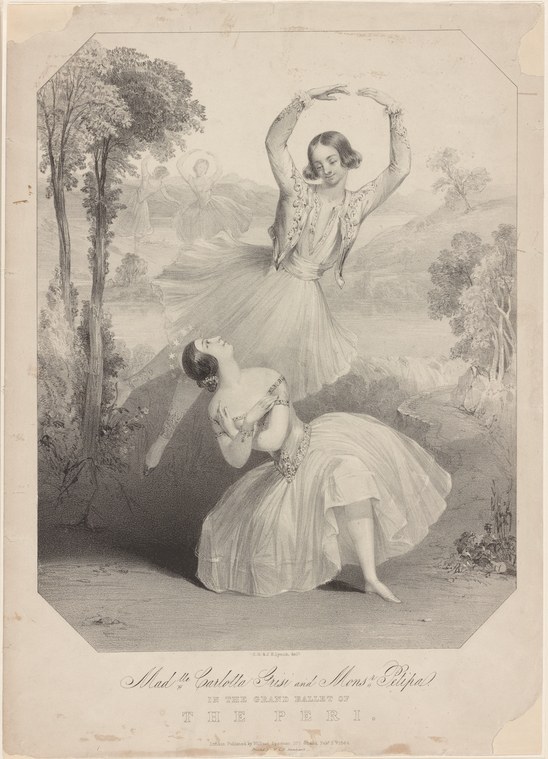
Madlle. Carlotta Grisi & Monsr. Petipa in the grand ballet of The peri
Unknown artist
- Collection:
- Prints depicting dance
- Source:
- New York Public Library
- Rights:
- Public domain — free to use, share and adapt.
- Recorded as:
- Public Domain
Grisi was among the greatest dancers of her generation, and *La Péri* is one of the handful of Romantic ballets that have survived into the modern repertory. This print preserves the costume and compositional staging of a historically crucial work that defined how ballet represented the female body and supernatural themes. For historians of Romantic aesthetics and theater, the engraving is evidence of how dance iconography was produced, distributed, and consumed in the nineteenth century.
What you are looking at
Two women in flowing white tutus perform in a wooded landscape. The standing figure at right raises both arms overhead in an attitude of grace or aspiration, her body elongated and her gaze lifted. The kneeling figure at left gazes upward at her companion, one arm extended. The setting is a pastoral grove with tall trees framing the composition and distant hills rendered in soft atmospheric perspective. The light is diffuse and romantic, creating an ethereal quality. A third, fainter figure appears in the middle distance, possibly representing a spirit or supernatural presence—a motif common to Romantic ballet. The engraving's fine parallel lines create tonal depth and emphasize the weightlessness of the performers.
The dancing
Both dancers wear the classical tutu and pointe shoes characteristic of mid-nineteenth-century ballet. The standing figure holds an elevated port de bras with arms raised in fifth position en haut, her torso erect and turned slightly toward the viewer. The kneeling figure's posture suggests submission or reverence, with her upper body inclined and gaze directed upward. Their relationship is hierarchical and narrative rather than symmetrical; they occupy different planes and emotional registers within the composition. The spatial separation and directional focus of the gazes suggest a pantomimic moment of recognition or communion.
The dance depicted
This depicts a scene from *La Péri*, a Romantic ballet first performed in 1843 with choreography by Jean Coralli and music by Friedrich Burgmüller. Carlotta Grisi, one of the greatest dancers of the Romantic era, originated the title role of the Péri (a supernatural being from Persian mythology). Monsieur Petipa, identifiable here as the male dancer, was a leading danseur of the period and would later become one of the greatest choreographers in ballet history. The composition freezes a moment of supernatural encounter characteristic of Romantic ballet: the mortal male figure gazes upon an immortal female spirit. The iconography—the elevation, the ethereal costume, the woodland setting, the theatrical lighting—is entirely consistent with Romantic ballet's obsession with the unattainable female ideal.
How it was made
This is an engraving, a reproductive print technique that dominated dance documentation in the nineteenth century. The artist employs fine cross-hatching and parallel line work to create tonal gradations and suggest three-dimensionality, particularly in the drapery and the atmospheric landscape. Engravings of this period were hand-pulled from steel plates and circulated as affordable prints, making famous performances available to a broad audience who could not attend the theatre. The technique's precision and black-and-white palette suited the idealized, almost sculptural aesthetic of Romantic ballet imagery.
About this work
This engraving documents a celebrated moment from *La Péri*, one of the canonical works of Romantic ballet, showing its star Carlotta Grisi in the supernatural title role. The image exemplifies how nineteenth-century dance was circulated and remembered through reproductive prints that elevated stage performance into fine art. It captures the core preoccupation of Romantic ballet: the encounter between the mortal and the otherworldly, rendered through elevation, ethereal costume, and landscape setting. The work belongs in a dance collection both as historical documentation of a landmark ballet and as visual testimony to how dancers and choreographers of the Romantic era understood their art—as a vehicle for representing transcendence and desire.
How to look at it
Attend to the moment of suspension: the standing figure is caught at the apex of a jump or in a sustained ballon, her arms achieving the fifth position overhead that Romantic ballet prized as the emblem of grace. The artist has chosen not a moment of rapid action but of stillness and aspiration. The kneeling figure's gaze and body angle create a narrative of yearning or recognition. The landscape is not mere backdrop but participates in the emotional register—the soft, atmospheric trees and distant hills evoke the dreamlike, otherworldly setting essential to Romantic ballet aesthetics. Notice too the fineness of the engraving line and how it dematerializes the dancers' bodies, making them appear weightless and ethereal.
The period
This engraving dates to the height of Romanticism in ballet, approximately the 1840s–1850s. In this period, ballet had become the dominant theatrical form for exploring Romantic themes: otherworldly female beauty, the supernatural, desire, and melancholy. Carlotta Grisi and Marie Taglioni were the supreme ballerinas of the era, celebrated for their technical ability and their embodiment of the ethereal ideal. The tutu had evolved into its now-familiar short form, freeing the legs for greater virtuosity. At the same time, lithography and engraving became the primary means of disseminating images of famous dancers and ballets, creating a mass visual culture around performance. This print is part of that culture—it is not a document of an actual performance but an idealized artistic interpretation of the ballet's most iconic moment.
Where it lives
This engraving is held in the New York Public Library's collection of prints depicting dance. Such prints were produced and distributed widely in the nineteenth century by theatrical publishers and print sellers, both as souvenirs of celebrated performances and as illustrations for dance reviews and arts journalism.
Dance in this work
Questions about this work
Who were Carlotta Grisi and Monsieur Petipa?
Carlotta Grisi (1819–1899) was an Italian-born dancer of extraordinary technical and artistic ability, celebrated as one of the great Romantic ballerinas. She created the role of the Sylphide in Jules Perrot's *Pas de Quatre* and was the original Péri. Monsieur Petipa was a leading male dancer of the same era; the name almost certainly refers to Marius Petipa (1818–1910), who would become one of the most influential choreographers in ballet history, responsible for the classical Russian Imperial Ballet repertory.
What is *La Péri*?
*La Péri* is a Romantic ballet choreographed by Jean Coralli with music by Friedrich Burgmüller, first performed in 1843 at the Opéra-Comique in Paris. It tells the story of a mortal man who encounters an immortal Péri (a supernatural being from Persian mythology) and pursues her, ultimately achieving union with her through dance. It is one of the few Romantic ballets to have survived into the modern repertory.
Why is this dance so important?
*La Péri* exemplifies the Romantic ballet aesthetic at its height: the idealization of the female dancer as ethereal and otherworldly, the supernatural subject matter, the poetic use of landscape, and the central role of elevation and ballon. It showcases Grisi's virtuosity and artistry and influenced countless later works. The ballet remains performed today.
What is an engraving and why were they used to document dance?
An engraving is a reproductive print made by hand-pulling ink from an incised metal plate. Engravings were the primary means of circulating images in the nineteenth century before photography became widespread. They were affordable and could be produced in large numbers, making them ideal for disseminating images of celebrated dancers and ballets to theaters, dance schools, and theater-goers who wanted souvenirs of performances.
More dance artwork





