49 works in this view — arrow keys or swipe to move between them.
Dance in Art
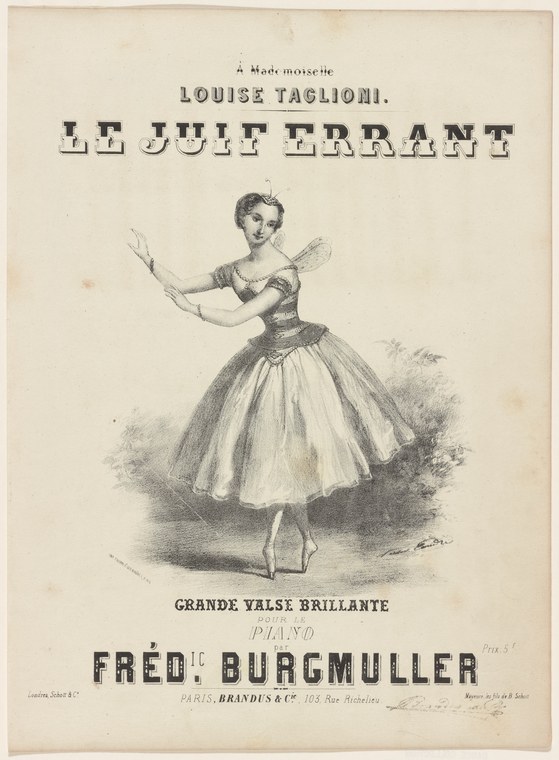
À Mademoiselle Louise Taglioni. Le Juif errant
Unknown artist
- Collection:
- Prints depicting dance
- Source:
- New York Public Library
- Rights:
- Public domain — free to use, share and adapt.
- Recorded as:
- Public Domain
This work directly documents the costume and stage presence of a named historical dancer and a now-obscure work; it is evidence of what Romantic pantomime-ballet looked like and how these works were marketed to audiences. It also illustrates the centrality of lithographic portraiture to dance celebrity in the nineteenth century, a mode of circulation and fandom that has largely vanished.
What you are looking at
A young woman in a mid-nineteenth-century theatrical costume stands alone against a plain background, her body angled three-quarters to the viewer. She wears a fitted bodice with short sleeves and a voluminous skirt of gossamer-light fabric that falls to mid-calf, revealing her legs and feet—the costume of a Romantic-era ballerina. Her hair is styled up, and her face is turned toward the viewer with an alert, almost wary expression. She holds what appear to be palm fronds or large feathered objects in both hands, crossed loosely before her body. The pose is neither fully still nor clearly in motion: her weight appears to rest on her right leg while the left is slightly bent, and her torso twists with a dancer's ease. The drawing is a finely rendered lithograph in black and white, with delicate shading that suggests the texture of fabric and the play of light across her figure.
The dancing
A single female dancer occupies the frame. Her arms are raised and bent, holding decorative branches or palm fronds that frame her upper body. Her posture is upright and composed, with a suggestion of balletic carriage. Her legs show no strain or exertion; the stance is poised rather than dynamic, neither in a pointed position nor in a recognisable balletic pose. The overall impression is one of theatrical presentation and display rather than active dancing.
The dance depicted
This is a portrait of a Romantic ballet dancer, most likely depicting a role or costume from a theatrical production. The inscription dedicates it to Louise Taglioni, a member of the celebrated Taglioni family of dancers prominent in the 1840s–1860s. The title *Le Juif errant* (The Wandering Jew) refers to a pantomime-ballet, a popular theatrical form of the mid-nineteenth century that combined narrative action with dance. The costume—the light, short tutu and the properties—suggests a solo role in a dramatic ballet rather than the chamber of a classical suite. The pose and setting indicate this is a costume portrait created for circulation rather than documentation of a moment in performance.
How it was made
This is a lithograph, a print technique that allowed artists to draw directly onto a stone surface and produce multiple copies. The fine detail and tonality visible here—the delicate rendering of fabric texture, the subtle shading, the fluid line—are characteristic of a skilled lithographic artist. The technique was widely used for theatrical and celebrity portraiture in the nineteenth century, enabling mass production of images for sale to ballet patrons and theatre-goers. The credits at the base (Brandes & Cie, Paris, Rue Richelme) identify a print publisher, confirming this was a commercial product with wide intended circulation.
About this work
This is a theatrical costume portrait of a mid-nineteenth-century Romantic ballet dancer, dedicated to Louise Taglioni and documenting her role in a pantomime-ballet titled *Le Juif errant*. It belongs to a substantial tradition of celebrity dance portraiture in lithographic form—prints made for theatre patrons and collectors to buy, treasure, and display. The image captures not a moment of dancing but a staged presentation of the dancer in character, the pose chosen to show off costume, bearing, and the dancer's celebrity status. It is a documentary artifact of theatrical practice and of the cult of the ballerina that flourished in the Romantic period.
How to look at it
Observe the specificity of the costume detail: the short tutu, the fit of the bodice, the style of the hair, and the handling of the properties all tell you this is a document of stage practice. Notice that the pose is not a ballet position but a presentation stance—the dancer is shown to the viewer rather than caught in action. The lithographic technique itself is worth attention: the fineness of the line and the tonal gradations show a high level of skill and care, indicating that this was a significant commercial product, not a casual sketch. The expression on the dancer's face—alert, composed, almost confrontational in its directness—captures something of the theatrical presence the image was designed to convey.
The artist
The lithograph is credited to Frédéric Burgmüller (or Burckmuller), listed as a composer by some sources, though the print itself may have been executed by a workshop artist from the publisher Brandes & Cie in Paris. The Taglioni family—Marie, Paul, Filippo, and relatives—were dominant figures in European ballet from the 1820s onward, and prints of their likenesses and costumes were commercial products of major publishers.
The period
The mid-nineteenth century was the height of the Romantic ballet, when narrative pantomime-ballets dominated European stages and individual dancer celebrities—especially the Taglioni family—commanded intense popular devotion. Lithographic celebrity portraiture was a thriving industry; publishers produced thousands of such prints for sale to theatre patrons. The short tutu visible here became the standard costume of the Romantic ballerina, and props such as palms or branches often signalled exotic or supernatural roles. *Le Juif errant* itself was a popular subject across multiple art forms and theatrical genres in this period.
Where it lives
This print is held in the New York Public Library's collection of prints depicting dance. It was produced by the Parisian publisher Brandes & Cie, one of the major publishers of theatrical portraiture in the nineteenth century, and is characteristic of the commercial celebrity prints that were made and sold in large numbers during this period.
Dance in this work
Questions about this work
Who was Louise Taglioni?
Louise Taglioni was a dancer and member of the celebrated Taglioni family, which dominated European ballet in the mid-nineteenth century. Members of the family were stars of the Romantic ballet and were extensively depicted in prints and lithographs like this one.
What is a pantomime-ballet?
Pantomime-ballet was a theatrical form combining mime, dramatic action, and dancing. Popular in the nineteenth century, works like *Le Juif errant* told narratives through gesture and movement and were major attractions in European theatres. They differ from purely classical ballet in their emphasis on story and character over abstract movement.
What does the short skirt mean?
The short tutu became the standard costume of the Romantic ballet in the 1840s–1860s. It allowed visibility of the dancer's legs and footwork and became iconic of the period. It signalled to viewers that this was a contemporary theatrical role rather than historical or classical.
How many copies of this print were made?
Lithographs like this were produced in editions, but the exact number of impressions of this particular image is not known. The technique allowed for multiple copies from the same stone, and Brandes & Cie was a major commercial publisher, suggesting a substantial circulation.
More dance artwork





